The Cartel

carterThe Cartel
by Don Winslow
2015 / (640 p.)
read by Ray Porter 23h 24m
rating – A+++ /  fictionalized true crime

Good stuff but very intense.  I happened on this just browsing Audible – I’ve read Don Winslow in the past but something is different here – this is not a B-level surfer-detective story.  This is fictionalized true crime – horrific true crime.  And it’s really kind of scary when you sit back from the narrative and realize that this is going on not on the border but it’s expanding.

The Cartel is a kind of sequel to Winslow’s The Power of the Dog (2006) which I haven’t read but really want to now – later.  (I need some rest from the intensity.)   That book deals with the origins of the Mexican drug gangs – up to the 1970s. In The Cartel Winslow’s focus is more on the younger generation of drug lords as they take over with increased violence and greed. He also deals with the confused and ineffective US response. >>>>MORE>>>>

Leave a comment

The Columbus Affair

columbusThe Columbus Affair
by Steve Berry
2012 / 165 pages
read by Scott Brick
rating –  A-

If you enjoy thrillers with a bit of  historical bent ala Dan Brown (and I did enjoy the first book but never believed it) – then The Columbus Affair might be just your cup of something.  This is the second of the two books my son gifted me and I want to get it read before the deluge of new books by old favorite authors hits in Sept.

Because very little is actually verified about Christopher Columbus he’s an apt subject for a novel like this.  At the time Columbus found the New World the Jews in Spain were under serious challenge from the inquisition.  We know that many Jews came over starting in 1494 but could Columbus, who wrote little of his own background,  have been a Jew in hiding – converted for self-preservation but still practicing his faith in private?  There is so little information and only a few clues – maybe … let’s suspend our disbelief –  >>>>MORE>>>> 

Leave a comment

The Morgesons

morgesonsThe Morgesons
by Elizabeth Stodard
1862 / 310 pages (K)
rating:  4 / classic US

Don’t bother unless you are really interested for some reason other than a good story, well written.  The plot is okay but after that any literary value goes straight downhill.   I think it’s because there is absolutely no rhythm to the narrative,  the characters are strange and I think they’re supposed to be humorous but that falls rather flat.

What we have is the coming-of-age story of Cassie Morgeson, a high-spirited (troublesome) girl from a strict Congregational (Puritan) family in New England circa 1860.  She hates school so gets herself kicked out.  Cassie’s sister Veronica is semi-invalid, pale, strange.  Their mother is very restricted in her words and deeds.  Aunt Merce shows some spunk if she’s living with Cassie’s family, but none at all at Gran’thers (mother’s father) who is extremely religious and strict.  Cassie and Merce live with Gran’ther for a year for the purposes of Cassie’s schooling.   >>>>MORE>>>> 

Leave a comment

The Game of Silence

gameofsilenThe Game of Silence
by Louise Erdrich
2006 / 288 pages
read by Anna Fields
rating –  8

I searched for a book to read for Indigenous Literature Week celebrated at the ANZ LitLovers blog –   I wanted to read another Australian book but I couldn’t find one I haven’t read which is available in the US as well as in ebook format (easier on my eyes).

I did find a book by Louise Erdrich which I hadn’t read and that will have to do – I love Erdrich’s books and have a read a good number of them.  Nice to read another one.

The Game of Silence is really a young adult book (junior high/early high school?) describing the life of a family of Ojibwe living at the  >>>>MORE>>>> 

Leave a comment

Long Way Down

longwaydownLong Way Down
by Michael Sears
2015/ (341 pages)
read by David Chandler 10h 35m
rating:  A / crime

I’m a sucker for economics/financial books like Michael Lewis’ non-fiction Flash Boys or in fiction,  Michael Sears.  Long Way Down is the third and most recent in his Jason Stafford series and it’s soooo satisfying.

The first-person Stafford is an ex-con, convicted of stock market finagling as a trader, he served several years behind bars but has reinvented himself as a fraud investigator for big financial concerns.  As such he works both sides – for the companies and for law enforcement and he’s trusted by both.   >>>>MORE>>>>

Leave a comment

One Second After

onesecondOne Second After
by William Forstchen Jr.
2009 / 345 pages (K.)
read by Joe Bennett
Rating 6 / contemp.  dystopian sci-fi

My son recommended this one to me (actually,  he gifted me with this and another book!  Yay!   )  And it’s time to take a break from my “heavier” reading – so …

A massive “nuclear electromagnetic pulse” creates a disturbance so great that electrical impulses end contemporary life as we know it – computer-operated devices,  electronic devices, other things on which society depends just quit. Nobody dies as a direct result but there is a lot of death due to dependence on electronics.   This shutoff might be in the middle of the freeway,  a medical infusion, a television show, whatever.  >>>>MORE>>>>

Leave a comment

Booker Challenge – personal

avatar-readingSo what the heck have I been doing posting review after review after review?   Well,  I was on holiday to North Dakota visiting the grandkids for 2 1/2 months so posting was difficult.   So I read and read and read and didn’t get all the reviews posted.  I took care of that since being home – plus I read a few books this week.

Also, and the point of this post, is I saw back in early July that the Man Booker prize Long List for 2015 would be published on July 28 (something like that).  So I had an idea – I would read them all and make my own educated guesses before the Short List was published on September 15, 2015.   That would give me about six weeks to read the  13 books on the list.  And when the Long List was released I was pleased to find I’d already read two.

I cleared out my pressing “to be read” pile and was ready on about August 1.  There are 4 books which are not available in the US –  one will be on September 1,  another in June, 2016.  There is no word on the last two of the books – they’re not available here yet.

And last night (early this morning?) I finished the last of the 9 books I had access to.  Here are my results although I’ll adjust it if necessary when I read the 10th of the available books,  Did You Ever Have a Family by Bill Clegg  (Sept 1).  Links go to my own reviews.

Long List at:
http://www.telegraph.co.uk/culture/books/booker-prize/11768503/longlist.html

My guesses for Short List (in this order – winner on top)
1.   A Little Life by Hanya Yanagihara
2.   A Brief History of Seven Killings by Marlon James
3.   Lila by Marilynne Robinson
4.   The Fishermen by Chigozie Obioma
5.   The Moor’s Account by Laila Lalami
6.   The Green Road by Anne Enright (Jonathan Cape)

***********************************
The Long List –

XXX  Satin Island by Tom McCarthy (Jonathan Cape) 210
XXX   The Illuminations by Andrew O’Hagan (Faber & Faber) 305

XXX  The Moor’s Account by Laila Lalami (Periscope, Garnet Publishing)
XXX  Lila by Marilynne Robinson (Virago)
XXX  A Spool of Blue Thread by Anne Tyler (Chatto & Windus)
XXX  A Little Life by Hanya Yanagihara (Picador)
Ireland

XXX  The Green Road by Anne Enright (Jonathan Cape)
Jamaica

XXX  A Brief History of Seven Killings by Marlon James (Oneworld Publications)
Nigeria

XXX  The Fishermen by Chigozie Obioma (One, Pushkin Press) – 304
India

*****  (Not Available in US yet)  *****
Did You Ever Have a Family by Bill Clegg (Jonathan Cape)/ Sept 1 – 304

The Year of the Runaways by Sunjeev Sahota (Picador) / June, 2016 – 480
USA

Sleeping on Jupiter by Anuradha Roy (MacLehose Press, Quercus) 256 /

The Chimes by Anna Smaill (Sceptre) ? –

Leave a comment

The Green Road

greenroadThe Green Road
by Anne Enright
2014 / 312 pages (K)
read by: Alana Kerr, Lloyd James, Gerard Doyle: 9h 45m
rating:  8 

Back in 1980,  in Ardeevin, Co. Clare 19-year old Dan Madigan told his family he was going to be a priest.   His mother then took to bed, as she’d done in traumatic times before, and stayed there for many days.  Mom has some problems and her children are affected in different ways.

Hanna,  the youngest child is the first focus chapter here.  The above announcement and leave-taking are basically from her point of view,  but there’s more to her story than that.  The next section is in 1991, New York, and Dan is now about 30 and a closet gay in the height of the AIDS epidemic – he shows little of the  compassion he might have had as a young priest,  but we aren’t specifically told what happened to him.  >>>>MORE>>>> 

Leave a comment

Satin Island

satinSatin Island
by Tom McCarthy
2015 / 208 pages
rating 8 / contemp fiction

Tom McCarthy has done it again.  His last novel was a hum-dinger of experimental fiction focusing on war and the letter “C”  in fact,  that was the title,  “C”.  I think McCarthy’s first novel,  Remainder,  was his best so far.

This time the protagonist’s name is “U” – he is a “corporate anthropologist”  working on a Great Report – an ultimate report on our society.  (This reminded me of Pattern Recognition by William Gibson.)  He gets stuck in an airport and watches signs and people and everything but is struck by what we call “information overload,”  the data is everywhere and he is unable to isolate what he wants.  >>>>MORE>>>>

Leave a comment

A Brief History of Seven Killings

historykillingsA Brief History of Seven Killings
by Marlon James
2014/688 pages
Rating 9.5 / contemp. fiction –  literary crime/historical
Read by a “cast”  (I read and listened to this one)

“And if a western needs an O.K. Corral, an O.K. Corral needs a Dodge City. Kingston, where bodies sometimes drop like flies, fits the description a little too well.”  (p. 84)

I alternated between reading and listening (about 1/2 – 1/2) to this interestingly fictionalized and blazingly brilliant narrative(s)  focusing on the attempted murder of Bob Marley (“The Singer”)  in the gang-ridden, socio-political anarchy of Jamaica of 1976 but continuing through 1991 or later.   And although Marley was not killed in 1976,  there was a huge violent aftermath to the shooting and so,  as a character says,  >>>>MORE>>>>

Leave a comment

The Illuminations

illuminationsThe Illuminations
by Andrew O’Hagan
2014 / 305 pages
rating – 8 / contemp. fiction

Typical contemporary fiction with the frame in today’s world and the interior story (at least one of them) far enough in the past to consider that part to be historical fiction.  In this case Anne, an elderly woman living in a senior home in southern Scotland  is having a few more problems with dementia and her daughter is not much help at all.  Only a kindly neighbor and Anne’s grandson,  a recent returned veteran from Afghanistan, can get through to her.  Maureen the neighbor and Luke the grandson have their own issues which give texture to the narrative.   Luke is trying to forget his crude and violent past while his grandmother is trying to remember her own.  >>>>MORE>>>> 

Leave a comment

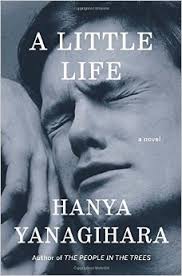
A Little Life

littlelifeA Little Life
by Hanya Yanagihara
2015/ 734 pages
Booker nominee
Rating –9  (reduced .5 due to the emotional manipulation I felt as it ended).

 Malcolm, JB, Wilhem, and Jude have been buddies since college days in the 1970s (I would guess).   They are all quite different except they are male, youngish, single, possibly gay and live in NYC.  And they are really,  really  good friends – the best kind, with love compassion, loyalty, everything you could want in a small group of friends – although over the course of the book – a lifetime – some of them have their fallings out, too.
JB – Haitian background, artist, works as a receptionist for an art publishing company, his family is lower middle class, his dad is deceased but there is a hugely supportive extended family and they thoroughly spoil him.  JB becomes a famous photographer and also  a drug addict.  >>>MORE>>>
Leave a comment

A Man Called Ove

oveA Man Called Ove
by Fredik Bachman (Sweden)
2014/ 364 pages
Read by George Newbern 9h 9m
Rating – 7.5  (but an enjoyment level of 9)

The blurs and reviews generally say “heart-warming” and “life-affirming” and trite as they are, the words are certainly are true. Sometimes I like these kinds of novels, sometimes not. It has to be both the right book and the right time. A steady diet would be annoying.

In this tale we have “A Man Called Ove” who is relatively young in the backstories,  but now he’s one of those guys who “… has been a grumpy old man since elementary school.”  Curmudgeonly, might be an apt word to describe Ove.  He knows how to do everything the right way, the honest, decent, correct snd proper way – the way which “any dummy should know.” He gets this original moral steadfastness from his father, now deceased, but, it would seem, without his father’s humanity. Ove is a very negative person in general.  >>>>MORE>>>> 

1 Comment

Island

islandIsland
by Aldous Huxley
1962/ 354 pages
rating 4 / sci-fi (utopian world creation)

Well – I certainly can’t say much for this one.  There is only minimal plot and the same can be said for the character development. So what is this? It’s basically a narrative comprised of the social, cultural and intellectual ideas of Aldous Huxley.  He’s created a world,  a little island utopia,  which is threatened by the outside world and the need for oil.   The book is peopled by “types” such as the Rani and her son (pro-oil), the scientists (anti-oil), and Will Faraday, a journalist who comes over for the money but listens and learns about the island – Pala.

Aldus Huxley was ahead of his times,  but between then and now the times he was meant for happened,  and now they are memory.  His thinking became very popular in the late Sixties but he died in 1963.   In this novel Huxley holds forth in a didactic and somewhat arrogant manner – smug.  The book is boring to me now,  but I can see where I might have enjoyed it in 1970 or so –  >>>> MORE>>>> 

Leave a comment

Maps

mapsMaps
by Farah Nurruddin
1986 / 288 pages
rating – 8.5

I really wish I knew more about the history of Somalia in order to make more allegorical  sense of Farah Nurruddin’s novel “Maps,” a part of his Blood in the Sun trilogy.
 Askar Cali-Xamari’s father died fighting for the independence of his area of Somalia,  the day before Askar was born. These events  occurred in the Somali-Ethiopian conflict of 1977. His mother died during or very shortly after childbirth. So Askar was found tiny snd alone, apparently conscious of being, exploring his body and staring by a woman named Misra, his aunt. Misra became Askar’s surrogate mother and kept him until he went away to school. During these years she kept him very close, holding him, sleeping with him, sharing all with him to the effect that his self-identity was in question.  The problem is that the young Askar wants, needs, to be a man because there is a war going on in which his father died a hero. And there’s also the troubling fact that Misra is ethnically Ethiopian.  >>>>MORE>>>> 
Leave a comment

The Moor’s Account

moorsaccountThe Moor’s Account
by Laila Lalami
2014/ 336 pages
rating 9/ historical fiction

Fascinating historical fiction regarding the taking of Floridaby the Spanish in 1555. The 1st person narrator is a Muslim slave from Morocco.
  1. Estevanico was a Moroccan-Berber and one of the first known native Africans to reach the present-day continental United States. He is known by many different names, but is commonly known as Esteban de Dorantes, Estebanico and Esteban the Moor. Wikipedia
    Kind of amazing that a woman should write about a Black, male, Moorish slave and perhaps conquistador in the days of Cortez – plenty of Indians and others, 95% male.
Leave a comment

Sapiens: A Brief History of Humankind

sapiensSapiens: A Brief History of Humankind
by Yuval Noah Harari
2015/ 414 pages
rating 5 (liked parts) anthropology

 Really annoying. Can the “history of mankind” (starting with the big bang and continuing into the future) be told in 400 pages including a few illustrations? Harari certainly gives it his best shot in this sporadically organized work of over-generalization, cherry-picking, digressions,  and skipping around.
There are places of interest but also too many really annoying parts. Overall, I’m impressed only by the ambition of this project.
The scope? The history of human-kind, homo sapiens, divided into sections which aren’t terribly neat and tidy.
The Cognitive Revolution – huh? Did this happen all at once? Did Sapiens go from rote memory to abstract analyzing, evaluating and creating in one massive jump? Harari seems to idealize the forager folks.  But then on to the Agricultural Revolution when troubles started happening. >>>>MORE>>>> 
Leave a comment