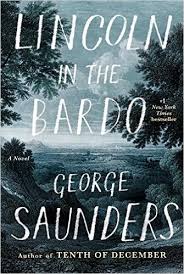
Lincoln in the Bardo by George Saunders

A friend disliked this book so much but I’d been watching it and been intrigued.  So, because  he and I disagree on books from time to time,  and because of the generally positive critical reception the novel has garnered,  I went ahead.  Actually,  I got both the Audible and Kindle formats because from what I’d read the structure seemed so unique and the “plot” so original I felt it would be helpful to straightening things out.
lincoln.jpeg
*********
Lincoln in the Bardo
by George Saunders
2017 / 367 pages
read by a whole cast 7h 25m
rating /  9.25  –  contemp historical fiction 
*********

On February 19, 1862  Willie Lincoln, age 11,  is dying in an upstairs bedroom at the White House while a state dinner is going on in the formal rooms below.  His parents are both attending the dinner.

Five days later Willie’s body is taken to a nearby crypt.

So many people died during the Civil War from Willie Lincoln (the President’s young son) to the thousands of soldiers in the war and all the people doing the things of their lives and dying, naturally or no.  There were rich and poor, black and white, young and old dying.  Some died in their beds and others in fires or scenes of ungodly violence.

These are their fictional stories,  real and imaginary,  as they leave their bodies and pass into and hopefully through a place called the “Bardo.”
http://www.abrahamlincolnonline.org/lincoln/education/williedeath.htm

It’s also the story of those they left – the life of Mrs Lincoln as she lived out the days following Willie’s death and more particularly of Mr Lincoln as he endured his his grief which was reported on by many at the time.

The story is told in the voices of 166 (!) characters of various sorts and the Audible version uses a whole cast of characters.  Some are historical figures,  others are purely fictional.   Of the latter,  the two most important are “roger bevins iii”   and “hans vollman” (uncapitalized to show they are not living I suppose)  who serve as “guides” for newcomers to the Bardo – these two seem to be stuck there and do this welcoming and advising to pass the time.

There are differences between the Kindle book and the Audio –  the written narrative has every single character or reference named – the Audio sometimes doesn’t do that during simple conversations.  The Audio narrator says the whole indicated word when the printed version says “F’..in’.”   I recommend using both for clarity,  although if I had to choose one it would be the print version.  (And that said,  the Audible version is exceptional.)

So…   I  was thoroughly enjoying myself through the first 10% or so  which is about the death of Lincoln’s son,  Willie,  and Lincoln’s visit to the boy’s corpse.   This is followed by more conversations of the ghosts (roger iii and vollman)  in “Bardo” (a Tibetan word meaning “intermediate state)  with more Bardo residents when the language got quite vulgar and it was really jarring.   (I’m okay with vulgar language in my reading material – I loved A Brief History of Seven Killings –  but this is over the top.)  I suppose in fairness to Sanders a lot of foul-mouthed  and angry people died as well and everyone goes to Bardo –

But there are only a few places like that and many, many  places which are just as tender and  touching as the first chapters.  The tone swings from really extremely sad to quite humorous and from Civil War dead in huge numbers to individuals dying alone or with loved ones.  It’s not an easy book.

I’m reminded of the third act of Our Town by Thornton Wilder.

There is a plot which follows the illness and death of Willie Lincoln all the way to his funeral and a bit beyond.   His father the President,  his mother Mary Todd Lincoln,  and a few others are followed though those dark days – some of them are reporting on the death and its effects – some are contemporary historians.

A LOT of research went into this book with the effect being one of some kind of reality  with so many points of view detailing the events and all the sources are noted – and I checked enough of them to know they are real books written by real authors including real memoirs of real people who witnessed a heartbreak in the middle of a war.

There are a total of 166 characters inserting their problems and ideas and difficulties in the novel  – many between life and death,  when the soul is leaving the body or has left and is waiting to actually be gone.  Others come from that point in history.

“Isabella Perkins from The Civil War Letters of Isabella Perkins compiled and edited by Nash Perkins III.”   There are several longer pieces from her and Nash Perkins.

The narrative as written in  print format is like the script of a play but without stage directions.

One chapter is exceedingly hard on Lincoln – well,  I’m not surprised.  There are war protesters for every war,  to draft Northerners into a war to keep the South in the Union when it wanted to leave,   OR go into a murderous war for the sake of slaves,  made no sense to many Northerners and they were pissed off.   And when the deaths piled up (more fatalities than the total of all the other wars from the American Revolution to the Korean War) the outcry would have been fierce.

Bottom line – this book needs a couple readings to really get a sense of the characters,  which ones repeat, which ones have one story,  to see if there are any or many connections other than being deceased – I don’t think that would be the case because at least a part of the point seems to be the number and variety of very recently deceased people.

Posted in 2023 Fiction | 4 Comments

A Proper Pursuit by Lynn Austin

I was really tired of unhappy books about genocide and refugees.  My mom was laughing and laughing about a book she was reading and was recommending to me.  Now,  I rarely if ever read anything recommended by my mother because her tastes run to the inspirational Christian lit – especially historical and light crime,  not romance.  But she had been going on about this  – was even going to order it for me so I caved and got an Audible version.

Unknown.jpeg

*******
A Proper Pursuit
by Lynn Austin
2007 / 432 pages
read by Jennifer Ikeda 16h 10m
rating –  7.5 (for fun)/ light historical fiction/romance  – (Christian)
*******

Okay – it is quite a bit more religious than I’m comfortable with,  (I’m not even a Christian, but I’m certainly not an atheist),  but that’s nowhere near the main plot of the story.  And overt religiosity is not always presented as an entirely desirable characteristic so I was, for the most part,  able to skim over those parts.   And then there’s the romance –  but that’s pretty humorous – fun.

It’s basically a pretty humorous book along the lines of Northanger Abbey by Jane Austen where a young woman is so enamored of reading gothic romance she imagines those situations going on in her life.   Here too,  our heroine’s perceptions are affected by her choice of romance reading,  but the entanglements are quite different from those of the Jane Austin’s book.

Told in first person by very courageous young Violet Hayes who, after graduating from finishing school in the spring of 1893,  is sent to her grandmother’s house in Chicago to find and appropriate husband.   There are also three aunts involved at grandmother’s house.    This is her father’s family. Violet has been raised without a mother and her family has not been honest with her but now her father is remarrying and Violet doesn’t like her new stepmother-to-be.    So, armed with new knowledge, she wants to look for her mother in Chicago and manages to stay a little longer than planned.  In doing that she finds herself with four very different suitors-  one is from back home and her father is pushing him.   In Chicago,  one man is rich and really only needs to marry to get stable for his father’s business,  one is a poor theological student who lives a life of good works.  And one is apparently a con artist with strange friends.

Meanwhile,  her matchmaking aunts are very different from each other.  One is society minded,  one is involved with charity including the Jane Addams settlement homes and the third is concerned with women’s suffrage and related issues.  There is fourth aunt who is afflicted with dementia and thinks her husband is fighting in Virginia in the Civil War.  And there’s grandmother who is very wise and loving,  but unable to be specifically very helpful.

But after awhile her father gets impatient and time is running out so Violet has to find her mother if she’s going to.  And her imagination works overtime while she pursues every possible lead,  even into the worst barrooms imaginable.

I suppose as far as secular themes go there might be something found in the ideas of love and deception.   Also,  I was pleasantly surprised by Austin’s skillful tension building – even if the outcome was fairly predictable  – I suppose that’s part of what makes it genre lit.

Historically the era is that of the Gilded Age and the story includes the conspicuous consumption of the very rich alongside the very poor working immigrants in filthy sweatshop conditions in the tenements.   It was also the era of the Chicago World’s Fair and women’s plight and their issues as well as suffrage coming to the fore.  The Great Chicago Fire of 1871 is remembered by one of the characters.  These events are pretty well woven into the lives of the characters as befitting good historical fiction.

Austin writes well enough, although there are an abundance of clichés, and she juggles these rather quirky characters masterfully while keeping the tone light and humorous through several plot threads.

Recommended only for readers who enjoy this genre,  but it’s pretty cute.

And now on to my usual fare –   lol

Posted in 2023 Fiction | Leave a comment

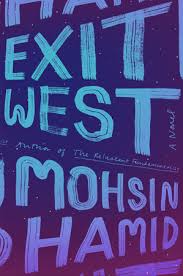
Exit West by Mohsin Hamid

This book is so short – and only 4 1/2 hours on Audible –  was it worth a whole credit?  –  Okay ,  I loved Hamid’s The Reluctant Terrorist (2007) so I went ahead.   Yes.  It’s worth it.

exitwest

*******
Exit West
by Mohsin Hamid
2016 / 340 pages
read by Mohsin Hamid 4h 42m
rating 9  / contemp lit
*******

Saeed and Nadia are two young adults who live and work in a largish city in an unknown country which is undergoing transformation into a very conservative hard-line place with military presence and fighting.  It’s typical of the kinds of places refugees come from.   Because of their journey I figure they are from Syria or thereabouts.   They met each other taking classes and now want to marry,  but at the moment it’s not possible.  They are generally trapped in the fighting.  It might not even be safe to be seen with each other. But they do.  Daily life is different in a war zone but still,  it goes on. 

Nadia is looking for a way out and thanks to a bit of magic/fantasy/metaphor (?), one day  a door appears. There have been rumors about these doors but this is the first they’ve seen.  Saeed’s mother is deceased,  but maybe his father could make the trip.  No,  he won’t go.  But he wants them to go,  he wants Nadia to look after Saeed and stay with him until they find someplace safe.  Nadia remembers that.  The couple leaves through the door and find themselves in a series of Greek refugee camps with thieves and brave souls and more doors and then comes Vienna.  After that there’s a camp in London where life gets harder and somewhat more organized,  but more difficulties are encountered in their daily lives –  which refugees belong to which groups,  there are divisions, disputes.  Who is a friend, who is not?

This book is a more a mediation on the life of a refugee and the nature of love than it is a plot or character-driven novel.   The characters are not “fully formed” or “rounded,”  and in my opinion that’s appropriate because they are meant to represent almost all refugees,  not one particular couple.  I think Hamid wants the reader to see many refugees in the faces of these two,  and to see these two in the faces of the refugees we see in the media – (or downtown).   To individualize them too much would take that recognition away – or minimize it  – “Our refugees are different.”  And I don’t think that’s the intended take-away.

Theirs is a multi-ethnic, multi-cultural life,  love in a time of ultimate danger, of impermanence, of transience,  of death,  as well as of wealth amid rubbish with wondrous good will and generosity amidst thievery and loss.   And the luminous writing of a compelling story.

The doorways are compared to the closet of C.S. Lewis but I saw it more like Colson Whitehead’s doors and stations in The Underground Railroad.

Yes – read it.

https://www.pbs.org/newshour/show/exit-west-author-mohsin-hamid-answers-your-questions

http://www.thenational.ae/arts-life/the-review/a-refugee-couples-search-for-a-way-out

http://www.slate.com/articles/arts/books/2017/03/exit_west_by_mohsin_hamid_reviewed.html

Posted in 2023 Fiction | 2 Comments

American Genocide: by Benjamin Madley

I’d been looking at this book for some time.  As those who have known or followed me for any length of time I have a couple of favorite nonfiction subjects –  the French Revolution, the history of Christianity and Native Americans.  It’s been awhile since I’ve read anything about the Native Americans and living in California for as long as I have (a LONG time) I wanted to know more.
amergen


*******
American Genocide:  The United States and the California Indian Catastrophe, 1846-1873
by Benjamin Madley
2016 / 712 pages
read by Fajir Al-Kaisi  15h 43m
rating  10 /  history (Native American)
(read and listened)  
*******

** Note – this is NOT a book for the faint of heart –

There is controversy about the use of the term genocide and it could never have been used prior to 1945 or so when some term was needed to describe the Holocaust of WWII.   But it happened prior to that – and not rarely.   Madley explains what he means and equates the words which were used in the 19th century (and 20th!)  in a very inclusive Introduction.   The words “exterminate” and “eliminate” come up in the primary source materials quite often.  That’s Madley’s point –  in terms of the UN Genocide Convention what happened to the natives in California fits.   And he shows that what happened here is a bit more extreme than what happened in the rest of the US.  It was a concerted effort on the part of the population and the government, both state and federal,  to remove the Indian presence.

The book is incredibly well researched,  well organized and nicely written.  But in its thoroughness it becomes tedious – killing, killing,  killing – page after page of massacres and body counts.

The chronology starts with the Spanish missions but moves briefly to the very short-lived Russian presence in the north,  then on to the Republic and finally to the Gold Rush, statehood and Indian removal.  But because there was nowhere much to move the Indians to,  they had to be killed.   So killed they were.   By state law they had no legal status – they couldn’t vote or testify in court,  couldn’t own land,  etc.

It was the population boom of the gold boom which stimulated the animosity and greed plus racism created the willingness to kill whatever stood in their way.  The newspapers often pushed them on – but not always.

Madley says the state established what he calls a “killing machine” which worked via militias which were state paid and then that was reimbursed by the US government.  It was the job of these “volunteers” (local ranchers and gold miners)  to handle the Indian problems.  And so they did.  And they got help from the US Army.

Chapter after chapter Madley details the many, many massacres of whole tribes,  annihilated because one cow was missing or one white man killed in revenge.  The reservations were very small and could not provide enough food for the tribes.  So a few Indians would wander off and steal a cow and that might be the end of their tribe.

There was also trafficking in Indians – when a mother and father were killed in a raid,  the children were stolen and sold as “indentured” or placed with “guardians” for several years.  (This continued for long after the Civil War ended.)

When the Spanish came it is estimated there were about 300,000 Indians in California.  By the start of the Gold Rush there were 150,000 and by 1873 there were about 30,000.  Today there are a couple dozen or more tiny reservations dotting the state -none in the top 50 of the US in size and one is the very smallest – at 1.3 acres, used as a cemetery.

In addition to a lengthy narrative,  Madley provides eight (8) appendices,  detailed Source Notes,  an organized Bibliography,  and an Index.  There are pictures and graphs.

An article by the author:
http://www.latimes.com/opinion/op-ed/la-oe-madley-california-genocide-20160522-snap-story.html


Posted in 2023 Fiction | Leave a comment

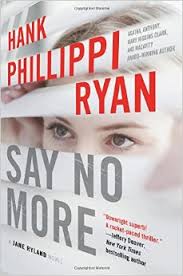
Say No More by Hank Phillippi Ryan

Well I was just wondering what to read next when there in the mail comes the newest book by Hank Phillippi Ryan –   🙂

But since my eyes are not what they used to be I decided to download a copy from Audible and do this my favorite way –  read and listen.   It’s a good idea because this narrator reads a bit fast but I got used to it – I usually get used to narrators.

saynomore.jpeg

*******
Say No More 
by Hank Phillippi Ryan 
2016/ 382 pages
read by Xe Sands  10h 50m
rating:  A+   /  crime – procedural
******* 

Say No More is the fourth of a series starring Jane Ryan,  intrepid television reporter of  local live news and documentaries.  I don’t remember ever  having read a crime novel in which a reporter was the protagonist – it works nicely.  (And now I wish I’d read the first three books in the series prior.   Oh well,  I’ve done this before and I catch up with pleasure.)

Anyway, the first thing we know Jane and her producer,  Fiola,  are witness to a car-wreck between a Cadillac and an older delivery van.  Jane almost automatically writes down the license number.  The two women get close enough that Jane gets a very good view of the driver of the Cadillac and  memorizes what he looks like before he finally collects his senses, steps on the gas and speeds away.  The women call 911 then go to check the van and it’s driver.  The cops are on their way.

Very shortly after the call,  the DA’s office gets involved with her hit-and-run 911 call  to the point of threatening a subpoena to get her to come in for a little chat.     Yeah? –  Okay fine – and that’s pretty much what Jane thinks, too,  “Huh?”

Meanwhile we have Jake Brogan, a homicide detective and Jane’s boyfriend/fiancé, working his own cases and just now finding out about the death of Avery Morgan,  the resident of a very classy neighborhood of old Boston brownstones.  This was reported by a new young neighbor woman who has her own sections and definitely has her own point of view laden with her own terrifying secrets.   The murder victim  was a visiting adjunct professor at the college where she taught opera.

Jane’s current documentary concerns campus rape.  She is interviewing girls from the campus who are willing to come forward.  One in particular with her own code name of Tosca.  She was in the opera class the visiting teacher Ms. Avery taught.  Tosca connects the two threads.

Thanks in large part to the short chapters and multiple points of view the tension never breaks and everything seems connected with the reader puzzling out how.  And then the threads seem to get tangled actually,  but in a good way,  with a cleverly twisted plot.  The main characters are nicely drawn and seem to be people readers would like to know.  The books are a series but from this sample there is more emphasis on the crime than on the over-arching character relationships and their development.

An added little interest is that the class  opera Tosca is and that motif is used throughout.
http://worldofopera.org/operas/operas/item/3729-in-tosca-puccini-presents-the-villains-villain?pg=page1

Finally,  the novel is of completely contemporary interest.   What happens when you know you should tell the truth,  but it will endanger yourself or others?   Or do you “say no more” (great title!)  and let a guilty party – murderer or rapist – go free to do it again?  –  Would you “say no more” to save your own skin?   How about “say no more” to protect your sources or some information you have which is protected but necessary to others?    And then there are the cases where reporting is mandatory. This idea affects several characters in different ways.

Overall a great sleep snatcher – full of life and action.

Posted in 2023 Fiction | 2 Comments

All Things Cease To Appear by Elizabeth Brundage

Wow –  I am forgetting to finish and put up my blogs! –  Finished this one a few days ago.  I picked it up because a friend in a reading group recommended it.  No group involved with this one.

allthingscease

*******
All Things Cease To Appear 
by Elizabeth Brundage
2017 –  466 pages
Read by Kristen Potter
Rating:  7 – A   / literary crime 
*******


The book opens with the death of a young woman in a farmhouse in upstate New York and her husband and family’s reactions.  It then switches to the two- thread back story which joins about midway.  – Complex structure.

First there is the backstory of the  very dysfunctional couple  who committed suicide in that same old farmhouse. They were the parents of several young boys  The boys are taken in by an uncle in town.

A few years later a young couple with a small child buy the place and then several months later she is found murdered in her bed.  (NOT a spoiler – it’s relates to the opening scene when George is the obvious suspect).  The story of George and Catherine Clare goes back to how they met and is told from the woman’s point of view.  George is a PhD student and then a professor of art history at the college in upstate New York. He is the only child of an upper class couple with their own problems.   He’s been a very difficult person from the day he and his wife met.   But Catherine might not be without her own issues – she senses a haunting,  a spirit presence.  When she finds out about the prior deaths in the house she worries.

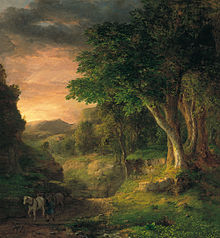
George_Inness_-_In_the_Berkshires

In the Berkshires – George Inness – 1850

The story of the boys and the Clares  intertwines
in many ways and it’s riveting to see how the murder transpires –  and there is a bit of “who-done-it” in there because although all fingers seem to point to George,  there are certainly other possibilities.

There’s also a rather literary element in that George specializes in the art of the Hudson River School of American art and that’s pretty much where they live.  Brundage brings in the ideas of light and dark as well as dropping the  names of  a lot of artists, particularly George Inness who painted the area,   and literary figures including Emanuel Swedenborg,  an 18th century Swedish inventor and theologian/mystic   – those two connect rather ambitiously on the level of spirituality and the afterlife.   George did his thesis based on discounting the connection between Swedenborg and Inness while Catherine might be sensing the spirit of Swedenborg’s angels.  (at least that’s what I get – it’s rather peripheral to the main plot.)

I really enjoyed this book except for two things.  The stretch between the spiritual theme and the basic murder plot was pretty slender and not necessary imo although it did add a certain texture.  Also,  there seemed to be a bit too much sex in it for my tastes.  I suppose that was also a part of the plot in a way but still – it was kind of disturbing.  That said,  yes,  I recommend it to anyone who enjoys a literary thriller without being in any way a formulaic mystery.

Posted in 2023 Fiction | 2 Comments

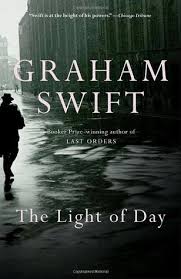
The Light of Day by Graham Swift

This one needs a reread as it’s very confusing to start out – who is whom?  Especially amongst all those women! But it clears up about halfway and is pretty straightforward after that although there are times when the frame story flashes back to something unexpected which was not all tidied up.

lightofday.jpeg
*******
The Light of Day 
by Graham Swift
2003 / 323 pages
Read by Graeme Malcolm 7h 5m
Rating:  8 & B/  literary crime 
(read and listened)
*******

Graham Swift is an old favorite and since he won a slot on the Booker Prize Long List back in 2003 The Light of Day was deemed worthy of reading in the Booker Group.   Yay!

Swift is as literary as ever here – the masterful use of appropriate language, the themes, the interesting structure,  the suspense is nicely woven in –

The plot  concerns a cop getting out of jail for something but what – corruption of some sort is what is said but …   These days George Webb is a private detective.

The husband  of his clients, Sara Nash, is (or was) cheating on her and she wants more info.  But there’s a frame story which shows Webb visiting a grave so somebody dies.  Hmmmmm…. Webb was obsessed and the story starts at the beginning of his relationship with Sara and takes the reader through the story of all that with masterfully developed pace using structure and a bit of foreshadowing in addition to normal situational suspense.

Good book although not your usual “thriller” because our 1st person protagonist is very thoughtful and emotionally involved with what happened.

Posted in 2023 Fiction | 1 Comment

The Growth of the Soil by Knut Hamsun x2

There is so much enjoyment in reading a book a second time especially when the novel is a classic with so much substance as Hamsun’s The Growth of the Soil.   I read it maybe 15 year ago at the urging of my son who had come across it and thought I’d enjoy it.  Yup – I surely did.

And I chose it for my selection at 19th Century Literature where, although it was published in 1917,   it technically qualifies because most of Hamsun’s works were written in that time frame.   However,  on the other hand,  as a book it does not belong in 19th century lit at all because Hamsun changed his style to Norwegian Realism,  an early form of modernist literature.

images

******
The Growth of the Soil
by Knut Hamsun
1917 / 366 pages (Kindle) 
Read by Greg W. at LibriVox
Rating:  10 / classic (Norwegian)
(read and listened)
*******

This is a ode to the common farmer who is independent,  works very hard to clear and work the land and tend his animals to produce food for his family and some to sell.  It’s the story of a successful man who sets up a small place in a “vacant” area of northern Norway and over the years,  makes it thrive.  He finds a wife and has children and patiently waits out the storms that ebb and flow around him.   He befriends his friends and forgives much.  He cares for his family and forgives much there, too.

There are other obstacles – the weather,  industry, cheats, lazy and/or gossipy neighbors,  the government, and so on.

The message is that it takes a country full of men like this,  devoted to hard work on the land, to make a real nation.

On the surface,  Isak,  a common enough young Norwegian man,  sets up camp in a remote part of Norway –  I think the time is about 1860 or so – before the switch to the Kroner (1875).   He sees a few Lapps there but no settlers.  He starts a little farm,  works very hard, improves it, adds to it, makes it thrive.  Over the years he is a real success.

OLYMPUS DIGITAL CAMERA

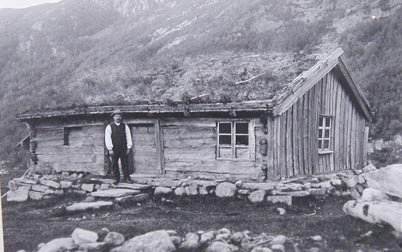
My great-great grandfather outside his cabin near Hol, Norway in the 1840s – just prior to immigration to the US. Note the sod roof.

One day early in the tale,  young woman named Inger comes along and offers herself to him as a house helper – she has a hare-lip and wants to get away from her village.  Isak accepts her and one thread in the novel is their lives as individuals and together.  Inger brings a cow.

Oline,  an older woman from Inger’s village comes to check on her and the cow.  Oline is sneaky, gossipy and a bit greedy.

Inger’s third child is born with a hare-lip and she murders it.  Infanticide is a huge theme – and a real-life concern of Hamsun.   Inger goes to jail and comes back changed into a more urban woman.   She bears more children and goes through her own changes.

As the years go by neighbors move in to farm but Isak’s land,  which he has now bought from the state and named Sellanraa,  is further up than anyone else.  Then copper is found on a piece of his land,  he sells that little piece and mining operations move in as does a store with a rather uppity owner.

The children grow and of primary concern are the older two,  both boys.  The eldest is Eleseus who is very smart in the ways of books but lacks something of a work-ethic.  Sivert is named for a rich uncle but is really a farmer at heart.

OLYMPUS DIGITAL CAMERA

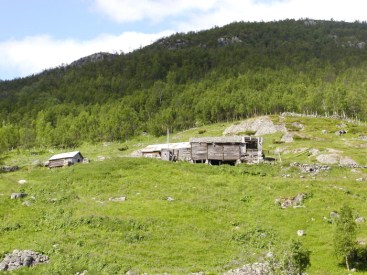
The neighbor’s farm in 2000 or so – when we visited. (Bakken)

As the years go by the industrial revolution makes itself felt and the local farmers acquire machinery.

The characters are hugely important in this novel – as in most social commentaries they are of a varied sort,   farmers of different  kinds,  a store-owner,  a rich uncle,  a bureaucrat-trader,  a miner, and so on.   The women are also different from each other but one of the main ones,  Inger changes a lot.  The story is as much about human nature as it is about the glorious life of simple honest living off the hard work of making the land and the women productive.

The structure works incredibly well on the kind of long-term, multi-character  story Hamsun is telling.  There are 31 chapters of about equal length.  In each chapter the time frame has advanced a few years and the narrator catches the reader up with the events of several characters’ lives,  about as well as zoning in on one or two events specifically.  The result is like looking at a beach and seeing both (!) the larger area as well as the grains of sand.  Difficult to do, and probably risky,  but it worked.

Themes abound – there’s nature,  of course,  and the idea of a simple honest and hardworking man living off the land in accord with nature is powerful.  Especially when he’s very successful.  And he’s always building – either on his own land or planning for something for his son.  The family/nation is growing?

Another theme has to do with the nature of man,  how laziness,  greed,  lust and pride show up in virtually all people,  men and women,  young and old,  and it destroys them.

Positive family values are vital to this project of building a successful farm/nation  so Isak, our super-hero of sorts, is quiet, loving, generous within reason,  shrewd, patient, forgiving, and so on.

Relatedly,  the idea of how the younger generation is getting more and more immoral is strong.  Perpetuating all of this is the expanding urban influence on young people.

Christianity is an important theme but it’s subtle – nature is a more powerful force than church.  Isak does see some eyes in the night and wonders if he’s met God or the Devil.  He tells Inger and changes his ways somewhat.  Conversion was a part of Inger’s changes.  The children are “confirmed” in the Lutheran faith and take communion –  Oline has a rather superstitious idea but Inger’s is more about repentance.   Only women are religious.

Some criticisms –
*Reading this in the US in the 21st century*  (and it was NOT written for us)  I see the way the Lapps are treated – they are regarded as sneaky with shifty eyes,  begging coffee and milk and even old socks.   On page 63 (Kindle) the narrator acknowledges that Inger has “an unchristian hate of all Lapps.”

The women are treated as property plain and simple –  suffrage is discussed in one paragraph and that’s it.  They can be devious though – Isak is the only truly “good” character in the book and he’s almost unreal – almost.   The book ends with with a seriously romantic notion of the men coming home to find the women barefoot in the fields working while the older woman is inside cooking the meal.   Infanticide by mothers is a much larger issue.

Overall – I’m in awe.

Chapter Summaries >>>> 


Posted in 2023 Fiction | Leave a comment

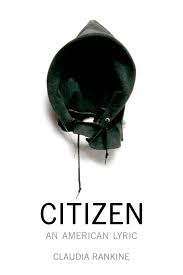
Citizen: An American Lyric by Claudia Rankine

Claudia Rankine recently received a MacArthur Genius Award for her work,  so her name came up on the Booker Prize Reading Group and her book,  Citizen,  sounded like a good way for me to improve my virtually non-existent poetry reading.   I’ve made it a challenge for this year to read some kind of poetry every month and I’ll  have to log it and blog it.  This particular book has also won numerous awards.

citizen.jpeg
*******
Citizen: An American Lyric 
by Claudia Rankine
2014 / 160 pages
read by Allyson Johnson 1h 37m
rating 9.7 –  very literary essays  – 
(read and listened)
*******

I’m not sure it’s poetry – but it’s more than simple narrative –  the subtitle probably says it – “a lyric.”

Anyway, it’s a physically beautiful little book with interesting graphics and photographs scattered throughout,  I think to bring the reality home.  One graphic is a piece of film footage,  another is a line of heads.   The narrative is primarily made up of tiny narratives which are absolutly worth reading more than once or twice – I’d say 5 times each is a minimum to let the words wash over you and then comprehend them and then sink into you and then wash over again.  –  Amazing.  (Chapter 2 is a longer piece of prose.)

The basic theme of the 7 chapters is how racism exhibits itself in everyday life.  I’d say that in some places there are similarities to Te-Nehisi Coates’ Between the World and Me – (2015)  which I read two times spread several months apart.  The books both deal with the realities of being Black in America and how it’s about the bodies,  male or female.

Some annotations from Chapter VI  (a really interesting chapter)
Hurricane Katrina (2005)
Trayvon Martin (2012)
James Craig Anderson (2011)
Jena Six    (2006)
Mark Duggan – (2011)

(There seems to be something missing from the Kindle version at the end of Chapter 6 – the Audible version kept going for a bit after the Kindle version stopped.)

Chapter 7 is a longish free verse poem followed by more snippets of stories.

This is powerful stuff – self-righteous at times,  vulnerable at other times,  sad and soft and indignant –  wise.   About bodies and minds and connections or disconnections.

Wikipedia has the some chapter summaries –
https://en.wikipedia.org/wiki/Citizen:_An_American_Lyric

Interesting essay at Entropy:   https://entropymag.org/the-limitations-of-claudia-rankine-and-ta-nehisi-coates-common-project/

Posted in 2023 Fiction | Leave a comment

The Stranger in the Woods ~ by Michael Finkel

This caught my eye prior to publication and although I don’t buy pre-release,  it was ready for me when the date,  March 7, came.   I’d never heard of the North Pond Hermit of Albion,  Maine,  or at least I certainly have no memory of it.

Christopher Knight was finally arrested after spending 27+ years as a “hermit” living at a camp in central Maine.   He stole what he needed to live,  nothing else,  and had virtually no contact with people for that entire time.  Knight disappeared in 1986 and was captured in 2013 while committing a burglary.  Wow.

stranger.jpeg

*******

The Stranger in the Woods: The Extraordinary Story of the Last True Hermit
by Michael Finkel 
2017 / 224 pages
read by Mark Bramhall 6h 19m
rating   9  / true crime – biography/memoir
*******

The memoir part is that of Finkle as he researches his subject.  The biography is that of Knight who grew up in rural Maine on a small family farm with four brothers and a sister, a father who worked at a creamery and a mother who grew vegetables and saved money.  They were all smart, honest, quiet and respected. They also read a lot, did well in school,  but also valued their privacy.

He lived in a very dirty looking make-shift camp which was in hearing distance of hikers and visitors.  He’d made the camp waterproof and as comfortable as possible with some amenities.  He read quite a lot.  In fact,  some of the book is like a bit of literary and cultural critique from Knight.  And he worried about his diet (as well he should! – lol)

And there are other digressions or maybe explorations would be a better word,  on the subjects of happiness,  mental illness (he wasn’t),  a broad range of other “hermits”  including those rarities in the animal kingdom,   etc.

knight

Between the ice cold of winter and the insects of summer,  Knight endured an extraordinary amount of discomfort.  There must have been a good pay-off – he must have benefited in some way from remaining outside of human society for so many years.   The boundaries of individuality and perception change as one spends time in real solitude.

Michael Finkel, an ex-journalist for the New York Times,   writes nicely and  although the material possibly could have been organized a bit better, the flow is nice.

https://en.wikipedia.org/wiki/Christopher_Thomas_Knight

http://www.gq.com/story/the-last-true-hermit

Posted in 2023 Fiction | 1 Comment

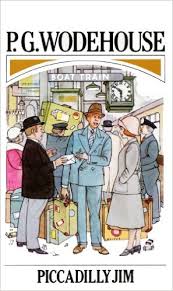
Piccadilly Jim by P.G. Wodehouse

Well, at least I can say I’ve read a P.G. Wodehouse now.  I doubt I’ll read another.

piccadilly.jpeg


*******
Piccadilly Jim
by P.G. Wodehouse 
1917 / 165 pages (Kindle) 
read by Frederick Davidson  – 8h 14m
rating:   5 (out of 10) /  humor-romance
(read and listened) 

*******

It’s basically a “zany madcap” (as we used to call them in the 1970s)  of a  romance which includes secret identities, kidnapping and some kind of explosive device.    Not my cuppa,  but there were a few times I really did laugh out loud.

The reason Mr Pett wants to kidnap his wife’s child is because he’s a fat,  lazy, insulant little snot.  Pett figures if he uses a method he read which was successful on dogs he can cure him – send him to a camp where he’s deprived of everything.

Meanwhile Ann Chester, Pett’s  niece,  has decided not to marry and really despises a clown she met named Jim Crocker.  Jim’s kind of like the step-son only an adult except that he got sick of himself and his immature ways and reformed.  So now he wants to meet the lovely woman he ran into at the station but finds out she loathes him.   So he pretends to be someone else.   There are other pretend identities and real kidnappers and so on.   It all gets a bit tiring.


Posted in 2023 Fiction | 7 Comments

The Muralist by B.A. Shapiro

One of my reading groups has a real enjoyment for books about art – from the novel Luncheon of the Boating Party by Susan Vreeland to the non-fiction You Must Change Your Life by Rachel Corbett.  Some are great,  some are not so hot – but how can one tell prior to reading?  –    Anyway,  this was the choice and on the schedule so, albeit with some reluctance,  I read it.

There are times when reading a generally poorish book sharpens my appreciation of the good ones and the reasons they’re good.   Also,  the literary value of this book is in almost pointed contrast to the completely delightful historical fictions I’ve read recently –  particularly His Bloody Project by Graeme McCrae Burnett and The Last Days of Night by Graham Moore.  It’s hard to pinpoint why those are so excellent and this one is so poor.

muralist.jpeg

*******
The Muralist
by B.A. Shapiro
2015 / 368 pages
read by Xe Sands 9h 9m
rating 7  / contemp fiction/historical WWII
*******

Danielle Abrams, a  young cataloguer of artworks for Christie’s  in New York City finds some works she believes were painted by her aunt,  Alizée Benoit,  a Jewish abstract impressionist who disappeared in New York City in about 1940.   Benoit has been a family mystery ever since she disappeared. That’s one thread.

The second major thread concerns the art world of New York City during WW II and Benoit’s place in it.  She is a completely fictional character but the focal point of the novel and supposedly the inspiration for artists like Mark Rothko, Jackson Pollock, Arshile Gorky, and Lee Krasner.    The tension of the story builds around what happened to Benoit as we follow Danielle and her search in the 21st century, and in the alternating chapters which follow Beniot in 1940.   Benoit’s life is told from several points of view,  her own and a few of  her friends.

Benoit’s life story takes place in the US where she works for the Federal Art Project of the WPA and mingles with  the their artists (including Rothco, Pollock,  etc.)  as well as Eleanor Roosevelt.

Her own main plot is getting her relatives out of Europe before they’re imprisoned by Hitler – 1939-40.  Meanwhile,  the US government is doing next to nothing – actually,  in this story and historically,  some powers in the US are actively impeding the escape of the Jewish refugees.

This is the kind of book which really gets on my nerves because just about  everything in it feels contrived – often to fit with its “message.”   There’s definitely a polemic edge to it concerning US concern (or lack of it)  for Jewish refugees and with that there are overtones of today’s issues concerning the refugees from the Middle East.  (I’m not sure that’s deliberate – it may be the nature of the issue.)

There are too many  peripheral characters who are unrelated to each other like Eleanor Roosevelt and Breckinridge Long as well as some of the artists.  None of them ever feels real –  even the historical ones feel like fictional cut-outs.    And they weren’t flat for the purposes of satire or to mirror the issues or to promote a theme or plot line.  Those are acceptable reasons to have flat characters.  My feeling is that these characters are  supposed to be fully realized individuals,  but something is missing,  it doesn’t work.

And the abundance of themes is too heavy  and complex for the skills of Shapiro –  abstract impressionism,  WWII,   Hitler, escaping Jews, mental illness and more.

Another annoying aspect is the cliche’d narrative.  And the dialogue ranges from over-the-top emotional and about to break down,  to chirpy sweet,  to studied casual.  (sigh)  Much of the problem for this can be placed with the narrator,  but not all.

There’s a lot of general knowledge type historical information in the book and there’s no smoothness to it’s inclusion – it feels like a couple of Wikipedia paragraphs about this or that and then back to the story.    There are huge unexplained coincidences and the basis for the novel is a completely fictional woman artist working with the WPA,   worried about relatives in France, and trying to get them proper visas.  It’s  entirely fictional – hypothetical maybe – so these historical details are just swirling around an emptiness.

Finally,  the narrator of the audio version is horrible,  swinging from overly-emotional and whiny to overly-sweet and hitting way too “casual” in the middle and always with a quavering voice –  (or at least that’s how it came across to me).   Remember Sally Struthers in the animal protection commercials? – There are times…

On the  plus side,  when Shapiro writes about art she does a very nice job.

Fwiw,   “the Abstract Expressionism movement began in the 1940s in New York City after World War II. However, the first real Abstract Art was painted earlier by some Expressionists, especially Kandinsky in the early 1900s. The main characteristic of abstract art is that it has no recognizable subject.  –  (Google)

“Early on, the Abstract Expressionists, in seeking a timeless and powerful subject matter, turned to primitive myth and archaic art for inspiration. Rothko, Pollock, Motherwell, Gottlieb, Newman, and Baziotes all looked to ancient or primitive cultures for expression. Their early works feature pictographic and biomorphic elements transformed into personal code. Jungian psychology was compelling too, in its assertion of the collective unconscious. Directness of expression was paramount, best achieved through lack of premeditation.”
http://www.metmuseum.org/toah/hd/abex/hd_abex.htm

There was no “first”  to influence the others.
https://en.wikipedia.org/wiki/Wassily_Kandinsky

US history:   Breckinridge Long:   https://en.wikipedia.org/wiki/Breckinridge_Long

Posted in 2023 Fiction | 1 Comment

Under the Dome by Stephen King

Oops – I forgot to blog this one – I read it in January:

It’s way too long.   King has said it was an idea he started when he was much younger and just didn’t have the skills to put together but it stuck with him and he finally finished it.  He also said that one of the later ideas was that he added some political commentary re George W. Bush,  Dick Cheney, waterboarding and a lot more in it.  Another comment from King was that the town could be taken to be a metaphor for the world as a whole in these days of climate change and general anarchy – who rules the world?

Basically what’s happens when the fictional town of Chester’s Mill in western  Maine is suddenly cut off from the world after an unexplainable clear and apparently indestructible dome covers it is that the corruption which was always there surfaces and takes over.  In the first hours several people die as a plane and cars or trucks crash into the dome.   Unfortunately,  the police chief is one of the first to die.

dome

*******
Under the Dome
by Stephen King
2009 /  1074 pages
read by Raul Esparza 34h 29m
rating  –  A /  sci-fi
*******

Then the  existence of the phenomenon becomes known and new law enforcement is necessary.  Big Jim,  used car salesman and city selectman,   becomes the leader and deputizes a new group of policemen some of whom should not be holding guns in the most peaceful of situations.  The Pentagon and Homeland Security become involved trying to break through the dome and they promote an old military man, Dale Barbara (Barbie)  to corporal.  Colonel Cox at the Pentagon is the contact.

Except for one or two people telephone communication with the outside world are cut off.  Television can be viewed but most signals are interrupted by the dome.   Then things get worse in part because food and power are limited but also because the “bad guys” are in charge and they seem to almost be on a rampage – but Big Jim has his drug operation to protect.

There are many, many  minor characters who weave in and out of the chapters,  but only maybe a half-dozen or so major ones.

Big Jim, the new leader,  deputizes his son,” Junior” and several others of like mind to the police force.   Jimmy has a propensity to serious violence and experiences migraine headaches – they’re all druggies and Big Jim owns the lab.

Julia Shumway is a reporter for the local newspaper who becomes friends with Barbie.

Scarecrow McClatchey is a junior high student who is curious about the power source of the dome and seeks answers.  He ends up helping Barbie.

Rusty Everett is a physician’s assistant who works with the injured and helps some prisoners of Big Jim escape.

See the Wiki for more: https://en.wikipedia.org/wiki/Under_the_Dome_(novel)#Characters

The theme is typical King,  how does man behave under extreme survival circumstances and the answer is pretty badly except for a few good people.  I remember that much from The Stand.

But there’s more to it than that if you think of our planet as the town of Chester’s Mill.  We’re under a little dome of our own atmosphere and it’s going fast – what is it we think we’ll do?   More specifically,  King made a comparison between G.W. Bush/Cheney and his own bad guys,  Big Jim and Andy Sanders.

Posted in 2023 Fiction | 2 Comments

The Girl in the Ice by Robert Bryndza

Oh this book started off so well.   A dead woman is found trapped beneath the ice at a pond by a boy who notifies adults who take it from there.   London Police Detective Erika Foster is on the scene after being off the force for several months due to the unfortunate death of her husband,  another detective,  who died in action partly as a result of her own actions.

There were three other women murdered recently – all prostitutes murdered in exactly the same way –  the ice was just the dumping ground.

61QpZWEdwyL._SL150_.jpg

*******
The Girl in the Ice
by Robert Bryndza (British)
2016/ 394 pages
read by Jan Cramer 10h 7m
rating –  A-   crime (procedural) 
#1 in the Erica Foster series 
*******

As the story unfolds it turns out this victim,   Andrea Douglas-Brown,  is the daughter of Lord Douglas-Brown a very rich and powerful man and his wife who have another daughter as well as a son.  Was she a prostitute on the side?   Or is there a copy-cat on the loose who wants her, specifically,  dead?  Possibilities abound.

It appears that Andrea had her own life going on,  engaged to a very wealthy young businessman involved in “events” planning and getting ready for her wedding.     But it seems she had a more private life going on, too,  a dark and twisted life including people who really do NOT want to be caught or their precious name dragged through the press for this.

The procedural part is also great – good interviews and investigations -but  the highlight is probably Erika herself – strong but vulnerable when it comes to some things  with both close and helpful friends as well as enemies.  Outspoken,  smart, and not averse to taking risks.  She leads the investigation.

It bogged down a bit when it got to the Slovakian stuff simply because that’s not really so easy an issue in the US – it’s more a technique used when the author of a series runs out of ideas which could happen in a small town.  In this case it worked better because I’ve seen the immigrant Eastern European prostitutes in Europe.  It might be worth an extra point if I overlook that.

And a word of warning –  the book gets pretty graphic about the sex and violence – not over-the-top,  but it’s certainly a bit more than I’m used to.

Posted in 2023 Fiction | Leave a comment

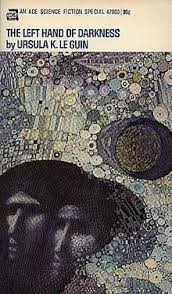
The Left Hand of Darkness by Ursula LeGuin

I don’t know why I’ve never got around to this book or anything by LeGuin except maybe a short story in an anthology.   I enjoy science fiction,  but have a real problem with fantasy. Still,  it haunted me that I hadn’t read it because it was so lauded for so long.   So I did.

lefthand.jpeg
*******
The Left Hand of Darkness
by Ursula LeGuin
1969/ 304 pages
read by George Guidal  9h 39m
rating:   5 / literary sci-fi fantasy
*******

Ekumen is a  coalition of humanoid worlds and a male native,  Genly Ai, the novel’s protagonist, is sent to invite Gethen,  a group of nearby planets, to join the coalition which  is mainly about free trade. This mission gives LeGuin the opportunity to explore a variety of social, sexual and political arrangements on the planet of Gethen as well as their religious beliefs.  Like no war and no sexual genders –

During his journeys he has a couple of adventures  and most of the book is description of LeGuin’s fictional world.

Dualism vs oneness  is a huge theme  –  “Light is the left hand of darkness and the two are one”  is a part of Taoism which also doesn’t have Gods as Western religions know them.  One group of Gethen have a structured as an us vs them religion (darkness vs light = Christianity) while the another group is more unified – both light and dark are needed for enlightenment.   Feminism is another theme but also a dualism between men vs women or gender vs non-gendered.

Although I enjoyed parts of it,  overall I wasn’t happy with the book.  Maybe if I’d come across it back in the 1970s or something when the ideas were new,  but it  seems pretty bland by today’s standards. The narrator might have had something to do with the blandness.

https://en.wikipedia.org/wiki/The_Left_Hand_of_Darkness

http://www.theverge.com/2012/8/11/3233320/the-classics-the-left-hand-of-darkness

Posted in 2023 Fiction | 1 Comment

Still Life by Louise Penny

Settling in on a mixed-weather Sunday to a cozy-ish mystery without a lot of graphic blood and gore and certainly no chases.   I say cozy-ish because the lead detective is not an amateur and the books take place in a small town.   Still – there is a bit of procedural in them.   This is not my first Louise Panny novel,  it’s just the first in the series as I might just decide to do all the books in order.  I read The Brutal Telling several years ago and wasn’t thrilled – I had a hard time with Ralph Cosham’s French accent and the whole thing seemed overly complex for such a simple story.

stilllife.jpeg
*******
Still Life 
by Louise Penny 
2005 / 352 pages 
read by Ralph Cosham 9h 37m 
1st in the Chief Inspector Gamache Series
rating:   B  / cozy mystery 
*******

Oddly enough I have rread this before –  I noted it on Goodreads as September 2013 and gave it 4 stars.   But why could I not find it in my audio books? –

This time I was more interested and it’s a good story with interesting characters – Cosham’s accent was not an issue although his voice is grating on my ears.   Still – I may listen to another one (although I may not) and the series is never going to be a favorite.  (I like some cozies – just not this one particularly – I the main issue is Cosham’s voice – and maybe I’ll get used to it –  that happens.
Setting – a small community called Three Pines,  situated a few miles south of Montreal and a few miles north of the US.   The neighbors are of various kinds appealing to the readers –  artists,  bistro and B&B owners,  gays, a black woman,  several older ladies and a few couples.

A map of Three Pines:
http://www.easterntownships.org/touristRoute/12/three-pines-inspirations-map-louise-penny

It’s nicely enough written and never escapes the crime genre – perhaps Penny knew her limits or her readership.    That said,  the book is full of literary quotes, but they did nothing to impress me – seemed a bit phony while trying to add interest.  The focus was on the crime and the personalities necessary to convolute and then solve it.

http://meanderingbaba.blogspot.com/2012/11/still-life-louise-penny.html

Posted in 2023 Fiction | Leave a comment

The Dry by Jane Harper

It’s been awhile since I read an Australian novel,  crime or not,  but this came to my attention via the 4-Mystery Addicts reading group and I followed through,  glad to say.  I think it’s probably written for Australian readers because there isn’t much information about the setting – a fictional small  town named  Kiewarra,  just a very dry place a few hours away from Melbourne.   Totally appropriate to a crime novel.

dryharp.jpeg

*******
The Dry
by Jane Harper  (Australia) 
2016 /  336 pages
read by Stephen Shanahan  9h 46m
rating –  A-  /  crime  
*******

Four members of a  family of five are shot and killed on their old drought-stricken farm.  The lone survivor is a 3-month old baby girl.

Aaron Fawk, a financial detective in Melbourne,  attends the funeral of the family including Luke Hadler,  his childhood best friend and the deceased owner of the farm.  In doing so he relives the times he went through as they were suspected of the killing of a local girl when they were in high school.  Emotions run high now,  with Luke’s death,  reviving the old animosities after all these years.  The parents of Luke ask Fawk to look into the killings.

The local detective, ambitious and newly hired to replace an old beloved man,  is on the scene.  is sharp and completely professional although a very nice guy, too.   Both parties have found good “partner” for their investigations.

The book is nicely written,  the characters are complex enough for a possible series (not that I expect one) and the setting is generally a part of the plot what with the drought – but I suppose it could happen anywhere which adds to the interest.

The plot is moderately straightforward but and unpredictable who-done-it at the same time.  Who killed the Hadler family?  And where was Luke the day Ellie died?   The general impulse of the community is to blame Luke who is obviously a killer based on Ellie’s death,  but the girl’s father and uncle are pretty clear suspects and there are other suspects.

One difficult aspect,  but rather literary in a way,  is the time frame jumps from the current day and its investigation,  to the past when the neighbor girl died as well as to other times related to the current day family murder.    These back-story  jumps come suddenly,  being triggered by a conversation or a memory.   For instance,  Aaron has always had his doubts about Luke’s innocence, but nothing was ever proven –  so Aaron remembers bits of that day.

Overall a good listen and Shanahan’s narration adds a nice Australian touch.

Posted in 2023 Fiction | Leave a comment