This is an older Slough House novella, published in 2018 and numbered 2.5 in the order. That’s out of book #s 1-8 so far.
The List By Mick Herron 2019 / novella Read by Gerard Doyle 1h 53m Rating: A / spy novella #2.5 in Slough House series
John Bachelor, a semi-retired MI5 employee, has been assigned to look into the life of the newly deceased Dieter Hess, an agent for whom Bachelor was the handler. He’s been told that Dieter had a secret bank account. Bachelor should have known.
There really is quite a lot squeezed into this novella which explores a bit of the life of John Bachelor. He’s an interesting Slough House series character (and they are all “characters,” but he’s not one of the actual Slow Horse regulars as a member agent assigned there. He just shows up occasionally.
Bachelor’s little story provides a bit of information about Jackson Lamb and a few others who work with or out of Slough House around which the rest of the series revolves.
It’s a good story catching the ambiance and flavor of their world of 21st century British espionage. Herron is a wonderful stylist and his characters are rich and complete.
Since I went on my binge read of this series back in March of last year, (see https://mybecky.blog/2021/03/ for my reviews) I really feel I ought to keep up. So I’ve been looking forward to this novel for about 6 months. Same author, same reader and generally same the setting and characters. Yay!!!
Bad Actors by Mick Heron 2022 / 345 pages read by Gerard Doyle 10h 51m Rating A+/9 – literary crime #8 of Slough House series (both read and listened)
But I sure did get reminded that you have to PAY ATTENTION to get involved because Jackson Lamb, Diana Taverner, Claude Whelan, plus Shirley Dander and Roddy Ho along with Louisa Guy and Lech Wicinski and Catherine Standish are all in here along with a new arrival to Slow Horses, Ashley Khan. But don’t let’s forget John Bachelor, the “milkman.”
This book is so funny and consuming and well written it took me 3 days to finish it and I didn’t want it to end. But please, please, please read them in order to get the complexity of the characters.
This was recommended by a friend whose taste in books is different in many ways, but similar in others. This time it clicked. (The friend lives in New Zealand.)
The Dreamseller Collection: The Calling and The Revolution by Augusto Cury 2008 translated by Clifford E. Landers 2021 Read by Christian Barillas 15h 48m Rating: 8.5 / metaphysical–psychology–visionary
This volume (or audio book) contains the first book, “The Calling” and its sequel, “The Revolution,” but the author says it doesn’t matter in which order you read them.
I much prefer book 1, “The Calling,” or as it is better known, “The Dreamseller.” In this book a strange and disheveled man, appears on a tall building’s ledge next to Julio Cesar a man who is about to jump to his death. The disheveled man sits down and talks this very unhappy man into coming down on his own. This strange man calls himself “The Dreamseller and he’s on a mission to change people’s ideas so they will love life and act like it.
The Dreamseller’s teachings and wanderings draw troubled people who are transformed by his teachings. He never forces them, he only talks to them and loves them and accepts them – including a couple alcoholics, an overeater, an egoist, some greedy and vain people as well as the broken-hearted, the judgmental, etc. At first the all-male group comes to live under bridges as they make their ragtag way across the land talking to people, getting in scrapes, and gathering more followers. Some of the followers, a bit later, are women.
The author, Augusto Cury, is a Brazilian psychiatrist and psychotherapist who has written many books in Portuguese and this one has been translated and sold in 60 countries as well as being made into a movie (2017). https://en.wikipedia.org/wiki/Augusto_Cury
As I mentioned, this book contains two novels. The first book, “The Calling,” ends about half-way through and then Volume 2, “The Revolution,” begins.
“The Calling” is excellent – it’s fun and kind of spiritual, it refers to Jesus without being a “Christian” book. The literary quality is good enough, but that’s not the only reason to read a book. This has a good message and plot, the characters are interesting and it’s a fun read.
Although Book 2, “The Revolution” gets a bit repetitive, the author says in the introduction that they don’t have to be read in order. The 1st person throughout is Julio Cesar who was saved from suicide and became a follower or a member of the “family.” He was addicted to intellectual pursuits and his ego. There are two drunks who also follow the Dreamseller, Barnabus is addicted to booze and self-promoting political speeches while Bartholemew is the other drunk and he just makes messes and is very funny. They are opposites but the same.
The Dreamseller himself has a mysterious past which is slowly revealed. He says that resistance is cyclical and that the real goal is to become a fully realized human being, aware of one’s defects as well as assets. The Dreamseller radiates acceptance and generosity advocating patience and calm. He becomes hugely famous and garners enemies as well as disciples.
One of the things I didn’t like in the second book was the screaming of the narrator – I think it was just unnecessary although it’s called “scream therapy.”
Marcia Chatelain is a professor of sociology at Georgetown University where she specializes in Black history. This book won a Pulitzer in History in 2020 and is well worth the read – it is indeed very, very good.
“This is the missing piece of the story of how race, civil rights, and hamburgers converged and changed everything. This is the story of how McDonald’s became black.” p 23
Franchise: The Golden Arches in Black America By Marcia Chatelain 2020 / 322 pages Read by Machelle Williams 10h 37m Rating: 9.25 / Business & Black America
McDonald’s is a big subject, it’s been around since 1940, that’s almost 100 years, and includes everything from nutrition to business practices and the environment, but the subject of McDonald’s also includes the social sciences, history, economics, politics and racist policies. When I was in college in the early 1970s, our professor told my sociology class that “Driving into McDonald’s is like driving into America.” And I understood what she meant. But that was back in 1970 or so.
Chatelain goes through a brief history of McDonald’s starting with the drive-in located in San Bernardino but skims to focus on the last 50+ years, since the first black franchise opened. So for the bulk of the book she shows that all those aspects are deeply intertwined, for better as well as for worse. which was attracting ethnically diverse neighborhoods after WWII and covering the material up through the aftermath of Fergusson’s troubles.
But although it covers all those things – it’s really about what the title says it’s about: “Franchise: The Golden Arches in Black America.”
It’s about blacks buying McDonald’s franchises and trying to make it into mainstream America bringing a piece of the inner city with them. It’s about food and nutrition, it’s about jobs for high school boys, it’s about bad and changing neighborhoods. It’s about racism and politics and clean air. In other words, it’s about money, “black capitalism.” That used to be a really progressive slogan but now? Not so much.
Since the 1950s, and Ray Kroc in 1961, McDonald’s has been organized around the concept and practice of the franchise. Kroc moved the headquarters to Chicago shortly after he purchased the business. After Martin Luther King’s death and the following riots in 1968 white franchees seemed to want out. so McDonald’s decided to recruit black franchisees for predominantly black communities. And they all learned and they all grew, thanks to this “experiment.”
And that’s the main point of the book, “Franchise.” These businesses were seen as a way for blacks to enter the economic mainstream of America. And although there are some digressions, because McDonald’s franchises are involved in a lot of things, the main thrust of the work is the idea of chain fast food restaurants in poverty stricken black areas.
Meanwhile advertising and marketing caught on to the idea that there was a growing market of upwardly mobile black consumers.
“Black people are not dark-skinned white people,”- Tom Burrell (1st black advertising executive in the US – Burrell Communications)
And the project grew but there were a few unhappy black franchisees and then there were a few bad apples in the bunch and then Jesse Jackson, there were lawsuits.
I’d been waiting for this book for about a week and got it a few days ago, the day it was released. 🙂 It certainly has been getting some play on MSNBC. Sad to say, I’m about half disappointed with it. I;m actually disappointed with the first half of it which is a rehash of what I knew plus a few added tidbits. I guess I fell for the hype. It sticks pretty much to mainstream politics of the subtitle – no Proud Boys info and so on.
This Will Not Pass: Trump, Biden, and the Battle for America’s Future By Jonathan Marin and Alexander Burns 2022 / (472 pages) Read by Dennis Boutsikaris 15h 12m Rating: 7 / politics
But the second half is concerned with material I didn’t really follow as it was happening. From Biden setting up his Cabinet, etc, McConnell working his way back to Republican control of the Senate (consider Manchin), and Biden’s difficulties with his agenda it was a rough year. Congress was not a friendly place for folks whose candidate had beaten Trump, Liz Cheney was a pariah to some while Manchin and Sinema seemed not to be Democrats.
And Kamala Harris comes in for some criticism, too. It’s uncomfortable for me to listen to this, but then, I’ve criticized her from time to time, too. It just seems like Harris got panned if she did anything and panned if she didn’t – and she mostly didn’t do much except have troubles with her own office management.
Would Biden’s agenda determine the future or would it get derailed in the Infrastructure Bill and Reconciliation attempts. Manchin and Sinema refused to budge but also refused to switch parties. The Investigation of January 6 insurrection goes on in that committee. And so we approach the 2022 elections with Biden faltering, McCarthy more inept, McConnell aging, and the culture wars going continuing with new blood in Congress and, unbeknownst to the authors, the Supreme Court leaking their ideas. And after that will come the 2024 elections – sigh.
This is the debut novel by a young black classical musician, a violinist actually, and it’s partlyinspired by some of his own life experiences. The major theme is racism but it’s a good novel – compelling and well written.
The Violin Conspiracy By Brendan Slocumb 2022 / Read by author Rating: 8 / 21st century fiction
Rayquan McMillian of Charlotte SC is getting ready for a competition in Moscow when his violin, a Stradivarius given to him by his grandmother, is stolen from his hotel room. An investigation follows, but the narrative goes to the backstory for how Brendan got to this place.
Rayquan is Black and poor and has had a difficult childhood which doesn’t get any easier when he starts playing a school-owned violin. Although he is terrifically talented, his single mother with 3 younger children is far more supportive of him getting a job at a fast food place, than she is of his playing classical violin. And racism is everywhere.
But he has a few supporters like Professor Stevens from Markham University who spots him at an early competition and helps develop his talents guiding him in the right directions. It’s with Stevens that Ray discovers the violin his grandmother gave him is a Stradivarius. That’s when he finds out that a whole lot of the world is as money-grubbing as they are racist.
I really enjoyed the book. It’s probably “young adult” or something because Rayquan is a young adult growing into manhood and he is such a good and “likable” character. This is also a coming-of-age story.
The other major characters each have distinct personalities and I cared about most of them. It was such a fun read, but not without some very painful parts because explicit racism is directly involved and that made me cringe although sad to say, that’s the part that’s most real, based on true events. There were a few scenes which were very tense – scary.
This book is primarily Dr Deborah Birx defending herself and her actions hile she was the Covid response coordinator for the Trump administration. Vanity Fair called it her Rehabilitation book.
Silent Invasion: The Untold Story of the Trump Administration, Covid-19, and Preventing the Next Pandemic Before It’s Too Late.
By Dr. Deborah Birx 2022 – (521 pages Kindle) Read by Kathe Mazur 22h 3m Rating: 7 / politics – memoirs
Birx is a dedicated doctor and military woman, her mission was to coordinate the efforts of the US government in spite of Trump and his administration being almost unwilling to admit there was any problem at all.
But about half way through I got rather annoyed. The book is, as The NY Times says, “earnest and exhaustive.” But that gets tiring. I’m a fan of Birx but I felt she was mainly defending herself (“Rehabilitating” herself?) by going over and over how she was right. The first part is fine. She details the troubles she had with the Trump administration and all that is definitely a kind of horror show of its own. But then she harps and harps on testing as thought that alone was the answer to Covid. And she talks about Covid without symptoms so that means everyone gets tested – regularly. But there’s a downside to routine and regular testing she never quite acknowledges.
For months and months it took the tests a week or 10 days to come back with results. And during that time the tested person was to be isolated, symptoms or no (see the title – “Silent Invasion”). That is they had to stay home from work, often without pay. And that’s also without a positive result which would mean another week or 10 days of isolation/quarantine. And then if your child tests positive you’ll have to stay home from work with him. No wonder folks didn’t really want to do it.
Birx has been criticized for not simply “telling truth to power.” But she makes it clear that “power” (Trump) wasn’t going to listen and neither were most of his minions although she did have the support of a few people in the administration.
But she was talking to others, the governors and business and those with whom she was coordinating. She felt like she was doing good work out there in the field getting the correct information to the governors and others to pass along to the people.
Most of this book is simply Dr Birx’s view of the events which occurred in her Covid domain from 1/2020 until 1/20/21. The country did have a health plan, but it was hopelessly out of date no matter which president was in office and part of her job was to bring it up to date in regards to Covid-19. No one was prepared in almost any way including “personal protection equipment” (PPE).
The Covid-related data was inadequate for a long time and those people she worked with didn’t understand it for even longer. Birx was used to working on an international level with programs for AIDS and their data was far more complete than US data for Covid. (What was she expecting when she arrived in the DC only a month prior to the virus getting to the US?) The CDC was operating in a self-created bubble – Johns Hopkins was doing better. And Birx almost had to start from scratch. And she went all the way to vaccination problems. (See the Epilogue where she also covers more improvements which see sees could be made.)
She seems rather authoritarian and has been criticized for being autocratic. That’s kind of the way she comes off in the book. Mostly she has nothing but criticism for the US efforts but she does commend a few people, Jared Kushner, Pence, the National Guard, and some others. And she’s actually glowing about Operation Warp Speed which was the development and distribution of the vaccines. They were getting a stockpile ready for whomever won the 2020 election. There was good partnership at that point.
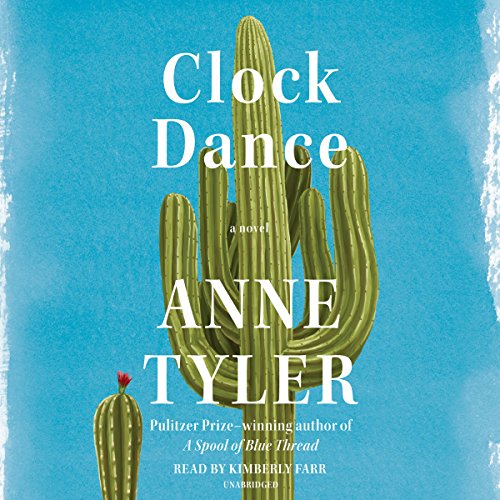
I usually really enjoy Anne Tyler and I’ve read quite a number, but not so much this time so it’s a good thing I got this from the library. It starts out with Willa as a young girl in her very middle class, Baltimore, Maryland home. The family is more dysfunctional that it would seem, but we only get to know that very slowly.
Clock Dance By Anne Tyler 2018 / Read by Kimberly Farr 9h 12m Rating 8 /Contemp. Lit
Because ver shortly we are presented with the fact that all is not what it seems – In the next chapter when Willa flying home from college with her boyfriend for a visit, she is convinced that a gun was pointed into her ribcage and she was told not to make a sound or she would be killed. That’s pretty unlikely and we come to see her as a possibly unreliable in general. Her boyfriend likes her though and later marries her.
It’s the story of a disingenuous and passive aggressive woman who seems ever so nice on the outside but struggles with her own desires. Willa can barely even mention that she has desires. Above all she wants to appear calm and reliable, responsive to the other people in her life. Rather than asking her husband to pick her up at the airport she’s disappointed that he doesn’t offer.
She and her husband move and have two boys which are mostly raised when Willa’s husband is suddenly killed in a car accident – he gets. bit too aggressive while driving and angry – road rage. Wilma knows this is in part her fault but I didn’t think that was obvious –
She marries again and her new husband, Peter, is ever so nice but he’s not perfect. One day Wilma gets a call from a woman in Arizona who says that Wilma’s granddaughter needs someone to take care of her because her mother has been shot in the leg and is in the hospital. Wilma has no grandchildren but she can’t bring herself to say no. So against her husband’s better judgement, they fly to Arizona and take up caring for the precocious Cheryl, age 6, and her mother, Darlene. It seems that Darlene was the girlfriend of one of her sons but it’s not his child and it gets complicated.
Willa feels loved and needed there, but Peter certainly doesn’t. Peter goes home and Willa stays on awhile. It gets tangled.
One thing about Anne Tyler’s books is that they are character driven. The plots are not intense and these are not page-turners. Her writing style seems very clear and to the point but leaves plenty of room for interpretation.
The History of Ancient Egypt by Bob Brier 2013 / Read by author 24h 25m Rating: 9 / history of ancient Egypt (Great Books Series)
I was expecting a series of rather boringly told lectures about an interesting subject, but I was wrong there. Brier is an excellent lecturer and he’s got some fascinating material to work with. He does go a bit fast.
The book goes from a chapter on pre-historical background through the early decades of nationhood and the first centuries of dynasty. Then comes the new kingdom and the times of foreign rule and finally the declining dynasties right down to the 29th Dynasty, the Ptolemies and Cleopatra. Tombs and pyramids are built, wars are fought and alliances are made, cuneiform is developed, religions are preached and medicine is used.
But it’s a tale of 3000 years so there’s bound to be a lot crammed in there. It’s dense and I could stand to reread it but …
The book is very long, though and the pdf file which comes with it is 162 pages long! So it occasionally gets repetitive.
This is a very fast-moving novel with lots of suspense and moderately graphic violence. It is super-good. I’d say it’s somewhere between Mario Puzo and James Lee Burke. The epigraphs of from Homer’s Iliad could have warned me but I didn’t catch on to those ideas until Part 2.
City On Fire By Don Winslow 2022 Read by Ari Fliakos 8h 54m Rating: A++ / crime thriller
From the Washington Post: “Don Winslow’s terrific new novel “City on Fire” does for Rhode Island what David Chase’s “The Sopranos” did for New Jersey. The Ocean State Chamber of Commerce won’t necessarily see it as a favor.” –
But old as I am I compared it more to Mario Puzo (The Godfather).
Instead of chasing the big drug lords of Mexican cartels Winslow’s main character (Danny Ryan) is involved with there long time Irish gang as well as the Italians and Blacks and the Mafia is always in the background.Times are tough in the 1980s and the fishermen and truckers need to supplement their income some way and there’s a gang which sticks to the usual rackets. But the sales of drugs has got in and the old ways are going out, as in the old “bosses” are dying and retiring and with them the old ways go – including the truce they devised many years ago. These old “bosses” include Danny’s father, Martin Ryan, and his rival Pasco Ferris. And it’s lucrative.
The action moves from romantic rivalries at a party to murder and mayhem and sinister retaliation with fathers raising sons having babies and unto the next generation. And it all curls around to the FBI not being any more upstanding than your run-of-the-street gangster.
There is a huge homage to Homer and other classics here. I’m now waiting on the second book in this trilogy.
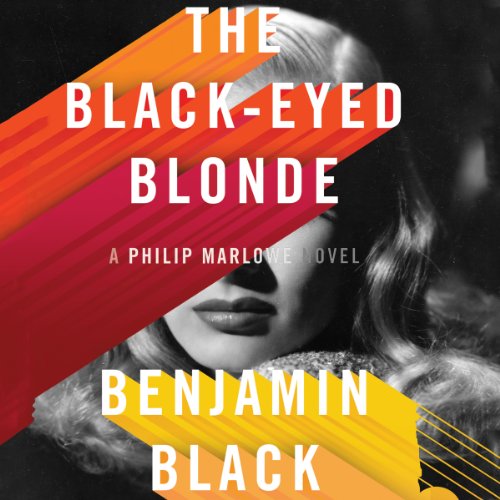
It’s been a long time since I read a Raymond Chandler/Philip Marlow novel – probably 15 years. And it’s been a long time since I read a John Banville aka anything – I’ve read books by him and I loved the Banville books, but I wasn’t too keen on Black’s crime novels. Still, he’s been around a long time now so they’re apparently selling and getting good reviews etc. So I had The Black-Eyed Blonde on my Wish List for some times but took it off. Then I found it available at the library. When this turned up as being available at the library I figured it was time to try him again.
The Black-Eyed Blonde by Benjamin Black 2020 / Read by Dennis Boutsikaris 7h 53m Rating: B+ / crime – PI
I dearly love Raymond Chandler’s Philip Marlowe and Banville/Black does a very credible re-creation – but it’s always a re-creation, it never really belongs to him. These detective novels are ever so much different from his very literary Booker Prize-winning works as Banville. I’ve read one other of the Black books and it was okay but the literary aspect seemed to slow down both the tension and the action. That wasn’t so much a problem this time.
Here the plot and characters follow Chandler’s lead with Marlowe. A rich and beautiful, black-eyed blonde walks into Marlowe’s office. Her boyfriend is missing and she needs the private investigator to find him. Marlowe is always the chivalrous “lady’s man” and obliges although she gives him almost nothing to go on. She pays pretty well, though.
The down side of this job is that her friend was accidentally killed two months prior and was cremated. Now he rests at the bottom of the lake. Or does he? Someone saw him in town, just walking along down the street. There seem to be two problems now; where’s Nico and who’s dead? There are other threads too, of course, like why does the blonde want to find Nico when she’s married to someone else? And what’s her brother got to do with it?
This book definitely belongs in the genre of American history, but it’s written in a somewhat different way because sometimes the specific subject determines the method to be used.
All That She Carried: The Journey of Ashley’s Sack, a Black FamilyKeepsake By Tiya Miles 2021 / 387 pages Rating: 10 / Black biography (both read and listened)
All That She Carried is the story of three Black women who were mainly illiterate and mostly slaves. For the most part they lived in Charleston, South Carolina until they moved (or were moved) away. The eldest was Rose who gave her 9-year old daughter, Ashley, a plain sack when she was moved to another plantation. In the sack were a tattered dress, some pecans, a braid of hair and love. Ashley was Ruth’s grandmother and Ruth embroidered that history on the bag. This is women’s history, documented, and from the heart.
Writing the biographies or histories of people who were not famous (so other people would write them) or even literate (to write their own letters and diaries and memoirs) has always been very, very problematical. Tiya Miles shows it can not only be done, but done to the highest standards.
All That She Carried is about a lot of things, but it focuses on a cloth sack given, in the mid-19th century, to a young slave girl by her mother as a going-away present. The child had been sold to a plantation far away.
A generation later the slave girl’s granddaughter embroidered the names of the prior owners on the sack. Then the sack was lost for awhile but a white woman spotted and bought it at a swap meet. She then did a bit of research and got it to where it could be researched and kept properly (not via eBay). The sack turned out to be a valuable artifact with documentation embroidered right on it. From where else do we get our history?
Tiya Miles, the author of All That She Carried, has a PhD in history and she now teaches at Harvard. She’s written and published five other books. I’ll take that to mean she’s a qualified historian. She knows how to do the research and how to present it – how to document it. It shows all over the place in this book, from the Introduction and the Notes to the Essay on Process and a Note on Terms. It’s all here.
Yes, Miles does wax poetic and metaphorical, but when she stretches to capture the feelings she makes sure she’s not neglecting the verifiable details. She sometimes goes a bit over my own line of objective reporting and analysis, as is sometimes necessary. But sometimes there’s a limit in that direction, too.
Although I had my qualms at first and sometimes throughout the book, I ended up I enthralled and I might have to read it again.
From page 17 (Introduction): “Because archives do not faithfully reveal or honor the enslaved, tending this intimacy with the dead necessitates new methods, including a trans-temporal consciousness and use of restrained imagination.” And from page 20 (Introduction): “You can sense by now that this is not a traditional history. It leans toward evocation rather than argumentation and is rather more meditation than monograph.”
The history is amplified by a closer look at some of the details like the reasons the pecans might have been in that sack and we even get recipes for South Carolina pecan pie. And there’s the background on quilts, slave economics, rice growing, sack making and so on.
But it’s a woman’s history – how else to do it with women who are not the wives of presidents and/or very literate? (I am not faulting anyone – history of the common people, social history, wasn’t even thought about until the 20th century with the Annales and Melbourne schools.
Some of my annoyance may have come from the narrator’s voice which is too soft and whispery. It makes the whole book seem to be an argument appealing to the emotions alone. Miles says it herself “read in a certain mood, Ruth’s verse on the bag can feel more like poetry than reportage.” –
She argues that this kind of writing off-sets the virulent hatred and anonymity of the Deep South. Ya think? I don’t know. She’s trying really hard to make a motif of “love” fit in. But that’s a detail and the whole is way outshines that detail. Bottom line is that I loved it- lol.
It took me a few minutes but I actually did feel like I was ready for another Paetro book. First I tried 21st Birthday but I’d read it already. So I got The 8th Confession .
The 8th Confession By James Patterson/Maxine Paetro 2009 / (369 pp) Read by January LeVoy 8h 50m Rating: B+ / crime – procedural (#8 in the Women’s Murder Club Series)
A bus explodes and about the same time a pedestrian nick-named Bag-man Jesus is found dead. An apparently very upscale couple is bludgeoned in their bed – the woman lives and we read about the end of a trial. Then the body of a rich single woman is found. There are five victims following the pattern and there’s an almost matching historical event, too. The plot here is good but …
First, I actively dislike this much sex and romance in books. Second, the music playing in the background is annoying.
BUT! There is a good plot in there which is standard Patterson – a serial killer, some drugs, a few bodies, chase scenes, etc. A couple of the characters are weird but well done – they fit right into the San Francisco I knew years ago. Other characters are nondescript and almost interchangeable. The four women of the Mystery Club are still developing their individuality. The tension is masterfully built, but … well, this is James Patterson. I wasn’t all that impressed with the reader.
Oh it’s good to be back into nonfiction again. Usually I read about 1/3 nonfiction, and 2/3 crime and other fiction. But sometimes I slip into more crime books while other times there are more nonfiction. Genre fiction often gets short-changed but I like to think the quality is quite high – lol.
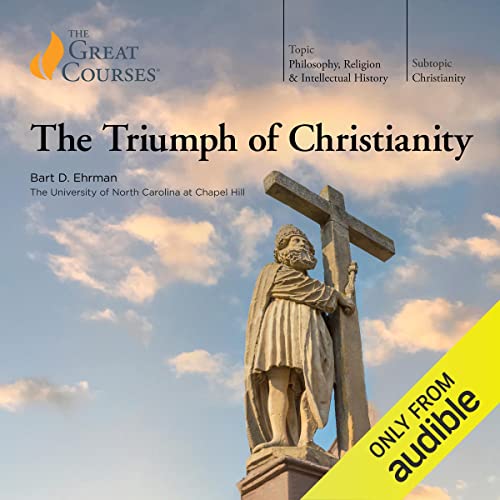
The Triumph of Christianity:How a Forbidden Religion Swept the World by Bart Ehrman – 2018 Read by author 11h 20m Rating: 9.5 / history of Christianity *Great Courses audio: pdf 2021
And I’ve read a number of Ehrman’s books but never one from Great Courses although I’ve read other books from Great Courses – (I mean listened to – sometimes read and listened, both.) Mostly these books have been about Jesus and the Gospels and how they differ from what fundamentalist Christianity seems to teach but it’s hard to make generalizations about what Christians believe. They’re history books, not religious books.
The 169-page pdf file which accompanies this Audible book is amazing and it includes fairly complete course notes. The audio is not a verbatim run-through of the notes, Ehrman sometimes inserts some comments. The pdf also has discussion questions and graphics, beautiful pictures, extra reading suggestions, and a good bibliography with recent entries – probably more,
Ehrman grew up in a nominally Christian home but moved toward fundamentalism in high school and then went to Christian colleges after which he dropped the fundamentalism and proceeded with a career in teaching and writing about Christianity as history as an atheist/agnostic.
Ehrman has been writing for a long time and his most recent book
The Triumph of Christianity starts out with Jesus, but gets right on with Paul and his contributions to Christianity as we know it today. The narrative addresses Jesus’ followers who were around after the resurrection and then to Paul, who had a vision rather than meeting Jesus, and the rest of the New Testament which is about 50% Paulism, either written by or about Paul.
The book includes quite a lot about the Romans of the times from Augustus to the death of Constantine and much of this was new to me. It deals with Christianity from the time of Nero to the Roman Empire’s taking up Christianity seriously, with the Council of Nicaea although only 5% of the population was Jewish and the majority pagan.
The book is mostly chronological but covering some aspects as topics, “The Christian Mission to the Jews,” “Early Opposition to the Christian Message,” “Reasons for Christianity’s Success.” And on to the end, “The Triumph of Christianity: Gains and Losses.”
I’m not sure I enjoy listening to Ehrman yelling and lecturing as much as I enjoy the more laid back but straightforward readings of his books. Let’s say it took some time to get used to. The pdf (included with the Audio/Great Courses version) makes it quite appealing though.
Because this book gets away from Jesus and the Gospels it has some different information from Ehrman’s priors, although that might be in books I haven’t read . Christianity was different from other religions of that era in that it set about evangelizing but they thought “the end” was imminent so spreading the word was paramount. This was a central teaching and it worked.
The love commandment was from the Hebrew bible – Leviticus – BUT there it meant to love your fellow Jewish person. That was reinterpreted by Jesus to loving even your enemy. That was different and it worked to enhance evangelizing. `
Ehrman has high regard for the book of Acts which is about Paul but probably written by someone else. Ehrman states that it was easier to convert Pagans than Jews and explains why.
Because evangelism was so important to Christians and because Paul preached to the pagans they grew by leaps and bounds. And there’s more to it than that, much of which was totally new to me.
I should like to read this again but maybe skipping the first half.
I’m just barely getting started with this older series. I read one Patterson years ago and decided it was too gory for me. When he started his Women’s Murder Club mysteries I kind of looked sideways at them, but it was too late, I was allergic to Patterson at that point.
9th Judgement by James Patterson/Maxine Paetro 2010 / Read by Carolyn McCormick 6h 44m Rating/ A- : thriller – procedural (#9 in Women’s Mystery Club series)
I’m just barely getting started with this older series. I read one Patterson years ago and decided it was too gory for me. When he started his “Women’s Murder Club” mysteries I kind of looked sideways at them, but it was too late, I was allergic to Patterson at that point. Except for The President Is Missing which he did with Bill Clinton – I enjoyed that okay – (not great but okay) (Links to my reviews on this site.)
Years went by during which I developed a habit of reading Christmas mysteries in December. This started with 1 or 2 per season but this past year it was 6 Christmas stories. (I save them up during the year.)
So one of them turned out to be the Patterson/Paetro novel The 19th Christmas (“Women’s Murder Club” #19 – 2021! ). I liked that one so much I went back and tried the first one in the series, 1st to Die. Oops! That was too graphic again and without Paetro something it seemed something was missing.
Then the other day, finding myself between books and unable to pick one, I noticed this series at the library which doesn’t usually have what I want but occasionally surprises me. I’ll gladly get a lot of these crime books from the library. So I got #9 now but I’ve read #s 19, 20 and 21 from Audible. (The library seems to have the whole series!)
I think this is standard-issue Patterson in that the violence is over-the-top. But I like the characters and the interaction between them. Yes, there’s still too much sex for my tastes and it’s used as a tension reliever from the fem-jeop (females in jeopardy) action of the main story which I find rather perverse. But the plots are also good, complicated and nicely twisted. In 9th Judgement there were 3 tenuously related plot threads going.
I’ll likely plod along with Paetro at my own pace – when I’m between books and nothing looks particularly enticing and I know I can get it at the library – and when it’s been a few months since my last Patterson book.
Having read six (6!) nonfiction books already this month, I really wanted to kick back and read some entertainment and I did that. I usually enjoy Harlan Coben’s books (not always) and this was not one of his best but it was good.
The Match by Harlan Coben 2022 / (363 pages) Read by Steven Weber 10h 4m Rating: C- / mystery thriller – P.I. (#2 in Wilde series)
Wilde is a 40-something private investigator who was abandoned as a child and lived for years in the forests before being collected and adopted. This idea starts in book 1 of the series and is more fully explored in this second book. After that part the story is very confusing for awhile and then things clear up.
There is a private and secret group of various people connected to law enforcement who know each other only as animal names and communicate via computer. They work together to eliminate certain criminals.
A Reality TV show is upended when a scandal breaks and a star disappears under suspicious circumstances.
A trial is going on in which Hester is waiting for the verdict regarding a possible but maybe not likely case of self-defense.
Someone is following Wild and two law enforcement officers are killed. And a 1st person becomes the primary killer but the reader doesn’t know who that might be.
I was wanting some to read something which was lighter, but not a mystery. A friend had said that The Lemon Tree was very good so I went to buy it and found I would get the Audible version discounted because I already “own the Kindle.” Ya? Hmmmm…. I wonder when that happened? lol! (But I think it’s been on and off my Wish List at Audible several times – heh.)
The Lemon Tree: An Arab, a Jew and the Heart of the Middle East by Sandy Tolan 2006 / 542 pages Read by author 11h 19m Rating: 9.5 / Israeli-Palestinian conflict (Both read and listened)
The Audible site categorizes this book as “memoir/religious” – I don’t quite agree. Memoir is not even okay because it’s more of a biography of two people linked by a house, a tree and a long, ugly war. Sandy Tolan, the author, is a highly regarded investigative reporter and professor of journalism at UC Berkeley. Paging through the Kindle version I see the book is very well documented but it’s certainly not a memoir.
BUT!!! This book is not what I expected or thought I was looking for! There’s a lot of military history and I didn’t realize that until I got into the book. At this point in my reading career I don’t have a problem with military history. Just because it takes place in Israel doesn’t make it a religious book!
I’ve read a couple books about the Israeli-Palestinian problems before, but that was probably a decade ago. I don’t remember the names of the others but they were nonfiction and included the Lydde and Ramia horror/tragedy in 1948.
I started out pretty well but before long I was a bit confused. And by the time I got to Chapter 3 I realized that the book is more challenging than I’d expected due to the military and political detail. So I went back and started in again at Chapter 2, “House,” where I felt like I was on more solid ground. Now comes several years of very complex political, military, and personal histories. And then (!) in Chapter 9 we get to the two people who became which was introduced in the first chapter.
This time the tale made much more sense and although yes, Chapter 4 (“Expulsion”) is pretty gritty as well as confusing, I was hooked. (And I didn’t used to like war stories at all, there are places scattered throughout the book which are definitely war stories.
It takes awhile to get back to the stories of the Bulgarian-Jewish family, Moshe and Solia Eshkenazi with their their baby daughter Dalia, on their way, fortunately, to Israel. World War II was over and the Jews were free, more or less. With Theodore Hertzl and David Ben-Gurion leading them on, thousands and thousands of Jews immigrated to Israel while others stayed in the homeland to see if they couldn’t remake it. The trip was arduous, the arrival in Zion horrendous.
Meanwhile the large family of Ahmad and Zakia was getting used to life in a single room in a new city where they were despised for having given up their homes. They were forced to live by their wits. And so the babies, Dalia and Bashir, were driven out of their homelands to new homes in strange lands, where others had just been removed. Dalia’s family got Bashir’s old house with its lemon tree. One day Bashir goes to visit his old house and that’s how he and Dalia meet. They connect on a personal level and they meet again and write letters.
The narrative is chronological, but goes back and forth between Israeli and Arab operations. Family information is inserted as applicable at first but more and more as the story goes on. Dalia gets into peace-promoting activities while Bashir becomes a terrorist and the leaders can’t stop the war.









 Becky's Books -