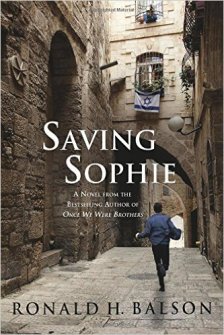
Saving Sophie by Ronald H. Balson

This story, the second in the Catherine and Liam series by Ronald Bolson,  opens with a guy making a very slick exit from the US via the Chicago airport.  The next thing we know some lawyers of an upscale investment company are searching for a lost bank transaction – lots of money – $88 million dollars worth of lost money.  And then our man from Chapter 1 turns up in Hawaii.

Jack Sommers has had a pretty rough few years – first his beloved wife,  Elena, the daughter of Palestinians from Hebron, died suddenly and then his in-laws sued for custody of Sophie, their 6-year old child.  Jack won the case but the grandparents stole the child.
sophie
*************
Saving Sophie
by Ronald H. Balson
2015/ 448 pages
read by Fred Berman 13h 42m
rating – A+ /  international crime (with history)
(#2 in the Catherine and Liam series) 

*************

Now Sophie is in Hebron going to school wearing a hijab and missing her father.  She lives with her grandfather, Dr. Arif al-Zahani, who teaches Sophie about the Palestinian issues and is apparently involved with a group with some terrorist plans.  Meanwhile,  Sommers has a plan in mind which will get Sophie back.

The narrative flows between the scenarios – Sommers with a friend in Hawaii,  Sophie with grandparents in Hebron,  and the bankers with their investigation when along come Catherine Lockhart and her boyfriend Liam Taggart,  the detectives of the series.  And LIam gets the State Department involved via a woman named Kayla Cummings.

The backstory is lengthy with deep sympathy for Sommers and Sophie.  The bankers have their own agenda,  and then we find some Russians are involved (sigh but lol).

I think Balson is trying to educate his readers as well as entertain them because he includes a lot of historical information on the Jewish/Palestinian struggle – back to the times of Moses and the Cananites and a bit on the time from the influx of Russian Jews, to the  fall of the Ottoman Empire and WWI and yes of course,  even 9/11 (a mere mention).

I’ve read some Israeli history from the points of view of several Israeli authors and Balson has done a really admirable job of compressing it (albeit definitely slanted toward Israel).   Some of the plot threads are more human than they are political –  father daugher relationships,  romantic ties in times of terror,  etc.   But the historical and political aspects never take over, although it’s a close call sometimes.

There are plenty of twists and turns and more and more as the plot moves along – the tension builds very nicely.  The ending is the stuff of true page-turners.

*************  SPOILERS!

If we understand Dr. Arif al-Zahanito be a serious nut-case,  a hurting and fundamentally radicalized element in a group of serious radicals,  then the presentation is okay.   We have nut cases in the fringes of politics in the US,  too.   But If he and his group of insiders are taken to be representative of Palestinians in Hebron (etc.) then it’s obiously not okay.   (I think Balson indicates several times that the doctor is allied with terrorists and not representative of anything.)

Balson writes nicely – this is an international thriller with some relationship sensitivies – not much real violence except towards the end there’s a bit more.

Highest compliment – I really want to read Balson’s first one – Once We Were Brothers – about a camp survivor and repercussions  from the Holocaust.

http://www.washingtonindependentreviewofbooks.com/bookreview/saving-sophie
Leave a comment

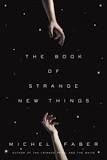
The Book of Strange New Things by Michael Faber

To me this feels like it’s solidly in the best tradition of sci-fi –  Brave New World by Aldous Huxley (1931) or Mary Doria Russell’s The Sparrow from 1996.

When Peter Leigh,  ex-addict but now happily married Christian minister of probably the finest kind,  is accepted for a job with USIC on a tiny and very distant planet called Oasis he’s not aware of all he signed up for.   He was hired to be the Christian minister to the indigenous population – the request comes from the natives themselves.  What he thinks is that he will be  bringing them the message of Christ – their first contact with the religion.  But he finds that some of the natives almost worship a book they call The Book of Strange New Things,  which is our Bible.

book of strange**********
The Book of Strange New Things 
by Michael Faber
2014 / 528 pages
read by Josh Cohen 19h 27m
rating –  8/ A++   (literary sci-fi) 
**********

Leaving his wife Bea is hard as she will miss him dreadfully.  But he looks forward to the mission with excitement,  so she has to let go.  Although they are millions of miles apart – light years – they will be able to communicate through letters delivered via a new technology calle dthe “Shoot.”

What he finds when he gets to the main USIC station is not exactly heartening.  The other crew members are somewhat jaded,  everying costs some of the money he planned on saving for a life with Bea,  and they are apparently watched carefully for many things including insanity.   So they’re very work oriented and professional for the most part and they’re kind of in charge of themselves.

The natives, who are very strangely formed and fragile,  live in their own community where they raise food for the USIC group in exchange for medicine which they don’t have.  They’re bright and as mentioned have had contact with Christianity before – from a prior minister who apparently disappeared.   The natives Peter gets to know are called Jesus Lover One, Jesus Lover Five, Jesus Lover 48, etc.  and they’re very receptive to everything Peter tells them – like they already live something like that.    Peter enjoys them,  builds a church,  tries to learn their language,  wants to live with them,  but then …

The natives:

 “Instead, it was a massive whitish-pink walnut kernel. Or no: Even more, it resembled a placenta with two fetuses — maybe 3-month-old twins, hairless and blind — nestled head to head, knee to knee. Their swollen heads constituted the Oasan’s clefted forehead, so to speak; their puny ribbed backs formed his cheeks, their spindly arms and webbed feet merged in a tangle of translucent flesh that might contain — in some form unrecognizable to him — a mouth, nose, eyes.”

Meanwhile,  21st century Earth is undergoing severe climate changes resulting in quite a lot of chaos.  Bea is trying to cope with this alone but it’s really, really rough.  And then …

Faber writes very well –  as he showed in the award-winning “The Crimson Petal and the White,” which I read  long ago.   He writes better than most science fiction authors  – the ones who stick to gizmos and ideas but don’t pay much attention to literary qualities.  That’s not a prerequisite for good science fiction, imo. I’m just mentioning it.   Specifically,  Faber develops the major  characters more fully and the dialogue is realistic.  The descriptive passages contain nice adjectives and metaphors.  Tension is carefully built and balanced between several scenarios – the USIC camp,  the Oasis native community and the Earth with Bea.

I really hope there’s a sequel.

***********  SPOILERS  ETC.  ************
Peter’s name is obviously symbolic – St. Peter is supposedly the foundation of the Christian (Catholic) church on earth.

It seems as though life on Oasis mirrors some things on Earth –  Bea gets pregnant and the heads of the Oasans look like fetuses.   As Earth falls apart in so many ways – from trash pick-up and crime to political, economic and environmental crises,  so too does the relationship of Bea and Peter.

2 Comments

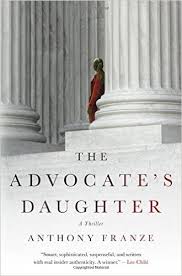
The Advocate’s Daughter by Anthony Franze

I finished this just after midnight last night so it’s the first book of April.

Sean Serratt,  a high-power attorney and a short-list contender for a newly open seat on the Supreme Court  has some bad old secrets. They’re really old,  from his high school days in Japan,  but also really bad.  Nobody,  not even his wife,  knows what he did, where, to whom, or why.  He has lived an exemplary life ever since and is now in the upper circles of power.    And then apparently,  someone knows.  But other people have secrets, too.  Everyone in Washington has  secrets,  or so it seems.

advocate
********
The Advocate’s Daughter
by Anthony Franze
2016/ 317 pages
read by Robert Patkoff – 9h 2m
rating:  A
********

Serrat’s lovely and intelligent daughter goes missing but is found pretty quickly – her apartment has been trashed and her body lies dead in the Supreme Court library.  The police almost immediately arrest Abby’s boyfriend,  an upper class black law clerk,  who loudly proclaims his innocence.   And what with a few other strange things going on – about Abby,  about Serrat’s son,  about computer messages –  Serrat begins to believe someone else was behind the killing and needs to know the truth – even in the midst of  profound family grief, intense media interest, and even some police scrutiny.

This is a really gripping , midnight-oil kind of family and legal thriller  – Franze writes well, keeping the tension up and the plot twisting with nicely drawn characters and fast-paced dialogue.  The Supreme Court setting adds intrigue and Serrat’s family issues add a great family touch.

I  wasn’t entirely thrilled with the ending but the tale had to wind up some way –

Good review by Philip Margolan at
http://www.omnivoracious.com/2016/02/advocates-daughter-amazon-book-review.html

Leave a comment

In the Courtyard of the Kabbalist by Ruchama King Feuerman

This book had been tempting me for a long time – the promise of a good story set in Jerusalem,  the Kabbalah,  etc.   So I nominated it for a reading group –  (sigh).   Much to my dismay,  it’s basically a love story – a romance.

But that said,  so is Major Pettigrew’s Last Stand and I love that book.  I guess there has to be a certain something else – a  light-heartedness,  a genuinely interesting situation,  whatever,  for me to enjoy it.   In the Courtyard of the Kabbalist has that something.

courtyard*******
In the Courtyard of the Kabbalist
by Ruchama King Feuerman
2013/ 281 pages
read by Sam Gunder  9h 36m
rating 8  / general fiction (religious)
*******

Yes,  I did have to exercise my suspension of disbelief more than once but it never snapped – probably because I really don’t know that much about the actual practice of Judaism – I’m just an interested person who is not taking this book of fiction as an authority on anything.

The Epigraph:
” If I tell you my story, you will listen for awhile and then you will fall asleep.
But, if, as I tell you my story, you begin to hear your own story, you will wake up.” – Chassidic saying. 

The old Rebbi Yahudda and his wife have been instrumental in assisting the community.  The two of them are very busy dispensing food and wisdom, praying,  etc.  Now the rabbi is sick – very sick.  His wife needs some help although she is a huge help herself.

Tamar – a young unmarried woman who has just moved to Israel from the US -wants a  scholarly  Jewish husband .  She has been seeking the advise of the rabbi who has told her to pray for days.

Isaac Markowitz – a middle-aged New York Jewish bachelor whose mother has recently died.  So he’s adrift and goes to Jerusalem to find himself – to actually succeed at something in a life of “almosts.”   He finds himself serving as the assistant to the rabbi.

Mustafa – the young Muslim janitor at the Temple Mount (Al-Aqsa Mosque) which includes the Dome of the Rock (Christian) and the Al-Aqsa Mosque.  This is the holiest place, holy to both Jews and Muslims, in Jerusalem as it is where the second Temple is supposed to have stood.  There’s a good zoom available at:   https://en.wikipedia.org/wiki/Temple_MountIsrael-2013(2)-Aerial-Jerusalem-Temple_Mount-Temple_Mount_(south_exposure)

Mustaa is an outcast to the Jews as well as his own family because of his disabiltiies.  Jews and Christians have been kind to him in the past but he really wants to please his mother. There are several other characters  interacting with the rabbi and Isaac but those are the basics.  But he went to talk to the old rebbi while he was off work for lunch,  and now goes to see and talk to Isaac – they become friends.

One day Mustafa finds an ancient pomegranate he has found in the trash at the Temple Mount and brings it to Rabbi Isaac (which is how he becomes known) – this causes some problems as it is appears to be an antiquity.  Whose pomegranate is it?  Mustafa shows it to Isaac who shows it to somene else and …  there’s a lot more than romance to this novel.  There are fables and wisdom and laughter and most of all,  love.

Leave a comment

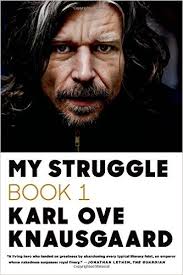
My Struggle: Book 1- by Karl Ove Knausgaard

I’d heard a lot about this book here and there,  many places,  in part because so many reviewers think it’s so great, but also because it’s quite different.  I suppose it’s a fictionalized autobiography or extended memoir and although the emphasis is on the non-fiction parts the book is categorized as fiction.

It’s obvious he was influenced by Proust – it’s heavy on  detail with not the slightest tiny note of irony.  Knausgard is telling us how his life is and how his life has been for him,  what he’s done, seen, learned and felt – mostly about his father.   The whole series is 6 volumes long,  it’s not chronological and it’s beautifully written in a kind of transparent style,  open and vulnerable, honest,   – maybe melancholic or sad,  maybe Norwegian (who knows?  and the translator is to be commended!).

struggle*********
My Struggle – Book 1

by Karl Ove Knausgaard
2012 / 448 pages
read by Edoardo Ballerini 16h 10m
Rating 9 /  fictionalized autobiography
(read and listened)
***********

The novel starts out as a kind of meditation on death and moves to his adolescence for a hundred pages or so. Although it seems to deal with Karl Ove’s teenage angst and desire to fit in somewhere,  the background presence is his father who is divorced from his mother with whom he usually lives.   These pages were just totally uninteresting to me – a teenage boy wants to drink and play rock ‘n roll and write and get into the pants of girls- sigh.

Then comes Part 2  which just shines with a section for his life today living in a small apartment with a working wife and caring for  three children while trying to write novels.  After a hundred pages or so of his life today  he moves on to his father’s death.  This is a frame story I suppose but it doesn’t bookend the inner tale – the subject of death does.

He’s pretty critical of a number of things,  his father especially,  his grandmother,  himself –  and much of the book is a quest for self-understanding.  But the overall feeling as it ends is one of acceptance –

Knausgaard seems to  ramble quite a lot, digress and philosophize and rant as he tells the story which is .  He remembers – he remembers a “LOT!”  but this is more of a memoir than an autobiography, imo.  It doesn’t have to be exactly precisely accurate – just his remembrance of what happened and his feelings – his interpreatiaon of it.

Page 194:

Chaos and unpredictability represent both the conditions of life and its decline, one impossible without the other, and even though almost all our efforts are directed toward keeping decline at bay, it does not take more than one brief moment of resignation to be thrust into its light, and not, as now, in shadow. Chaos is a kind of gravity, and the rhythm you can sense in history, of the rise and fall of civilizations, is perhaps caused by this.

And page 196:

You know too little and it doesn’t exist. You know too much and it doesn’t exist. Writing is drawing the essence of what we know out of the shadows. That is what writing is about. Not what happens there, not what actions are played out there, but the there itself. There, that is writing’s location and aim. But how to get there?

A couple reviews from The New Yorker:
http://www.newyorker.com/books/page-turner/why-name-your-book-after-hitlers

http://www.newyorker.com/magazine/2012/08/13/total-recall

2 Comments

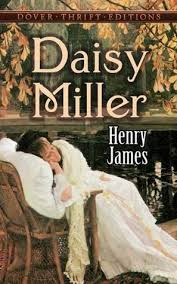
Daisy Miller by Henry James

I’ve read Daisy Miller at least a couple times prior to this read but it’s soooo good – Similar to The Turn of the Screw and other shorter works by James.  Every word counts – maybe twice –  I love it.

I think the book is mainly a character study of several people taking a holiday at a resort in Switzerland and Rome circa mid-1870s.   All but two minor characters are originally Americans but one has lived in Europe for many years,  another for several years and the remaining major characters are only visiting Europe for the first time.   The resort is full of Americans at this time and that was very much a status thing at the time.

Daisy*******
Daisy Miller

by Henry James  
1878/  104 pages (?) 
rating – 10 /  classic of classics – 
*******

Characters –

* 1st person “narrator” – Henry James?  –  only very briefly seen in the very first pages. The tale is mostly told in 3rd person.
*  Winterbourne – a young man visiting his widowed aunt,  Mrs Costello.   It’s rumored that he has an older woman/lover (?)  in Geneva where he usually lives although that relationship might only be rumor.  He’s an American but has lived in Europe for probably a couple years.
* Daisy Miller – a beautiful young (age 19?)  American girl of the upper class in Schenectady with some ties to New York.  She’s spoiled, willful, flirtatious and friendly.   Says she loves Europe but it’s because she wants to be a part of the “in” crowd here – the really upper crust ex-pats.
** Schenectedy,  New York was NOT the pinnacle of society in those days – or ever.   – lol.  It’s s a true backwater,  about 170 miles from NY  and a place where even the rich and well educated folks probably said “ain’t” in those days.
* Randolph Miller- a 9-year old boy who is spoiled and willful – just like his sister.  He likes America better.  Overly friendly with hotel staff.
* Eugenio – the “courier” for the Millers – disapproves of the Millers for their overly familiar ways. He’s a product of old Europe.
* Mrs Costello –  the rich widowed aunt of Winterbourne – very snobbish, a part of the “in” crowd of ex-pats and quite protective of that station.   Has headaches.
* Mrs Miller – the mother of Daisy and Randolph – (father is not along) – embarrassed about her children because she knows they don’t “fit.”  Doesn’t sleep a lot,  she must have other issues – maybe with dad or she’s chasing Randolph.
Mrs Walker – the expat social center of Rome
Mr Giovanni – Daisy’s paramour in Rome – the one she scandalizes everyone with.
So we have the rich but unsophisticated Millers in collision with the ultra-snobbish expats in Europe.
There are many levels to the story – many ideas for interpretation but imo – it’s a culture class although Daisy is presented as being more in the “wrong”  than the socialites.
I love this story –  every word counts.
Leave a comment

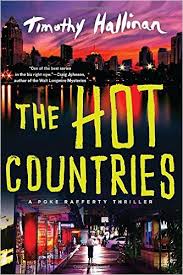
The Hot Countries by Tim Hallinan

This is the third of a little trilogy internal to the series as a whole so the the tale just seems to  go right on in Bangkok and the life of Poke Rafferty,  travel writer and now family man  living in Bangkok,  moves right along with it.  The last three Poke Rafferty novels are really meant to be a trilogy of sorts  – this is the culmination of the bunch.  I suppose they can be read as stand-alones, but I didn’t do it that way.

If you’re interested,  the first novel in the series is The Fear Artist and the second is  For the Dead  and they’re both excellent.  The title for this book works just as well as the others – “Hot” can have several meanings.

hotcountriesThe Hot Countries
by Tim Hallinan
2015/ 336 pages
read by Victor Bovine – 10h 3m
raitng –    / literary crime
(#7  in the Poke Rafferty series)


In the prior book,  For the Dead,  Poke’s ex-bar dancer wife, Rose,  is pregnant and  now, a few weeks later,  she still is.   Meanwhile Miaow , their now 13-year old daughter who was adopted from the streets,  is peforming in a play at school.  Poke is, well, poking around looking for something to write about but still concerned about some old issues from the prior book,  as well as some new ones.    In the course of this activity someone usually dies or gets in serious trouble and Poke ends up solving the crime and catching or killing bad guys .

He does this with the very quiet help of his good buddy Artid,   a detective on the Bangkok police force.   Also in that prior book a girl named Treasure was saved from a burning building – she’s now living in a children’s home and very safe – or supposed to be.   Treasure is beautiful but handicapped by trauma at the hands of her now deceased father – a wonderfully well-developed character and I’m reminded of something from Dickens with these street kids in the home and elsewhere.

The book opens in a bar called the Expat Bar in downtown Bangkok where Poke goes regularly because the now aging regulars were very kind to him when he was new to the area.   They go to drink and harass each other-  spend the evenings.  Poke realizes what a sorry bunch they have become over the years – Wallace, a fairly major character in the novel,  is almost senile and things can get his mind off track – back to his Vietnam days where too many people died, or back to Yah,  the Thai bar-girl, the love of Wallace’s whole life.   But these old curmudgeons have valuable information from their years in the city,  very helpful information,  good ideas.  And they’re friends – very good friends.  “We all need friends at times. Doesn’t much matter who they are.”

Anyway,  one day a guy named Varney shows up at the Expat Bar.  He wants money (of course) and something or someone else.  Poke is on alert – he has quite a lot of money due to the end of the prior book and is hiding someone.  The game is on –

Hallinan has a very nice literary aspect to his writing,  but he never loses sight of the  main plot and the tension and somewhat gritty scenarios his readers expect.  He uses lovely and evocative language in the descriptions of Bangkok ,  especially of the rain.   The basic, perhaps universal human qualities of some of his characters also puts this book into the literary category – the aging Wallace,  for instance,  or terrified Treasure and many others.  And between the old farts in the bar and the street urchins, he gets the human spirit just right.

http://www.reviewingtheevidence.com/review.html?id=10470

http://www.tzerisland.com/bookblog/2015/11/4/the-hot-countries-by-timothy-hallinan.html

http://tedlehmann.blogspot.com/2015/10/the-hot-countries-by-timothy-hallinan.html

Leave a comment

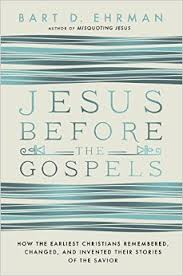
Jesus Before the Gospels by Bart Ehrman

This is basically more of the same Bart Ehrman I’ve read for 2 prior books except that for this book Ehrman uses some extra-Biblical sources to show the historical inaccuracy of the Gospels because there was nothing written for 40 years and who knows what can happen with memory over the course of 40 years.   He goes on to discuss various kinds of memory and finally to put all that together to understand the nature of the memories of people who lived and heard about Jesus, were converted,  between those years.   In some ways Ehrman is continuing his work rather than repeating it (although he does that, too).

jesus************
Jesus Before the Gospels

by Bart Ehrman
2015 / 336 pages
read by Joe Barrett
Rating:  9 – 10h  5m

************
The book deals with oral tradition,  inventions, 1st person accounts,  distorted memories,  collective memory and inaccuracies within the Gospels,  the sayings of Jesus and the rather special cases of John and Thomas.  At the core it’s about the context in which they were written,  the nature of memory,  and finally, the context in which that memory took root.  The book is very well organized and builds slowly to its conclusions and the conclusionss are what made my rating as high as it is.

I am in complete agreement with Ehrman,  but I have problems with him anyway and sometimes argue as I listen to the books.  Sometimes he is just so astounded that there might be differences of opinion about the interpretation of the Gospels or the historical Jesus – his readers should be shocked like his fundamentalist students are.    This is true in Jesus Before the Gospels,  too,  but something changes at about Chapter 7 and he starts putting the information together – our knowledge of memory and the nature of the individual Gospels – Mark, John and Thomas especially – as well as in their contexts.

The last three chapters save the whole book and I’m glad I read it.

2 Comments

Betrayal: A Dismas Hardy Novel

This is one of the very few John Lescroart books I’d not read,  avoiding it becuase of the war-type subject matter.  But I finally needed a Lescroart/Hardy fix,  especially with Collacci reading,  so I broke down.  I’m glad I did

The story opens with a couple scenes where Dismas Hardy gets the cases of Charlie Bowen, a recently “disappeared” attorney who was handling some appeals.   Then it goes into backstory for the long tale of Evan  Scholler, a lieutenent in the US Army,  and Ron Nolan, Navy SEAL special contractor.

betrayalBetrayal:  A Dismas Hardy Novel
by John Lescroart / 2008
(#12 in the Dismas Hardy series)
read by David Collacci  14h 43m
rating:   B+


Back in 2003 when young Evan Scholler was a soldier serving in the Iraq war he met a Navy Seal contractor named  Ron Nolan who seemed ot have some seriously shady tones.  Scholler is trying to get back together with his girlfriend, Tara Wheatley,  so since Ron is going to San Francisco anyway, he will hand deliver a letter for Evan.

But Ron ends up lying and dating Tara – apparently murdering a mugger who interferes.  We then know for sure that Ron is a very bad guy even if the girlfriend thinks he saved her life.

That takes up 2+ hours of the book.  Then we switch to Abe Glitsky, a black, Jewish seargent at the police department.  Glitsky is a good friend of Dismas Hardy who is now a lawyer (but worked with Glitsky early in the series).   Because the next thing we know, another an ex-Navy SEAL is found dead of a broken neck in an alley.  It’s not about robbery.

And we go back to corruption in Iraq – (sigh) – The US seems to have some lying  and greedy wildcat contract cowboys,  both on its hands.    And another hour or so for the war effort –  (ho-hum)  There is some underlying tension about who will die next – or will he just be hurt – but the emphasis is on an anti-war statement Lescroart wants to make.  Okay – me too – against the war – you’re preaching to the choir.  Now let’s get on with a story?  –  I especially enjoy legal thriller with Dismas Hardy involved.

Finally, about half-way through the book, the plot starts thickening.  And it’s slow but steady build-up until we get back to Dismas Hardy and his stack of appeals – one of which concerns Evan Scholler and Ron Nolan (amongst others).

Good book –  I especially enjoyed the Dismas Hardy parts and if you get this one out of order htere really isn’t much “series plot” to be lost in –  it’s Dismas and his second wife,  Glitzky and his second wife – etc.  They are really,  really minor players.

Leave a comment

Susan Wise Bauer & Barbara Tuchman

tuchman.jpg

I found this quote on the home page of  Susan Wise Bauer,  the author of some incredible  books of world history.  The author of the quote,   Barbara Tuchman,  is another favorite.  I’m currently reading Bauer’s The History of the Ancient World –  just started – it’s interseitng but uses the Bible as a primary source in a way.  That said,  I still agree with Tuckman’s wonderful quote.

Leave a comment

Orphan X by Greg Hurwitz

This is basically a chase-type  thriller using an almost super-hero protagonist, several  evil bad-guys and some technology.  Scott Brick adds even more suspense.

The premise is that in the 1980s some orphans were raised and trained to do assassination work for various intelligence agencies.     Evan Smoak was one of the kids and some of the flashbacks deal with his training,   but he managed to escape.  Now, as an adult with plenty of money,  he works as the “nowhere man,” an internet pseudonym,  helping people with serious problems  -like the girls who are used as a prostitution ring,  the man who got in trouble with the druggies but can’t go to the police because he’s an illegal alien.   Both of those cases are definitely life and death.

orphan


Orphan X
by Greg Hurwitz
2016/ 368 pages
Read by Scott Brick 11h 15m
Rating:   B-

The orphan program was abolished and the orphans went their own ways,  some very bad wayw.  And now someone seems to be on Smoak’s tail.  They were trained pretty much the same way so the best guys are the best guys at setting up,  hunting and killing their prey – now they’re doing  it to each other and everyone is suspect.

I’m not particularly fond of this much chase-down-and-kill, but I enjoyed a couple of Hurwitz’ prior books, so I gave it a try.  I don’t think I’ll bother anymore.

Washington Post review:  

Leave a comment

Mrs Eckdorf in O’Neill’s Hotel by William Trevor

Mrs Ivy Eckdorf is a strange gal – 40-ish and divorced again,   she works as a photographer.  She decides to visit Dublin‘s O’Neill’s Hotel because she’s  heard it’s got strange things going on now and in the past.

The aging deaf and mute Mrs Sinnott, who lives in one of the upper  rooms,  owns the hotel,  but her son, Eugene, a drunk and a gambling addict manages it, spending as little as possible on maintenance.    It used to be an upscale sort of place,  but it’s fallen into disrepute – serious disrepute – and disrpair as well. The aging Mr O’Shea  does the butlering but he seems not quite right in the head anymore,  longs for the old days.  And  a guy named Morrissey uses the rooms for his line-up of aging hookers.

eckhoff

Mrs Eckdorf in O’Neill’s Hotel
by William Trevor (Ireland) 
1969 / 265 pages (and I’m reading the paperback!)
rating –  8  – 20th century fiction  
The eponymous Mrs Eckdorf,  whose intrusive and somewhat unbalanced character is on display from Chapter 1,  has decided  to investigate matters.  She heard about the hotel from a barman on a cruise ship and being a photographer (or saying she is) she wants to find out what she senses must be the real tragedy that initiated the downfall of the hotel.

When she finally get there Mrs Eckdorf says  she’s thinking of buying the place and interviews several people including the son Mr Sinnott,  his ex-wife Philomena and their  son Timmy.  She also calls on Mr and Mrs Gregan,  Mrs Sinnott’s daughter and her hubby as well as Father Hennessy,  an aging  Catholic priest from across the street.  Finally she peruses the “exercise books” which have been kept by old Mrs Sinnot over the years in which the other regulars of the hotel characters have left messages because not only is she 91,  she’s also deaf and mute.

Mrs Eckdorf is convinced that soemthing terribly tragic and romantic happened there – but did it?  What did happen?

This was a hard book to get hold of  -it’s older and not in print – not even avaialble in teh US except by 3rd parties.  So that’s how I read it.  –  And paper is no longer my chosen  version anymore for several reasons – my eyes and the inherent clumsiness of pages mostly.

Leave a comment

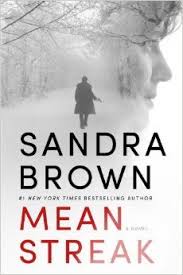
Mean Streak by Sandra Brown

This novel has some flaws but I enjoyed almost all of  it anyway.  First – what are those two neighbor guys drinking?  Is it milk (which one wipes from his mouth),  coffee (which is spilled during the ensuing melee) or beer,  as one of the characters reports later?  –  lol

The plot feels a bit contrived sometimes – especially towards the end.  And the women characters are so demanding – they scream moer and more questions – (the kind which will only lead to even more questions).

mean2Mean Streak
by Sandra Brown
2014/ 496 pages
read by Jonathan Davis  11h 51m
rating – A- / suspense-thriller-romance


But those are such rather minor issues and I easily overlooked them because of the originality of the main plot line (to me anyway),  the characters are well developed and  the tension is of the page-turning and oil-buring variety.

Finally,  but worst for me,  the story has a streak of romance  which would normally just turn me right off.   For some reason it was okay in this case because the suspense-thriller aspect overcame it – up until about 3/4 through anyway.   Even the graphic sex was okay – nicely done, actually (although only one briefer scene would have been plenty for me).    But overall,  it added to the story in some character developing way.  (Yes,  it was a bit trite,  the whole romance part smacks of cliche’d trite,  so much I kind of guessed the ending at about 3/4,  but … sigh…)

Emory Charbonneau, a very successful pediatrician goes for a solo training run  in the mountains of North Carolina.  As a marathon runner she’s confident and enjoys running alone.  But she  disappears up there and then the fog sets in.   Besides,  by the time her husband Jeff, who is otherwise occupied,  reports her missing, the trail has grown cold – and the man is so arrogant the police suspect him of something.

Meanwhile,  the unconscious Emory finally wakes up in a strange mountain cabin with a man who refuses to tell her anything about himself – even his name.  It’s very suspicious – very tense as she tries to escape.

Then the seriously  awful neighbors pull some tricks and a young girl needs help desperately.  What’s a good doctor to do?  What can she do?   The twists continue – and continue.

Leave a comment

The Cossacks by Leo Tolstoy

I’ve read this before but maybe it was time again – the 19th Century Lit group wanted a suggestion and they hadn’t read this one (for the group anyway).

I’ve read it before along with many of Tolstoy’s other works and had a feel for it but as usual with second readings of really good books – books which aren’t plot driven anyway – there is so much more than “how does it end?”

cossacksThe Cossacks
by Leo Tolstoy  (Russian)
1864/ 104 pages (Kindle)
read by David Thorne – 7h 16m
rating –  9.25 /  classic

To an extent,  the book  reflects Tolstoy’s own early adult life but, although he wrote while he was in the Caucasus,  he didn’t actually write this story until about 6 years later.  Much of it is based on early thoughts related to themes he developed later – love and pacifism especially.  In this novel there is a decided emphasis on the natural man,  simple living, it’s almost romantic but the attention to detail puts a realist spin on it.

Olenin is a free and very immature aristocrat who joins the military to get away from what he is coming to think of as his meaningless and somewhat degenerate lifestyle in Moscow – besides,  he has women troubles and owes money.   It’s not a big deal – he really doesn’t think much about other people.  He wants to find love but isn’t sure he believes in it.

As he and his serf and brother ride across the Russian Steppes he falls in love with the landscape – he is totally awed.  Then he comes to a village where the whole place captures his imagination and his heart. He falls in love and he wants to stay.

Reading and rereading this book opened my eyes once again to the wonder of Tolstoy – this isn’t his best book by any means,  but the promise is there in everything from the scope to the plot and characters.   Actually,   I could read it again.

Notes  —-> 

Leave a comment

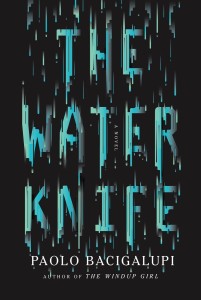
The Water Knife by Pablo Bacigalupi

Set in the foreseeable future,  the southwest area of  the US,  around Phoenix and Las Vegas,  has been hard hit by climate change and  drought. The area has no water.  Neither does neighboring Texas and migrants flood into Arizona.   What happened is that the old source of water for the area,  the Colorado RIver,  has been completely diverted to either Las Vegas or California.

TheWaterKnifeThe Water Knife
by Pablo Bacigalupi
2015 / 379 pages
read by Almarie Guerra 14h 5m
rating:  A+/  dystopian future-thriller

And now there are water wars.  A water tycoon in Las Vegas named Catherine Case has built an empire of arcology units with her water coming from wherever she can get it,  legal or not.  She frees and employs a prisoner named Angel Velasquez to do whatever she needs done – a lot of killing it seems.  Angel gets wind of something bad happening in Phoenix,  he goes down to check it out.

And what’s happening in Phoenix is that a journalist named Lucy Monroe has been writing about the water wars for years.  One day her lawyer buddy James Sanderson tells her he’s got the something really big that will change the game and he’s either selling it or has sold it – apparently some documents giving someone the rights to the water.  Then James is killed in cold blood.   That’s the trouble Angel has gone to Phoenex to check out. Who killed Sanderson?  –  Probably the Callies – (Californian water people).

arcoloy

A design archology for New Orleans – https://en.wikipedia.org/wiki/Arcology

Meanwhile,  Maria Villarosa, a young Texas immigrant,hows up at the cafe of her good friend and they find a very cheap water source and procede to set up a little marketing scheme.  They’re found out by the narcos.  This is very bad news for Maria –  big trouble.

The stories of those three,  Angel, Lucy and Maria, comprise the 3rd person narrative with alternating chapters given to each.   The tension runs very, very high – although there are great futurist ideas, the result is more thriller fiction than science fiction.

The violence was the typical graphic stuff but the sex was a bit over the top for the subject-matter although considering that one of the themes is how we all have a violent  streak it works in its own way.   >>>> NOTES, links, etc.  >>>>  

2 Comments

The Incarnations by Susan Barker x2

This must be my year of rereading – I’m doing a lot of it.  I read this just last month and I really disliked it (see review)  but several members of my group enjoyed it quite a lot.  Hmmmm…. I was put off by the sex and violence which, to my sensitivities, went way overboard.  Oddly enough – it’s generally historically accurate.

Anyway,  I thought I’d give it another shot and I am so glad I did.  Having managed to get through the sex and violence the first time (this is not for the squeamish),  it didn’t really bother me the second time -no more shock factor,  I guess.   (And that’s just like the rather weird sex in Avenue of Mysteries by John Irving which had me skim the first time to get it over with.)


incarnation
The Incarnations
by Susan Barker
2015 / 374 pages
read by Timo Chen and Joy Osmanski 14h 20m
(both read and listened)
rating – 9.25

This is an absolutely exquisite work of  historical ficiton which takes place in China circa 2008,  but with interior stories from the 7th century (Tang Dynasty), the 13th century (Jin Dynasty),   the 16th century (Ming Dynasty) , the 19th century ( Qing Dynasty) and the 20th century (Cultural Revolution).

In the frame story a Bejing taxi driver starts receiving strange letters from someone who apparently knows a lot about him and his 5 past lives.    He suspects his friend Zeng with whom he has been having an on-again/off-again sexual relationship although Wang is married to a woman he loves and they have a child they both adore.  Wang has other problematical issues in his life – the son of a rich and corrupt bureaucrat and his deceased wife –  Wang now has a stepmother and his father is aging badly.  The New wife is his aging mistress from the 1980s.   It comes to be revealed that Wang had a very unhappy childhood,  a breakdown in college and then a stint in a mental hospital.

The structure of the book makes the identity of the person sending the letters and pages of “incarnation” stories a bit difficult to puzzle out because the letters are often separated from the stories.   Figuring out the identity of the sender is the main plot line – who is Wang’s soul mate?  Who is the 1st person “I” in each story to Wang’s “You?”

Each of the stories is more like a novella within the novel but it works beautifully because in addition to its own plot line,  this reader was trying to figure out how bits of it fit into Wang’s life – there are interwoven connections.

The main themes are all about power and who can do what to whom as well as why.  There are sexual powers and legal powers and employer powers – from the power of slave drivers to the power of cliques of high school girls to the power of Mao.

The historical research which went into this is wonderful – I googled and googled.  And made copious NOTES >>> 

BookPage Review:

Leave a comment

NYPD Red 3 by James Patterson with Marshall Karp

“Hunter Alden did not live in the real world – he lived in the world of the 1% of the 1%.”  Too bad,  the head of his chauffeur,  Peter Chevalier,  is found in their garage and his the body in a New York City park.  Happy New Year.   Then it appears that Hunter’s 18-year old son, Tripp Alden,  and his film-making friend,  Lonnie Martinez,  are missing –  kidnapping is suspected.

nypdNYPD Red 3
by James Patterson with Marshall Karp
2015/ 384 pages
read by Edoardo Ballerina 7h 5m
rating:  A /  crime – detective
(#3 in the NYPD Red series)

I’ve read exactly one James Patterson book prior to this and I have no idea which one it was. I didn’t like it a bit because of all the anonymous gory violence.  But … this  book sounded good – and it was on sale – so I give the guy another chance. And it looks to me like I picked a winner – for its genre.  (Even the others in this series don’t look this interesting – they sound like more serial killer mayhem.)

Fwiw,  I know that most of Patterson’s books these days are written by other authors – a kind of “stable”  if you will.   I’m not completely opposed to that as I think it can give promising authors a chance to both learn and get noticed.   This one is with Marshall Karp and I suspect he’s the actual writer of a good idea Patterson came up with – or at least developed  into an outline – that’s the way it usually works.  Otoh,  the idea is rather original so maybe it was his idea and Patterson developed it a bit leaving Karp to do the writing.

It’s nicely written for a thriller of this sort,  the dialogue is snappy and fun,  the tension builds nicely,  the characters are fairly well developed,  the structure adds interest,  and the plot has some surprises.  I’m glad I read it.

It’s all about the money – or is it?  Because there are  lots of other things going on – things Hunter Alden  will not share with the police or his wife, Janelle, or even his aging father,  Hutch Alden.  These are things which prevent Hunter from answering the phone with those folks in the room – even if it might be a ransom call.   Hunter will not discuss anything with the police at all –  not ransom, not information, nothing.   Hunter says he wants to find his chauffeur’s killer and proceeds with his own investigation which has its own twists.

NYPD Red is the unit assigned to  the case and Zach Jordan and his partner Kylie MacDonald draw the case.   NYPD Red is on all the important cases involving Manhattan’s wealthy families. They’re good,  but they’re cops,  and they’re good cops – not open to corruption of any kind.   Those two have an ongoing relationship which goes back a long way,  but it’s supposedly  on a back-burner for now.  Besides,  they both have ex’s they’re still involved with.  Zach’s portion is often told in 1st person.

Hunter eventually gets the call – the ransom/blackmail demand.  It’s way, way worse than anything which had crossed Hunter’s mind.

Part 2 delves into the story of Silas Blackstone, Hunter’s all-purpose man –  Blackstone apparently does a lot of things for Hunter,  has been doing them for a long time.  The narrative switches to what’s going on with someone named Cane who has the boys and then goes back and forth between several characters.  The tension kicks in at page one and only lets up for relationship matters between the cops – Zach Jordan and Kylie MacDonald.

So the question is –  who’s pulling the strings?   Who killed the chauffeur,  who kidnapped the boys and who’s behind the person who actually did it?   The ending isn’t great, but it satisfies.

Leave a comment