This book was a disappointment because I’ve very much enjoyed Sears’ prior novels – the ones in the Jason Stafford series. This is another New York thriller but I’m not sure about it – somehow there is the same-old, same-old feel to it what with a fallen lawyer trying to scrounge a living. This time the other players are just too weird for me I guess and it turns into a thriller with no real distinguishing qualities.
The Tower of Babel by Michael Sears Read by Richard Poe 12h 18m Rating: B- / crime – thriller
From Amazon: Shamus Award-winning author Michael Sears brings Queens, New York, to literary life in this crime series debut featuring a somewhat seedy lawyer with a heart of gold (or at least gold plate).
Queens, New York – the most diverse place on earth. Native son Ted Malloy knows these streets like the back of his hand. Ted was once a high-powered Manhattan lawyer, but after a spectacular fall from grace, he has found himself back on his home turf, scraping by as a foreclosure profiteer. It’s a grubby business, but a safe one – until Ted’s case sourcer, a mostly reformed small-time conman named Richie Rubiano, turns up murdered shortly after tipping Ted off to an improbably lucrative lead.
With Richie’s widow on his back and shadows of the past popping up at every turn, Ted realizes he’s gotten himself embroiled in a murder investigation. His quest for the truth will take him all over Queens, plunging him into the machinations of greedy developers, mobsters, enraged activists, old litigator foes, and old-school New York City operators.
It took me a little while, but I finally decided on another spy novel by Mick Herron. This one is an older stand alone and nothing like my favorite Slough House and Jackson Lamb books. It’s read by Julia Franklin rather than Gerard Doyle – and I much prefer Doyle. Oh well. The narrator is particularly annoying when she’s doing the children’s voices but otherwise she’s okay.
Reconstruction by Mick Herron 2003 Read by Julia Franklin 12h 55m Rating: C / crime-suspense thriller
It starts very slowly – inch by inch and minute by minute we get to the young bad guy demanding admission to the nursery school, getting it, and holding the kids and adults hostage. Then we progress with the situation as one teacher shows her instinctive courage and the other adults shrivel up. But slowly it transpires that the hostage taker is the boyfriend of a secret agent but they have to keep it quiet because they are are gay. Meanwhile Milo, the boyfriend, has gone missing along with a quarter of a million dollars.
Herron is known for his unique writing style and story structure and with every single one of the Slough Horses series it worked for me. But not this one. I think I might have to wait for the next Jackson Lamb (Slough Horses) book. Gerard Doyle is an excellent reader and although Julia Franklin is quite good there’s something missing. I have no idea what.
This may be the grossest book I’ve ever read and that’s seriously too bad because it’s also brilliant. On the one hand it’s so gross there were places which simply creeped me out. On the other hand I finished, totally entranced.
The Discomfort of Evening by Marieke Lucas Rijneveld Translated by Michele Hutchison 2018 / 296 pages Read by Genevieve Gaubt Rating: 8.25 / 21st century lit
But there are things which are just not discussed in polite society so why does Rijneveld insist? Is it to shock us? (Sometimes shock is used to shove us into the reality but other times it’s simply to make money.). Did she have to use constipation to symbolize grief with abusive treatments for the remedy? Oh well – nothing new here because it seems to me shock is what most of the Booker Prizes have been awarded for the last few years. (“We’ll just shock those judges into really paying attention to our book!” sayeth the publishers who nominate and the judges go, “Oh look! This will get people talking!”)
Certainly Rijneveld’s Dutch Reformed religion doesn’t encourage this grossness – even gay and lesbian clergy is okay with them. Dutch Reformed is generally pretty mainstream but I suppose it has extremists. The shock value might be part of her own “trans” thing as she doesn’t use gender-specific pronouns like “he,” “she,” etc. they’re all “they” and “them” in her life but she does in the book.
I think yes, some kids are like Jas, the 1st person narrator, and just fascinated by bodily fluids and functions etc, but this child is kind of bizarre about it and should have outgrown it, imo. But I have to concede that yes, it is about guilt because when her pet rabbit died Jas had wished her brother Matthies would die instead – and then Matthies died in a fall. Guilt.
The religious family tries to come to terms with why their young son and brother was taken each dealing with the loss in their own ways. It’s not a soft and heartfelt book of “healing.”
There is a lot of child and animal abuse and it takes place in 20th century Europe. It’s graphic and it’s gross – that’s the main thing, “My poop belonged to me.” I suppose living on a cow farm one’s attention is drawn by the bums of cows. It reminds me of Ottessa Moshfegh in a younger character – I liked Moshfegh’s books better.
Adolf Hitler is mentioned more than one time (why?) and the basement has something hidden in it – hot dogs for the Jews Mom has hidden there? Don’t get me entirely wrong, there are some (a few) parts which are almost magical – love and toads and cows. And the writing is awesome, lush, gorgeous.
More likely it’s best to say that it’s about children dealing with adult situations and issues like sex and death and guilt and so on when even their parents are not doing very well in that regard. I don’t think the religious issues have much to do with it. The book is probably very good in regards to the way guilt-ridden kids might see these things.
It should be said that this particular 1st-person narrator child (and her parents) are kind of “off balance” so I think maybe balance (sanity?) may be a tiny theme – at one point mom has coffee in one hand and tea in the other “as if to balance.” Falling (the max of un-balanced) happens and is greatly feared. There are other incidents of maintaining balance. Also, hiding and secrets are important to the kids because mom and dad have their ways about discipline and the elder brother is a bully.
Children acting as 1st person narrators are very difficult because they are, by nature, unreliable in that you can’t quite trust what a kid tells you – maybe the term “untrustworthy” narrator would be better if you have problems with the word “unreliable” in this context.
Whew! Starting out with #1 in a series. (After the last #4 as stand-alone crime book this is a relief.) And it’s a gentle book – where the last book put the thriller before all else, this one is a twisty procedural without a lot of chase scenes or violence although there is nicely built and developed tension
An Accidental Death By Peter Grainger – 2016 Read by Gildart Jackson 6h 52m Rating: B+ / crime procedural
DC Smith is back to work at the cop shop after an absence. He should retire but … He gets a new recruit, Chris Waters, who turns out to be the son of an old co-worker who has left to open a surprisingly successful detective agency.
Together Smith and Waters investigate the case of teenage boy who drowned in the local river. The cause of death is noted as being a “?” on the autopsy form. Okay – fine. A cigarette pack is found – it’s from Bosnia. A local mansion/estate appears to be occupied, locked up and guarded. What’s going on?
This is just what I needed to relax with while being entertained. And it draws you in to the the mystery itself as well as to the characters which is as it should be because this is the first of 8 books so far. 🙂
This is pathetic – it’s #4 in a series of 4 (so far). And it would really be best to read the books in order – (take heed). Unfortunately it was my first, so there were lots of connections I didn’t make and events I didn’t have the back-ground for and even characters who were probably developed in prior books. Myers tried to explain but there was more than what he said in the pages here and I knew it. There were lots and lots of characters with some of them seeming to drop in from almost nowhere halfway and more through the book.
A Criminal Justice by William J. Myers 2020 / 395 pages Read by Will Damron 11h 25m Rating: C- / legal thriller (for the book as a stand-alone) (Series – #4!)
It’s a legal thriller with the emphasis on thriller. Perhaps illegal thriller might be a better category for this one because it would seem at first glance that neither the prosecution nor the defense cares much for technicalities. Almost all of them have connections to unsavory side of the law. As a result the book as a whole almost didn’t work.
The story starts out pretty simple – who shot and killed Edwin Hanson, the billionaire businessman, in the parking garage of his family business building? As we come to find out, the man has two wives still living with a son by each and a younger brother with whom Edwin did not completely share his inheritance.
The main suspect, arrested and jailed, is Mick McFarland a defense attorney whose wife Piper has a pretty shady past. Mick and David have a long history – Mick has a history with almost everyone in the court system but then he used to be a prosecutor.
Mick went to prison years prior for killing Jennifer Yamora, a television reporter who was having affairs with both him and another man, David Hanson, the brother of Edwin, the victim. But thanks to Piper’s efforts (which we don’t see in this book) Mick was released due to evidence conveniently found long after the event. Jennifer’s brother wants her murder avenged.
As you can see, the story is much deeper and broader and twistier than a solo novel can stand up to. And everything is thrown in to wind it all up maybe?
I don’t know if it will be worth my reading the first three books in the series because it’s the plot which is serialized and not the overarching relationships or whatever most serials do. This is NOT a stand-alone by any means.
I’ve read some crime series books way out of order – Dave Robicheaux by James Lee Burke for instance, and those are fine as standalones (better in order but …) Back in the days before the internet when we had to shop at indie bookstores I was satisfied with that. Not now – now I’d much prefer to read a good series in order – it’s almost mandatory (not quite – some are more firmly linked than others or linked in different ways.)
So the fault in the rating is mine and this might be a fine series if not a book.
A question from a reader posted on this blog prompted me to reread this marvelous book. Yes, I had a good crime novel going but I’m open these days and From a Low and Quiet Sea is quite short, a novella really and I read it about 300 books ago (18 months).
From a Low and Quiet Sea by Donal Ryan 2018 / 191 pages Read by a cast – 5h 42m Rating: 10 / contemp. lit (read and listened)
I gave it a rating of 9 last time and I read it twice then (back-to-back) with some extra time spent on the last section. The writing is some of the most beautiful prose I’ve ever read – but Irish fiction can get to my heart. The review here has no spoilers https://mybecky.blog/2018/10/12/from-a-low-and-quiet-sea-by-donal-ryan/
This following review has spoilers: The tale involves three unrelated men and their lives. They don’t connect until the end. The first is a refugee from Syria who loses his wife and child after which he kind of lands in Ireland. This guy is not in his right mind after all this. His family is made up of professional people, but there has been some religious-political taint on them.
The second story is that of a somewhat dull and very troubled young Irishman with a foul temper and quite a lot of bad luck. His life has been a mess.
Finally, the third man is a wealthy accountant who is so sad with remorse and loss he can almost not bear it. He’s trying to make his confession to a priest, but really he’s telling the reader how he’s guilty of every sin there is. And he starts recounting the little stories of his deeds. Yes, he has sinned.
All three men have lost considerably and their stories tell how they responded to great loss. All three desperately want to die, but they don’t.
In the second to last “chapter” we meet the women, the immigrant man’s new girlfriend, the Irishman’s mother who thinks about death and heaven remembering the man who fathered her son.
And then in the final chapter they all come together in a bus wreck and it’s all okay in very different ways. The last short sections have to be read very carefully with an eye to what the whole book has led up to for each of these folks individually so that they can see how each others’ story ends.
I read this years ago but my reading group selected it for April and because it had been so long I did it again. I have it at home in paperback so I purchased a Kindle version – it’s not available on Audible. (Although there is a free interview with SIngh there.)
******* Fermat’s Enigma: The Epic Quest to Solve the World’s Greatest Mathematical Problem by Simon Singh 1998 US (title Fermat’s Last Theorem) 315 pages Rating – 9 / mathematics and history *******
It is just as good or better than I remembered and I’m glad I reread it. Singh outlines the history leading up to Andrew Wiles who solved the problem (or provided a proof for a theorem) which had stumped mathematicians for over 300 years.
Fermat had provided the simple little equation and said there was a solution but no space in the margin of his book to write it. Most mathematicians say he was spoofing but considering Fermat’s strength as a mathematician I suspect he had an intuitive feeling that it was correct but he, with the mathematics of the 18th century, had no way to get there. Wiles, using the mathematics of the 20th century, had more tools and got there. He did, however, spend 7 + years in isolation to complete his childhood dream.
I’m going through a lot of sale books lately, but that’s a good way to find new-to-me authors such as LynDee Walker. First impressions were that not only is the narrative try too hard to be cute and funny, the reader gets overly dramatic and I’m not fond of the Southern accent. Maybe reading is a different experience because the reviews are good.
***** Front Page Fatality by LynDee Walker 2018 / 254 pgs read by Therese Plummer – 6h 51m rating: B / crime thriller *****
That said – it grew on me and by Chapter 8 I was kind of hooked on this. I might go through the series which is only
I think it’s a good plot. Nichelle Clarke is a youngish crime reporter for the Richmond Virginia newspaper. She’s been on the job there for 6 years, making a reputation for herself and working her way up. One Saturday morning she finds that two drug dealers have been discovered dead on the beach and then before long there’s a boat crash where the drivers were both police officers. Meanwhile the FBI is involved in some way. And then she finds out there are some stinkers in the cop shop – sticky fingers in the evidence room. Life gets dangerous for a curious and ambitious journalist. The plot starts out fast and doesn’t let up.
The rating is lower because the writing style is really just mediocre and there’s too much attempted humor.
I got this because it was on sale and because I’d heard a lot about it over the years and because I’m interested in Irish history and finally because Gerard Doyle narrates it. I was kind of hoping for some similarity to the Slough House series by Mick Herron and that didn’t turn out but … it was still okay – there are similarities. It’s the first of a series and I’ve read a couple of the later books.
******* The Cold, Cold Ground by Adrian McKinty – 2012 Read by Gerard Doyle 10h 4m Rating: B / suspense thriller *******
McKinty is nowhere near the author Herron is, but the story is good and I did enjoy it. I don’t know whether I’ll be reading more in the series or not.
Two homosexuals are found dead with their hands removed and exchanged. They’re found separately and the killer gets word to the police after the first one. Then a woman’s body shows up – she has a past but her death might be suicide?
Meanwhile the IRA and other organizations are involved in the struggles and troubles and hunger strikes and the British soldiers are torn between both sides – although they’re pledged to the Brits.
This is excellent historical fiction and there are many threads. On the good side they all get tied up at the end.
This is the first in a series but I don’t know if I’ll read more of them or not – maybe on sale.
******* Crashes and Crises: Lessons from a History of Financial Disasters by Connel Fullenkamp 2018 Read by the author 11h 16m Rating – 9.5 / econ lectures & PDF (Great Courses) *******
That’s what this book is about – the economic crashes and the crises of the west from the Tulip Bubble of the 17th century to the German post-WWI hyper-inflation, the US stock market crash of 1929 and the housing loans of 1990s – as well as much more. I suppose the focus is mostly on 20th century topics from New York’s Lehman Brothers to the Silicon Valley dot com boom and Orange County’s bankruptcy. I loved it! I might read it again because there’s a wonderful pdf chock full of lecture notes. (I should give it a 10 for doing that!)
From Amazon: Professor Connel Fullenkamp of Duke University guides listeners through four centuries of economic disasters – from tulip mania in the 1600s to the Great Recession of 2007-2009. Each of his 24 lectures covers a notable incident of financial misfortune or folly that is worthy of a Hollywood thriller. You hear how Charles Ponzi conducted the moneymaking scam that bears his name; how mining companies in the Old West sprang up like Internet start-ups, with a similar imbalance of winners and losers; how hyperinflation destroyed Germany’s economy at the beginning of 1920s and how its resulting stock market crash nearly sank America’s stock market. You also hear how the Great Depression deepened through a wave of bank panics; how, in more recent times, the US savings and loan industry went belly-up; how Orange County in California went bankrupt, how Japan’s hard-charging economy came to a screeching halt; how currency crises swept the globe; how subprime mortgages nearly sparked a second Great Depression; and much more. You also learn how technology has transformed stock trading, how cryptocurrencies work, and why we live in an era of financial instability.
As well as entertaining you with riveting stories, Professor Fullenkamp inoculates you against the gullibility, overconfidence, and herd mentality that have trapped even Wall Street professionals in misguided investments that lost billions. You won’t have any trouble staying awake through these stimulating lectures. And, armed with the knowledge of how to stay out of harm’s way, you may even sleep better at night.
I took a long time about reading this and made copious notes to keep the characters straight but I only listened, there was no Kindle version to go along with the Audio. It took me a couple readings but I totally enjoyed it – all 2 hours of it – lol – a novella. It’s not really one of the series but it has a few characters from the Slough House series.
******* The Marylebone Drop By Mick Herron 2019 / Read by Gerard Doyle 2h 8m Rating: A+ /crime – Spy *******
Then I wrote those notes up into a review. And because I didn’t get it posted right away I forgot about it. Then, hinking I had posted it already, I trashed my drafts – omg. So here – the publisher’s summary:
“A drop, in spook parlance, is the passing on of secret information. It’s also what happens just before you hit the ground. Old spooks carry the memory of tradecraft in their bones, and when Solomon Dortmund sees an envelope being passed from one pair of hands to another in a Marylebone cafe, he knows he’s witnessed more than an innocent encounter. But in relaying his suspicions to John Bachelor, who babysits retired spies like Solly for MI5, he sets in motion a train of events that will alter lives.”
On sale and although I’ve read a number of Mitzner’s books this might be one of the weakest. I loved A Conflict of Interest, 2011, his first, but Mitzner seemed to go downhill after that . Still, they’re pretty good legal thrillers. This is the first of a series of three and I’d already read the other two.
******* Never Goodbye By Adam Mitzner 2018 / Read by Erin Burnett 10h 6m Rating: B+ / legal thriller *******
This one would be much better read than listened to because there are three women with leading roles and the voices are too similar – they’re identified at the beginnings of chapters. Still -it’s complex and although I kept thinking I had predicted the ending, I hadn’t.
The plot involves Lauren Wright, a woman New York assistant prosecuting attorney for the victim’s bureau, whose dead body is found in Central Park. Eventually another woman, Dana Goodwin the new chief in the victim’s bureau, is on trial for the murder with still another woman, Ella Broden (the old chief of that bureau), as lead prosecution. Boyfriends and husbands are also involved.
There is a certain amount of LGBTQ matter, almost a theme, as well as low-grade techie stuff.
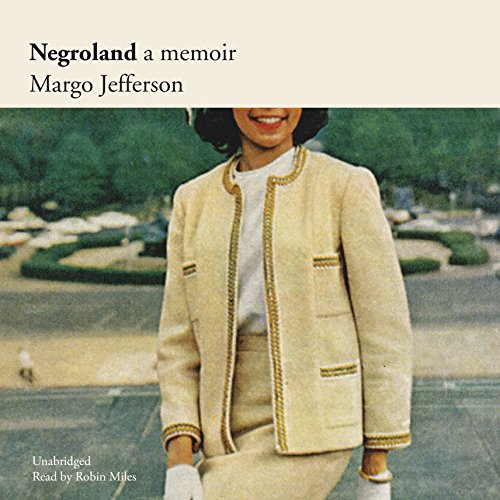
Negroland, by Jefferson’s definition, is that demographic which is comprised of upper middle to upper class Blacks from the days of slavery through today. The author was raised in this community and it has been written about in various ways by several authors down through the generations from prior to the Civil War.
******* Negroland: A Memoir by Margo Jefferson 2015 / Read by Robin Miles 7h 59m Rating: B+/ memoir *******
This may be the most honest memoir I’ve ever read. What’s it like and how does it feel along with what all happened growing up as a privileged “Negro” in a white world. Negro is the word Jefferson uses rather lovingly. I think she understands the heritage of that word because it replaced the term “Black” back in the slave days. Respectable people would use the word “Negro” because it was much more respectable at the time.
I say most honest memoir because it seems to me that, by what she reveals, Jefferson makes herself vulnerable in all sorts of ways. Some of this would really hit home if I were to tell anyone similar things. There’s a lot of wisdom and insight being passed along here.
But that’s one thing which makes the book really great and no wonder the book won the National Book Critics Circle Award in Autobiography. Jefferson also won the 1995 Pulitzer Prize in Journalism/Criticism for her work with the New York Times. Another thing which contributes to the success of the book is the Jefferson’s easy mastery of language. It’s clear and yet literary in a wonderfully accessible way.
Back in the days, (and probably today too), wealthy and aspiring Blacks were “privileged” while Whites were “entitled.” That’s a big difference – a huge difference – and it’s based on color.
So Jefferson talks about shades of brown and hits the racism associated with colors light enough to pass easily for white to the never-pass of ebony. She discusses members of her own family who either reject white culture altogether or go the other way and pass for white (until they retire?). Her father was the head of pediatrics at the oldest black hospital in Chicago and tremendously proud of his success. Her mother was a socialite and their children (2 girls) were sent to the best schools, often white private ones. Margot’s sister Denise became a noted dance educator.
The book covers the 1950s when Jefferson was a child in upscale schools and then living down the road from the University of Chicago. It goes on to include the 1960s and ’70s when the US was in turmoil with both race riots and draft protests as well as the war in Vietnam itself. And then the 1980s when change was in the air but not in the enforcement of the law. The kids helped change the morés and the fashion, but the ideas only mutated from the old social attitudes which came from the Victorian era. And women’s rights and status were barely touched until the 1980s.
The last couple chapters get a bit draggy with Jefferson analyzing Little Women in terms of the roles and temperaments of young women, not necessarily black women. And then some nostalgia creeps in when she talks about Marshall Fields and other cultural traditions of Chicago.
I discovered another Mick Herron book in my digital library – Down Cemetery Road. This was published prior to the Slough House books and I suppose it shows. Still the Mick Herron I know and love shines through.
****** Down Cemetery Road by Mick Herron 2003 (1st edition) Read by Julia Franklin 13h 46m Rating: B / crime-spy ******
Down Cemetery Road is the first of three books (The Oxford Series) which feature Zoe Boehm, a rather idiosyncratic private detective working out of Oxford, England. Here Zoe is avenging the death of her husband and has suddenly inherited the case of Sarah Tucker who hired him to find a missing child. It’s fast-paced and complex. I think Herron’s later books are better – it feels like he’s more in control of his plot and style which are different and the humor finds its place.
This book is not very good – until it is. It kind of sneaks up on you, or it did on me, and I got sucked into a seriously twisty thriller. Yes, it starts out with a bang, a family is found dead in their motel room in Mexico. And I suppose that’s to kick-start the story, but it’s not enough to keep going. I did kept going anyway and as I went along I kept getting more and more involved with the characters and what could possibly have happened for this family to come to this end and who did it and what is all this cover-up is about and who’s doing that? One of family sons is in college and couldn’t get away and an older son is in prison for something – we’re not told. That’s suspicious to start with, but there’s a lot more.
******* Every Last Fear by Alex Finlay 2021 read by Cady McClain , Jon Lindstrom 10h 57m rating; B / crime thriller *******
At first, every sentence seemed like a twist. Then I got more used to the characters and the time frames. There seemed to be a bit too much extraneous material, but there’s an interesting structure. Alex Finlay is the author’s pseudonym so this may not be a debut novel although it feels like one.
Except for himself and his older brother, Matthew Pine’s vacationing family is found dead in a motel room in Mexico. Matthew didn’t go with them as his college schedule conflicted and Danny is in prison for the murder of a teenage girl for which the Supreme Court has refused to hear an appeal. His father, is having serious troubles with money and work due to spending both time and money on his son’s legal troubles.
There is a lot of fluff in the book, but the main plot is very tangled, too. There are several places where I really had to suspend disbelief and it’s important that crime novels maintain credibility. That said, it’s compelling in some way – the concept, the characters, the puzzle, the tension, I don’t know. The structure is interesting and helps build tension going back and forth between “Before” (the family murder) and “After” as well as alternating between characters. There is also a bit of dramatic script inserted because the first crime was made into a documentary.
Unfortunately the male narrator has a pronounced sing-song rhythm and uses too much drama but that becomes less annoying as the book went on. The female narrator is good.
Overall I enjoyed it after I got used to it, but I wouldn’t necessarily recommend it to anyone.
I was totally disappointed in this one. I read it thanks to a challenge to read one of the group’s “favorite authors” of 2020 whose books we hadn’t read before. Okay fine – I picked Ken Bruen who was favorite #3 in the top 25! (I’m only missing 4 or 5 authors of that list total.)
******* A Galway Epiphany by Ken Bruen 2020/ 400 pages Read by Gerry O’Brien 6h 7m Rating: C- / crime *******
Too bad – this book was too violent for me, the characters used gross language, and they drink too much. If we want to compare these authors to classic authors this goes along with Malcolm Lowery and Under the Volcano.
I loved Don Winslow’s Cartel trilogy and that was seriously violent but it has some literary value to make up for the gore. Blood Meridian is an incredible book, one of my favorites of all time. I’ve also very much enjoyed the whole of Mark Herron’s Jackson Lamb series as well as all of James Lee Burke’s Dave Robicheaux series. These are masterpieces and have an abundance of totally redeeming literary value. The only literary thing about Ken Bruen’s books is that he name-drops some other good books – that doesn’t make a book literary even if he does include Burke. (One problem I might have is starting so far into these Jack Taylor books – there are at least 20 prior to this one. Taylor might be winding up his career the way Robicheaux and Lamb are.)
The plot threads were interesting enough, but keeping 3 or 4 of them in the air at one time gets a bit much. No wonder Jack seems a bit old and worn out.
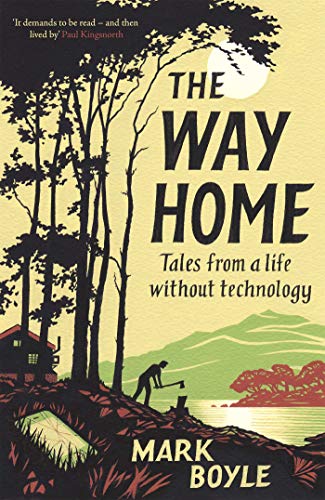
Reflections on living without technology, off the grid if you will, and off the land without a chainsaw or a smartphone. Author Mark Boyle built his own little house and grew or hunted his own food and even started his own fire for cooking and heat without a lighter. He and his parter lived this way for well over a year. Boyle had a modern type fishing rod and a bicycle but he gave up the bike locks.
The Way Home: Tales from a life without technology by Mark Boyle 2019 / 335 pages Read by Gerard Doyle 8h 36m Rating: 8.5 / memoir-environment
Boyle writes for the Guardian and he also wrote the book “The Moneyless Man: A Year of Freeconomic Living” published in 2010. That book was based on his experiences living without money for a year.
His little house and property are in central Ireland which he purchased in 2015 with the proceeds of his first book.
Starting with a chapter called “Winter,” the narrative follows the seasons through the years he lived without technology. He explains what he does like finishing his home, making friends and planting some vegetables. He also records his thoughts and ideas. He’s an interesting thinker and a good writer with a smooth if somewhat digressive style. He sometimes sounds like an old curmudgeon when he gets a bit nostalgic in his romancing of the past and complaining about “people these days.” I have a feeling he’d be the first one off the farm if he felt he was stuck there and wanted to see the city.
Chapter 2 is called Spring and Mark is busily planting more herbs and veggies – 30+ varieties. He objects to all the plastic he’s using and considers foraging instead. (Which is kind of silly – my ancestors were farmers and they didn’t use plastic back in 1840 when they immigrated to the US and settled in Iowa – they had wooden and metal tools – check out your local museum.) He takes mental excursions into his personal history along with what brought him to the point of living as he does now. And he contemplates his values – usually as opposed to what he thinks the rest of society does.
He has many friends and makes new friends easily so much of the book involves people he knows and meets and what they all do.
Since his youth he says he has wanted to do something with his life which had meaning, but how does one define that? Early on he left and returned to college a few times majoring in accountancy and taking a few odd jobs which suited him. He starts writing essays and articles for the Guardian and started living without money which turned into articles and a book.
He says he misses Joni Mitchell – ??? Excuse me? Mitchell is 78 or 79 years old. She was popular when I was in my teens and a bit older (plus an odd album or two in the 21st century). But Boyle is only 41 years old So, yup – that was nice music and it suits what you’re doing son, but don’t tell me you’re nostalgic for it – lol. That would be like me being nostalgic for WWII. (That didn’t take much off my rating though – it’s a very enjoyable book if you like memoirs.)










 Becky's Books -