Evicted ~ by Matthew Desmond x2

As the discussion on this book started at the All-Nonfiction Group  I realized I hadn’t really paid enough attention to remember accurately,  so I decided to read/listen to it again focusing on the reading.    I knew there were several families involved and I remembered some names,  but not any details.  (I finished the first time back in mid-February – not that long ago).

This time  I notice Desmond calls himself an “ethnographer,” a person who systematically studies people and cultures.
evicted


*******
Evicted:  Poverty and Profit in the American City

by Matthew Desmond
2017 / 448 pages
read by Dion Graham – 11h 10m
rating:  9   nonfiction – sociology    
(both read and listened) 
******

One reason I may have had a problem the first time is that I was probably looking at it from a policy analysis point of view.   That was something I studied in grad school as a candidate for a Masters Degree in Public Administration (a long time ago though).

The book opens with Arleen  who has 2 young boys   who is evicted for non-payment and trouble with her boys in a snowball fight and a kicked in door.

Sherrena and her husband Quentin own and manage the apartments where Arleen lives.   A lot of the book is how Arleen got there.

Lamar is dishonorably discharged vet with no legs due to gun violence after he got out.  He lives with his two teenage sons but other boys show up.   He’s waiting back pay on SSI and behind in rent.  He’s probably a great tenant.   Hard to find jobs.  He works at the apartment house to pay  some of his back rent –  (This guy was probably my favorite of the bunch.)

An unnamed tenant who called a renter-assistance program (DNS) and got Sherrena in trouble so she got evicted the tenant for back-payment.

Lenny Lawson manages a trailer park for Tobin CharneySusie works in the office and also lives there a bit cheap.  Charney is often in trouble with the Milwaukee Council.

Families at Charney’s trailer park include Tina,  Mrs Mytes, Rufus,  Jerry,  Larraine, Pam,

Larraine,  who is intellectually challenged and lives alone,  gets an eviction notice from Tobin as does Pam who lives with her boyfriend Ned and their two young daughters.  Neither one can come up with Tobin’s rent.   Both Pam and Ned have drug abuse and sales histories – felonies.  Pam and Ned work for their welfare checks but they also need transportation – and “A lot of money went to dope.”    –  street to where …

Ned and Pam move in with Scott and Teddy – heroin addicts from across the street – and Scott and Teddy got a big back-rent to pay off thanks to Tobin.

Back to Sherrena’s apartments Trisha, illiterate from an abusive home,  moved in upstairs from Arleen.

A large family called Hinkston lives in the duplex in front of  Lamar.  Doreen,  the mother,  took her eldest daughter Patrice and family in after they got evicted. Doreen’s place was trashed and electricity pirated – Doreen’s was not in good shape.

There are other people who come into play – Crystal,  Doreen and Vanetta,  for instance.

The book was still depressing and long.  The author says he was depressed for years after writing it.  No wonder.

Wisconsin is a difficult state to reform – they want to cut back on all aid and all state assistance and state jobs –  all of it.

But I’m not a “bleeding heart” liberal –  the resources of the US are great but they are  NOT unlimited.  The fact that more money is spent by the government on the housing costs/needs of middle class and up thanks to tax deductions of way more people proves nothing.  I don’t think that having a secure apartment or house alone provides a stable home life (which I agree is necessary for the healthy development of children).   These people are not functioning on many levels –

If the housing voucher program were expanded to include all those who qualify monetarily what would happen to the people who don’t keep their places up?  Whose neighbors complain about them big time?  The mothers whose men are gang members, felons,  domestic abuse perpetrators,   or are severely depressed and/or addicts themselves?   Where do they go?   Or do they just stay in their homes and the neighbors and landlords be damned?

This does NOT mean I’m against expanding the voucher system –  not at all!  It really does need to be expanded.   It means certain problems will have to be addressed in order for it to work the way we want it to – efficiently,  effectively and e
Posted in 2023 Fiction | Leave a comment

City of the Lost ~ by Kelley Armstrong

Another homicide detective with a secret –  she killed someone (oh my – sigh).  But this time who and when are up front and the crime is the retaliation which follows.

The twist is that because the guy Casey Duncan killed was the relative of a mobster she needs to get away from the retaliation which has now become a serious problem.   Casey has no parents,  husband or children who might be threatened,  but she does have a roommate/best friend named Diana who seems to be the needy type to which abusers are attracted and now she’s trying to get away from her ex-husband,  a serious abuser.

ctyoflost.jpeg


*******
City of the Lost
by Kelley Armstrong
2016 / 416 pages
read by Therese Plummer 13h 47m
rating –  B  /  crime/procedural-thriller
(1st in Rockton series – or Cassey Armstong series)

*******

Then it gets interesting because Diana and Casey are able to get ahold of a kind of sanctuary town in the wilderness of Ontario, Canada which finally,  but reluctantly,  accepts them.  In order to be actually admitted to the town of Rockton,  the pair has to leave everything and everyone they know behind so as to create an entirely new life.   They’re going to be living off the grid in the wilds of Canada.  

Rockton is a self-suffient community so the folks there are relatively safe from whomever was after them – or whatever they are running from.  There are some innocent people as well as some dangerous people there and now the community has problems with drugs and other illegal activities –  including missing people and grizzly murders.  Even the council isn’t clean – only the original founders still keep the hope.   Rockton is not a safe place and that’s essentially why they take the two women,  not because Diana needs to be hidden,  but because they need the homicide detection services of Casey.

After Casey and Diana get to Rockton there is a certain dystopian feel to the novel,  kind of like Steven King’s  Under the Dome.  But be warned – there’s also more than a bit of a romance involved –  it’s never overshadowing but  it’s close. Mostly it just adds complications to the plot in general

Casey is a strong,  likable and very nicely developed character but even as a 1st person the reader still wonders what’s making her tick.   Also,  there are a couple of other well-drawn characters including Eric Dalton,  the sheriff – he’s a kick – very complex.

The setting is adequate but I never really got the “feel” of outback Ontario although the potential is there.   The set-up and crimes are a bit far-fetched but not quite beyond my suspension of disbelief.  The plot is tension filled and quite gritty.  There are some really good twists – several.  The length of the book is not wasted.  a page-turner.

Yup –  I have the next installment of the series on my wishlist.   (g)

Posted in 2023 Fiction | 1 Comment

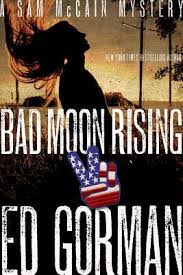
Bad Moon Rising ~ by Ed Gorman

Another reading group choice –   I don’t think I’ve read anything by Ed Gorman before this and this is the 6th in a series.

It’s 1968 and a community of hippies has settled on some land just outside the  small Iowa town of Black River Falls.  Sam McCain,  our 1st person narrator,  lawyer and private investigator,  is called in to investigate the murder of Vanessa Mainwaring,  the beautiful daughter of a prominent local businessman.  Her body was found in the barn on the hippies’  property.

The town is divided about 1/3 not minding the “hippies”  and 2/3rds opposed to them in general.   They’ve watched the news and police beating of dirty kids.

badmoon.jpeg


*******
Bad Moon Rising
by Ed Gorman
2011 / 211 pages
read by Joe Barnett – 6h 10m
rating –    C-  /  series crime 
Sam McCain Mysteries, Book 9
*******

The main thing about the book (and probably the series) is the nostalgic look back at the times – the  fictional small town of Black River Falls,  Iowa is kind of like what we watched on TV then,  The Andy Griffith Show and so on,  except there is a distinct 21st century underside.

The details of the setting are quite good –  and hard for me to read in places because of my own experiences during that time frame.  The who-done-it mystery has a rather clumsy and formulaic feel – it seems secondary to the setting and the ideas of Sam who rambles on about this and that.

Sam is a mellow sort of guy – he’s not working for the local cops but rather checking it out for a client who has been arrested.  I’m not sure I’m all that enamored of the guy – he’s like the opposite of the arrogant, loose cannon,  Harry Bosch.  I got really tired of the continual stream of considerations ideas from Sam.

The other characters are somewhat flat and tend toward “types,”

From what I understand all the books in this series take place within the time frame 1957 – 1970? and were given the titles of song lyrics.   I’ll not be  reading more of them – but a really mediocre book sometimes hones my skills about what makes a book good so …

https://lareviewofbooks.org/article/the-criminal-kind-ed-gorman/#!  –  it’s a better review.

Posted in 2023 Fiction | 1 Comment

The Persimmon Tree ~ by Bryce Courteney

Okay – I know Bryce Courtenay is not known for his literary word-smithery,  but I listened to The Potato Factory by Courtenay years ago and enjoyed it quite a lot – aside from falling in love with the voice of Humphrey Bower.

The Persimmon Tree follows the lives of  Nick Duncan and Ana Van Heerden as they fall in love and get separated by the war.   Nick first becomes a seaman taking Ana’s father’s boat to Australia where he becomes a spy. in the war effort.   Meanwhile,  Ana is trapped in Java.  The story spans the time between the fall of Singapore (and the American landings at Guadalcanal)  in 1942 to a few months after the end of the war against the Japanese for Pacific supremacy.   The setting is the South Pacific and the Indian Ocean,  Australia.   There are really two stories – Nick’s story and Ana’s story.

persimmon.jpeg


*******
The Persimmon Tree
by Bryce Courteney
2007/ 500 pages
read by Humphrey Bower –  27h 56m
rating:  6/10 –   historical fiction 
*******

Themes of race, love and family are explored but never very deeply,  more like commentary on those things.

Courtenay is not what I would call a “good” writer at all – but he tells a good story with well developed characters.

But by the end it was just too long and it got tedious as well as predictable.  I’m glad it’s over.

I doubt I’ll read another by him even if his narrator,  Humphrey Bower,  is so good.


Posted in 2023 Fiction | 2 Comments

Flat Spin ~ by David Freed

Ahhhh…. a good old crime novel, a thriller actually,  where I don’t have to think a lot. I don’t usually try to figure out “who done it,”  I just go with the flow,  ideas drifting through my head.    What Freed has given us is a who-done-it with a bloody plot line wrapped up in a fair bit of humor.

I bought it on sale in order to have something going at times like this – I’m kind of drained from Lord Jim and want something lighter.  It worked. And Audible’s little ploy of putting “1st in a series” books on sale worked,  too, fwiw.

David Freed is a Pulitzer Prize-winning journalist for the reporting he did on the Los Angeles criminal justice system and he’s written much more.  He also wrote about Operation Desert Storm and is a licensed pilot.    The man knows what he writes about – he writes about it in this book.

Unknown.jpeg


*******
Flat Spin
by David Freed
2012 / 300 pages
read by Ray Porter – 9h 7m
rating:  A- / crime thriller
*******

Cordell Logan, our 1st person protagonist, is a self-employed flight instructor working out of LA now that his job as a secret and covert anti-terrorist agent for a private undercover  (contract?) organization,

The title refers to what he thinks of his life as a whole – it’s in a “flat spin.”

Savannah,  Cordell’s ex-wife has come to him to ask him to investigate the murder of her new husband who was also Cordell’s boss and friend before Cordell found out about the affair and dumped them both.  Now the grieving Savannah seems to want Cordell back in her life.

The police apparently  want to blame either Savannah or Cordell or someone close – as usual. It gets complicated in Cordell’s head,  but he’s a smart, wise-cracking kind of guy who uses some Buddhist (yup) ideas along with the humor to stay focused and sane.  How much can he tell the police what he knows about his ex-boss,  or should he just investigate on his own?

There are Russians involved but that’s okay because other clues lead also to family members and neighbors and whomever else might want Echeveria dead.   Very interesting plot line without getting too complicated.  And then there’s another death which is also related to the old terrorist-hunting organization.  In some ways it’s a typical crime/spy/who-done-it/ thriller,  but in other ways it’s a notch above.

This is the first of a series and the over-arching  plot of the relationship between Savannah and  Cordell is pretty interesting as Cordell really tries to stave off her advances and come to grips with the situation in his head.  I suppose each crime story will be different.  We’ll see –  Book 2,  Fangs Out, is in my wish list.

Roy Porter does an excellent job on the reading.

Posted in 2023 Fiction | 4 Comments

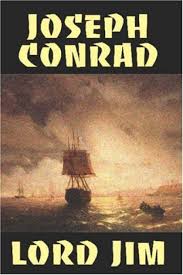
Lord Jim ~ by Joseph Conrad

I’ve read and loved a couple of books by Joseph Conrad,  The Secret Agent and Heart of Darkness – both quite good.   I’ve tried to read Lord Jim prior but could never get past the second chapter for some reason –  the general idea of men at sea  never appealed to me much at all,  although there are exceptions.

Whatever  –   a reading group chose it to read and there I was,  struggling to pay attention again and after all that effort finding the book not really worth effort.

lord jim.jpeg


*******
Lord Jim
by Joseph Conrad
1899 / 308 pages (Kindle)
read by Ric Jerrom
rating:   7 /   classic fiction
*******

This is likely the lowest rating I’ve ever given to a classic  – (checking … checking … Nope – Aldous Huxley’s Island got a 4.).     I know there are folks who think this is one of the best books ever written but there are also those who think as I do –  it’s a big overblown short story with too many digressions and the distancing of Marlow’s story telling Jim’s story sometimes within the stories of others.

Anyway,  as Marlow tells us, Jim was a parson’s son who wanted to be a seaman – got trained and landed a job on a ship but blew it when a great storm turned up.  The ship and many men were lost.  There was an official inquiry and Jim had to testify as did the other survivors and is disillusioned,  angry and silent afterwards.  As far as the others were concerned,  Jim  had shown himself to be a coward and a liar.   The first three chapters are boring and over-written but I got through it.

Then, at the tail-end of Chapter 4 Marlow shows up to continue the story with his story of Jim,  in Jim’s own words of course.  Marlow helps Jim get work.   Lots of quote marks to pay attention to –  both double and single.  Listening might be a far less preferred option here.

The paragraphs are still pages long and for me, anyway,  definitely a slog to read,  but   there is some tension building  (I think the reader of the Audible version should be thanked for that)  what with the pressure on Jim to testify,  on his testimony and what was thought of it,  the suicide of one of his later interlocutors,  Jim’s tale to Marlow,  etc.

Then smack in the middle of Chapter 12 (out of 45)  Marlow changes direction and introduces a Frenchman who was involved in the rescue and about a conversation they had later.

This change of direction happens so frequently that it’s seriously distracting and makes the whole book seem fragmented and choppy,  almost like different stories strung together.

And it gets overly excited – I was just plumb worn out listening to Jerron reading it even if I was following (trying to follow) in the Kindle version.   In doing the over-dramatized reading I think Jerron did bring a lot of meaning to the story but at what cost?

(Fwiw,  I had to check with Schmoop chapter summaries to make sure I was understanding what was going on –  I  was always on the right track,   but still….)

I really get tired of so much description there’s no room for anything else – not reader ideas in creating the scene,    not suspense,  nothing.  It’s all about getting every detail of that physical  courtroom and its occupants described.  And there are too many internal stories – all of which come back to Jim – that the main plot keeps getting lost.

And then,  leaving the courtroom after the sentence,  with some omniscient narrator telling us  how Marlow described something to some audience on a verandah,  he goes off onto a story of something else. The long long paragraphs turn into  pages which go on and on as Marlow’s  multi-layered story-telling unfolds . .Is Marlow a reliable narrator? – LOL! –

I suppose the themes are “being a gentleman” (“But then,  he was one of us!” –  repeated..)    and how that was of highest importance –  Jim needed redemption for his error (which was not his alone).  This was all about what other people thought of you   Then there are the ideas of imperialism/racism –

I doubt I’ll ever read anything by Conrad again –  there are just too many really good books in the world.

Interesting:
http://www.editoreric.com/greatlit/books/Lord-Jim.html

Posted in 2023 Fiction | 2 Comments

Reservoir 13 ~ by Jon McDonald  

It happened again!  I started listening to this and then at some point realized it is really quite good,  like meaningfully good.  Furthermore, I’m wasn’t  “getting it”  all.  So I stopped,  maybe 1/3 through,  and download the Kindle version.  I started over.

This book really ought to be read in some kind of text format for several reasons.   But because the paragraphs are long,  it’s also a good idea to listen.  I think listening and reading is probably best.   Warning –  every sentence is important in some way – the best of minimalist styling.

The story: (no spoilers)   On a New Year’s Eve,  sometime in the late 1970s,  Rebecca Shaw age 13  went missing from a very small and quiet English village where she and her parents stayed summers and holidays.  Although everyone turned out to look for the girl, and they looked everywhere,  she wasn’t found by nightfall of this cold day.   The police and media showed up and helicopters flew over the reservoirs and quarry while  divers went down and journalists took pictures.  There was no sign of Becky.  And then a day or so later it started snowing.  The rather remote village is a lonely kind of place where most of  the people know each other,  but tend to mind their own business –  even within families.

reservoir.jpeg


*******
Reservoir 13
by Jon McDonald  (England) 
2017 / 304 pages
read by Matt Bates – 8h 48m
rating:  9 / psychological suspense
(Booker Prize Long List) 

*******

In February the police conducted a dramatization of a possible scenario for possible witnesses and reporters.  The police conducted more interviews.

By March she still hadn’t been found. Did she just vanish?  The girl’s mother was visited yet again.

Meanwhile the seasons change and life goes on with herons sloping and dances planned and the hawthorn coming out.  That,  essentially,  is what this book is about –  that and the grief process when there is no closure – when a grievous loss is unexplained.

Then she was sighted, by someone,  somewhere,  and a van was found.  A tipster showed up with a tale about the van.  But this is a quiet village and most folks don’t share all they know-  just some quiet speculative gossip maybe,  so the stress takes its own toll.

The suspense is sharp, at least at first,  but that’s part of the theme and I was hooked almost from the first sentence because McDonald is superb at his craft.  The landscape and seasonal changes are full and complete and mixed into paragraphs with many different characters telling this or that.  This creates a focus on the search for Becky but also of time passing – memories dimming,  life going on,  There are repeated passages like “Rebecca, Becky,  Bex,”  and “The clocks went forward and the evenings opened out.”   Time is passing,  suspense is building very slowly but deliberately.

There are some backstories in the beginning which add to the suspense in their own way,   bu there’s no foreshadowing.  And the suspense gets muted as the citizens of the town  adjust to this new reality, the new normal,  which never is really quite solid because Becky is still missing and nobody really knows how to talk about it.   Where could she have gone/  They’re all stuck in some phase of grief.

It was a cold night to have been out on the hill. She’s likely just hiding, people said. She’ll be down in a clough. Turned her ankle. She’ll be aiming to give her parents a fright. There was a lot of this. People just wanted to open their mouths and talk, and they didn’t much mind what came out. By first light the mist had cleared.  (Chapter 1) 

Although much of the narrative relates to the seasons and the landscape it’s just woven right into the middle of paragraphs because “life goes on” for everything – for the community as a whole including the environment.   This is mostly about a whole community and its response to tragedy and grief – the kind with no closure – and continuing to live their lives.

“As the dusk deepened over the badger sett at the far end of the woods, a rag-eared boar called out a sow … The woods were thick with the stink of wild garlic and the leaves gleamed darkly along the paths. Jackson’s boys went out to the fields and checked the sheep.”

About 40 characters are named in the first chapter and the narrative follows several  of them though the years.   There’s James,  who had known Becky better than most – he and his friends were in their very early teens when she disappeared.   And there is Sue and her husband Austin Cooper.  It’s interesting how many of the characters are caretakers in some way –  or they are in relationships which seem to be less than stable for some reason,  or they’re single widowed, divorced.   The unsolved mystery of Becky’s disappearance creates stress on almost everyone.

But many minor characters populate the story,  James’ friends  Sophie, Deepak  and Lynsey,  the vicar Jane Hughes,  Irene and her son Andrew,   Martin Fowler the butcher and his wife Ruth,  the Jackson boys,  the Hunter family,  Cathy and Brian Fletcher,  etc.   At first all are presented from quite a distance and we are informed about them through an unnamed omniscient narrator.   Over time, the distance shortens and we get to know many of the characters and follow their stories.

People sometimes have dreams about Becky or the idea of her missing will creep into their minds,  but they keep it quiet,  waiting maybe,  and mostly just tend to their own business.    And this brings us to Chapter 2 – (maybe page 40 or 45,  I’m listening)  so you know there are no spoilers above –  and Chapter 2 is New Year’s of the next year and so it goes.

McGregor’s creates enormous tension with a hugely atmospheric setting  and his minimalist but completely realistic styling.  The setting is a HUGE part of what makes this novel so excellent.   The natural landscape is described in simple straightforward language – and the landscape changes as the months go by and the reader is given something similar to town gossip, for instance,   “A lone man was seen staring into reservoir 8,”  or “It was known that Reverend Keep was talking to Rebecca’s parents.”  There are critters in the natural environment which are not neglected,  the beavers and bats and swallow and sheep all have their annual cyclical time frames,  their patterns.

But then life goes on and in just the same way as the seasons change,  people get on with the changes in their own lives –  kids grow up and there are funerals and weddings and divorces and births.   Adults drift apart and move,  the kids grow up and go to college.   Interest in Becky Shore diminishes,  but never really gets extinguished – it’s like the entire community is lacking closure.    Sometimes the investigators show up again, because the case remains open,   or there’s a memorial or someone says something but mostly  life just goes on. There’s this distinct feeling of time passing both quickly and slowly – like with the changes in a landscape or in a marriage and kids growing up. Patterns – lots of patterns –  time and patterns.

The tension which is so palpable in the beginning,  when Becky first goes missing,  is in large part replaced over time by tensions within the characters and their relationships and this is what builds on several fronts.  The individual sentences about various different things which happen in that particular time frame are all included in a single paragraph which gives the reader little snips of information one at a time which adds to the tension.

There is a fair amount of repetition as the years,  time is a huge theme,  goes around in its cycles.  Mention is made of “Rebecca, or Becky, or Bex.”  The well-dressing ceremony comes and goes,  along with everything else. in a year.

In this ongoing and bit-by-bit character development  and plot lines there are clues as to what might have happened to Becky –  who might have done something, or the reader thinks there may be.  And there is occasional work on the reservoirs so whenever that comes up the reader really thinks perhaps Becky’s body will be found.  -The underlying fears the characters must feel when their loved ones don’t show up on time is thick,  even with no mention of it from the author.  Psychological suspense.

McGregor is good and I’m feeling a sense that I might get his first book,  If Nobody Speaks of Remarkable Things.  


Posted in 2023 Fiction | 3 Comments

Evicted:~ by Matthew Desmond

Chosen by the All-nonfiction Group as the selection for March,  I likely would  have passed on this book because,  although I’m interested in the subject,  i feel kind of burned out on reading bad stuff about life in the US.  That said,  the book received many important awards and accolades including the Pulitzer Prize.

I’ve personally lived and worked among people who get evicted and move and end up in shelters and jail,  who have to choose between a jacket for the child or medicine for grandma.    I’ve dealt with them for over 25 years as their social worker and as their child’s school teacher.  I know there are many,  many good people stuck in tough situations where folks who are not so good take advantage of them or simply can’t help.  Bless them and bless the ones who do (including Matthew Desmond).  I’m fully aware that my experience may have colored my review.

evicted.jpeg

******
Evicted:  Poverty and Profit in the American City
by Matthew Desmond
2017 / 448 pages
read by Dion Graham – 11h 10m
rating:  8/  nonfiction – current events (policy analysis?) 
(both read and listened) 
******

The book was pretty much as I expected.  It’s basically the sad (heartbreaking, really) stories of several lower class families or individuals in the city of  Milwaukee,  Wisconsin juxtaposed with the story of one of their landlords.  The problems seem overwhelming  and beyond the ability of any one person or agency or group to fix.  Meanwhile,  however,  some of them are in the position of making a profit off of the situation and they don’t really want it fixed.  The landlords are stuck in the middle and although they sometimes  try to help the individual tenants their underlying motive is the profit part of the story while the motive of the tenants is survival.

The ultimate point of the book is to encourage the use of a “voucher” system of housing for the poor ensuring that all who want it are able to have a home.   Desmond doesn’t get to this until the last chapter – the Epilogue,  actually.    That point is certainly not set out in the Prologue which is set at the beginning of Arleen’s story with authorial comments interspersed along the way.

What happens to the tenants when the city powers decide to shut down a trailer park  which is plagued with drugs and prostitution?  We’re never told how large this place is – 10 units,  200?  Most of the residents are already strapped between utility bills and still can’t pay for their medicines,  to say nothing of back-rent and family funeral expenses.    Some landlords know exactly what the profit lines are – when to help and when to evict.

The people Desmond follows are black and white,  single and “married,”  of various ages and with children or without.  The black women with children have it roughest – the single white male probably the easiest.

I wonder about the “nonfiction” aspect.  I wonder how honest Desmond is being about the alcohol, tobacco, pets, drugs and crime (including domestic violence) in his “memoir” (which is really what it turns out to be as discovered in the Epilogue and “About This Project” sections.

The bulk of the book follows eight families as they get evicted and try to find alternative housing  when the whole system seems set up to thwart them.  It includes a lot of blow-by-blow action with dialogue as remembered I suppose as the research was done by living side-by-side with them for awhile and doing interviews.  The narrative is probably quite “creative” with the dialogues.  (NOT saying it’s not all basically true.)

It’s a shame the US is such a disaster when it comes to providing health, education and welfare for its citizens (and non-).  That is truly tragic.  Other countries seem to do a lot better –  I don’t know if I see vouchers as being the answer, but there are certainly alternatives which would improve the situation.   We can’t even get  half the homeless shelters we need in L.A.  It’s about making the middle class pay more taxes when they’re strapped between good schools and insurance and “getting ahead.”     It’s a given that the rich will create loopholes in whatever tax law is passed – or maintain off-shore accounts.

In the housing issue,  I’m blaming neither landlord nor tenant for the issues (non-payment of absurdly high rents or upkeep of dilapidated units plus mortgages and seriously objectionable neighbors/tenants).  But I don’t think scamming the system and trying to get by or being disorderly is likely to stop no matter what “system” is put in place.

Bottom line I suppose it’s a very eye-opening book for those who don’t know the way it is for people who are always on the verge of being evicted and having their entire lives up-rooted.   It’s interesting.

Posted in 2023 Fiction | 4 Comments

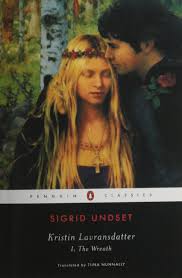
Kristin Lavransdatter: The Trilogy ~ by Sigrid Undset

This incredible classic was on sale (I still can’t believe that!)  and I snatched it up because although I’d read the first volume of the trilogy,  The Wreath,  I wanted to reread it and continiue with the whole thing.   I have the Tina Nunnally translation –  the newer one,  the better one,  the one which has the whole book including light (to us) sex scenes.  (see criticisms below ) and the one which is translated using the style Undset used –  plain old realist lit ala

It is vital to read these books in order because they consist of one chronological story line through the ages and there is no back story repetition as we find in today’s series books.

Kristin.jpeg

*******
Kristin Lavransdatter:  
1. The Wreath; 2.  The Wife:  3. The Cross 
by Sigrid Undset
1921 – 1925 /  1168 pages
read by Erin Bennett  – 44h 59m
(read and listened)
*******

First published in the early 1920s,  the trilogy of  Kristin Lavransdatter by Ingrid Undset was the main reason the Norwegian  author won the Nobel Prize for Literature in 1928. Undset was the daughter of a Norwegian archeologist and grew up learning and living with the history which she pursued obsessively as an adult.  The trilogy takes place in central Norway of the 13th century and the historical accuracy is usually given as the reason for the Nobel Prize as well as the fact they continue to be published classics.

The Nobel Prize in Literature 1928 was awarded to Sigrid Undset “principally for her powerful descriptions of Northern life during the Middle Ages”.
https://www.nobelprize.org/nobel_prizes/literature/laureates/1928/

This is NOT the romantic medieval literature of the actual middle ages like King Arthur or like the rough-and-tumble narratives of the old Norse sagas.   This is very much in the tradition of 20th century realism  with extraordinary historical accuracy.

The Wreath – (Book I)  – Kristin Lavransdatter is a young woman living in 14th century central Norway who was raised in a very loving and devout home (Norway was Christianized in about 1000 and it spread rather rapidly but mixed with the old superstitions for a long time.)  She was betrothed to a wonderful man,  but showing her willfulness and  immaturity fell in love with a rich scoundrel.  Her father was so upset he sent her to a convent where she learned a lot but never really “reformed”  as that wasn’t in her nature.   She returned home and …  well ….she does what she wants – that’s a part of her very character.

thingchurch.jpg

A stone kirke (church) near Jahren-(my photo) – probably 14th century

In The Wife (Book II)  and The Cross (Book III)  the story goes through the next several decades with essentially the same characters plus Kristin’s sons and new friends as she matures and ages.   Their lives entangle in a multitude of episodes until Kristin’s last days.  There is a lot of death in the second and third books.   I won’t go through the overarching plots because the premise of  The Wife would be a spoiler in itself.  The actual plot line does have a certain soap-operaish feel to it.

It’s basically an incredible domestic drama with some politics thrown in.   There are a   lot of characters involved and tragic twists based on the human condition.  What really gives the novels power and life are two-fold –   first there’s  the character and nature of Kristin herself,  and second there’s the accurate and detailed historical element of the setting which is naturally woven in almost organically,  as a natural part of the whole.

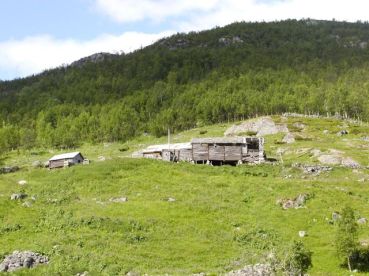
bakkenhouse.jpg

An old home place in south-central Norway – 19th century.  

I imagine it would be hard to write a book with this much historical research.  The author would have to keep it from “showing” and overshadowing other elements like character development and plot.  Undset always works her knowledge to best effect,  masterfully.

Also problematical for authors of historical fiction is that the if protagonist is a historically accurate depiction of a typical person of that era, a contemporary reader might very well find it difficult to sympathize.   On the other hand if the lead characters are not “typical” in their attitudes the book might lose some authenticity.  I think Undset bridged that divide wonderfully well – Kristin is not typical – she’s of the upper classes and a beloved child of good parents. (I’d imagine there were plenty of willful and rebellious girls in medieval Norway.)

The idea that God as well as the Church and its priests

inchurch.jpg

Inside the old Kirke – 

were of highest importance to Kristin and her family is emphasized  as well as the dress, food,  personal names and servant positions of the times.  Throughout all three books this attention to detail never lets up.

The superstitions which still abound even a couple centuries after Christianity was introduced  are fascinating and in contrast,  but not in conflict,  with the dictums of the Catholic Church.  That said,  the trilogy is chock full of drama what with  quite a lot of sex between various couples,  married to each other or not,  lying, fighting,  and murdering while floods rampage and churches burn.  This is the stuff of life and death,  love and honor.

Although Kristin is devout she battles guilt her entire life because she has a temperament which defies control and she has to pay the consequences.   To me it gets a bit morbid.  But still she can’t quite change her ways.  She’s a very  determined woman and she pays a price.  This is a really devout woman who lives in a real physical body in a very real and often sinful world.

The language is plain in both Norwegian and English – that was the “realist” style of the times which was popular and Undset adopted in keeping with other authors of the times.  Very strong character development is also emphasized in realist fiction.  Tiina Nunnally’s 1997 translation is supposedly excellent (I wouldn’t know).

Reading the books in the 21st century it’s hard NOT to see a feminist reading whether Undset meant it that way or not.  Whatever it is in the feminist canon it’s rather dated with the heroine  The protagonist is a strong,  devout yet risk-taking woman who has to live under the domination first of her father and then her husband.   She has a lot of physical labor,  emotional difficulties and family issues while the religious-social constraints are huge.

** Criticism:  ” Kristin Lavransdatter was notable and to some extent controversial in its time for its explicit characterization of sex in general and female sexuality in particular; and its treatment of morally ambiguous situations.” https://en.wikipedia.org/wiki/Kristin_Lavransdatter

Slate Review: http://www.slate.com/articles/arts/books/2017/01/why_sigrid_undset_author_of_the_kristin_lavransdatter_trilogy_should_be.html

Penguin-Random House
https://www.penguinrandomhouse.com/books/297272/kristin-lavransdatter-by-sigrid-undset/9780143039167/readers-guide/

Scholars and Rogues Review:
https://scholarsandrogues.com/2015/04/12/sigrid-undset-and-the-art-of-storytelling-kristin-lavransdatter-i-the-wreath/

Crisis:  A View for the Catholic Laity:
https://www.crisismagazine.com/2015/death-kristin-lavransdatter

Posted in 2023 Fiction | 5 Comments

Murder on Astor Place ~ by Victoria Thompson

I read this for the 4-Mystery Addicts reading group and it’s a book I would never have picked up on my own,  but it was pretty good.   Fwiw,  I’m getting kind of tired of reading about women in trouble though –  about their lives of hardship and pain and so on.  They always seem to be victims of something –  even the “strong” women due it against sexist adversity.

Although Thompson is usually considered to be a writer of “cozy”  mysteries,  this one gets quite gritty and sordid  in subject matter.   With “cozies”  crimes don’t  actually happen in the narrative.  They virtually always in the past or off-stage,  so to speak,  with the story line following the efforts of the detectives after the fact.  Another thing is there’s also an amateur detective as well as a police presence somewhere.   Murder on Astor Place fits.

astorplace.jpg


*******
Murder on Astor Place
by Victoria Thompson 
2015 / 288 pages
read by Callie Beaulieu –  8h 32m
rating:  B+ /  historical-procedural
Gaslight Mysteries #1 

*******

We’re in  New York circa 1895-96 and the papers are full of Teddy Roosevelt as Police Commissioner.  This was the height of the Gilded Age which,  although I’ve read better descriptions of it and some novelists work it into the story better,  Thompson uses it quite well and it’s front and center to the main plot –  probably the plots of all the novels in the series.
https://en.wikibooks.org/wiki/History_of_New_York_State/Gilded_Age_New_York_State

This is the first in a series so I expected some good character development for the lead detectives in order to set up an over-arching plot.  There is that –  Sarah Brandt, our amateur detective is a midwife by trade, but that’s illegal in the city at the time so she’s not exactly a fan of the police.  Sarah is

Vanderbilt_Mansion_at_660_Fifth_Avenue

“Petit Chateau” Vanderbilt Mansion at 660 Fifth Avenue. It was built in 1882 and served as an influential example for other Gilded Age mansions, while also demonstrating the visual outpouring of wealth.

the widow of a murder victim and estranged from her prominent family.

One night while delivering a baby,  she discovers the body of a 16-year old girl.  This turns out to be the sister of a past friend.  The girl  had been strangled.  Sarah  starts doing a bit of investigation of her own.

This activity brings her into contact with Police Detective Frank Malloy who is a  good at his job.  He fears for Sarah’s safety and rather resents her interference.

It turns out Alicia VanDamm, the deceased,  was the daughter of very prominent couple,  Cornelius and Felicia VanDamm –  and Alicia was pregnant.  And then it turns out the Russian midwife is also dead.  The tale goes on.  There are a few family members and servants and gossipy society ladies to investigate and interview.  Also,  there’s an underlying hint of a possible romance between Sarah and Frank.

The historical part is light although Thompson certainly did some research – sometimes it shows,  sometimes not.  The New York police department of the era was notably corrupt  and Roosevelt took some measures although he and his faction tooted his own more than was probably deserved.    Thompson has an extensive oeuvre with romance and mystery series going back to 1985.

Bottom line –  I did enjoy the lead characters of Sarah and Frank,  the mystery was good enough with a few twists,  the history was light but accurate – and sometimes  new –  for instance Astor Place is a real street,  very short,  located in Lower Manhattan.   I’d like to find time to read Book 2,  Murder on St. Mark’s Place,  but …  we’ll see.

Posted in 2023 Fiction | 4 Comments

Rules of Civility ~ by Amor Towles

I’ve wanted to read this book ever since I read A Gentleman in Moscow (2016) a couple years ago.   That was such a brilliant book it just spun my head as it warmed my heart.  (I gave it a 9.5 and read it twice.) –    So I nominated it as a group read at the Modern Fiction Group. (Yes  I did.)

rulesof.jpeg

*******
Rules of Civility 
by Amor Towles
2011 / 368 pages
read by Rebecca Lowman – 12h  3m
rating:   8  / historical fiction –   
*******

Sad to say I as totally bored for the first third or so and then off and on through the book.   There’s just this somewhat lost young woman trying to make her way in the Big City of New York (she was born in Brighton Beach – an immigrant Russian community in southern Brooklyn),  with a  a roommate who happens to be the daughter of a rich couple trying to make it on her own and that’s how she met her society boyfriend.   Our bookish 1st person protagonist has a truly dull job as a typist in a law firm typing pool,  but she does her best with it and that changes –  everything changes.

The Prologue takes place in the 1960s when Katey Kontent (pronounced “con-TENT”),  is visiting a New York museum with her husband where she sees a displayed photograph which includes the image of a very old close friend,  Tinker Grey,  who does not look like the  rich and handsome banker he had been.   Her mind goes back to the year 1938,  when that friendship started,  what it meant to her,  and how it ended.

Of course that means the themes of memory and reliability are worked in along with  love and honor and desire,  a lot of desire.

The bulk of the narrative takes place between January 1,  1938 and December 31,  1938 which is presented complete with the stuff of  the era –  the architecture, including skyscrapers,  and  the music  the movies, the nightclubs and dancing plus the arts and fashions and various levels of society from high to low.  There’s also a lot of smoking, drinking and some talk of the Spanish Civil War.  Katey reads a lot of Dickens and others but she gobbles down the Agatha Christies.

The first 1/3 makes for some rather boring reading,  but on consideration it’s all necessary to understand the complete change Katey’s life takes due to that friendship and it’s aftermath.  It’s necessary to get to know Katey’s  humor and her bookish ways as well as where she came from –   The title of Towles’ novel comes from a book by the young George Washington and it’s referred to more than once,  with meaning.  

Then finally,  at the end of Chapter 12 (maybe 120 pages in), Katey makes a what seems like a rather small decision but it’s really a change which almost immediately impacts the whole trajectory of her life (and the plot).  I was hooked.   The bookish but also card-playing and cigarette smoking Katey is catapulted into the upper tiers of New York literary and cafe society, their clubs and parties,  their individual lives,  their friends and their habits – circa 1938.  Overall it was pretty good story but having read A Gentleman in Moscow I was somewhat disappointed.

http://www.amortowles.com/rules-civility-timeline-contexts/


Posted in 2023 Fiction | 7 Comments

Longbourn ~ by Jo Baker

I’m as much a fan of Pride and Prejudice (Jane Austen – 1813)  as most moderately well-read folks,  probably –   it’s a great book,  funny and very insightful as well as being nicely-written and it’s definitely stood the test of time.  Furthermore it’s like a bird’s eye view of the times – to a limited extent.

What we have here in Jo Baker’s Longbourn is a take-off or a spin on Austen’s story and I likely never would have read it on my own but this was a group selection. Yes,  gentle reader,  I did enjoy it.

longbourn2.jpeg

*******

Longbourn
by Jo Baker
2013/ 331 pages
read by Emma Fielding – 13h 31m
rating:  8.75 / historical fiction 
****

It’s a very good book on it’s own but I think it’s better if you’re quite familiar with Pride and Prejudice because what happens in Longbourn is happening simultaneously with what goes on in Pride and Prejudice.

For those who don’t know or remember –  Longbourn is the multi-famiiy estate where the Bennetts of Pride and Prejudice,  live but which will be given over on the death of Mr Bennett  to a cousin,  a clergyman named Mr Collins.  Such were the laws of inheritance by “entailment.”

So the good Mr and Mrs Bennett are mainly concerned with finding “eligible” (rich) husbands for their five daughters ages 16 to 21.   But when an eligible  bachelor moves in nearby and brings a friend who is even more eligible,  the situation becomes interesting.   There are several men available, but their either not quite satisfactory in terms of of appearances and getting the girls “properly” provided for – and of concern to the young women it’s for love as well.     That’s the take-off point of Pride and Prejudice.

Meanwhile,  the stories which are NOT told in Austen’s book are those of the servants.  As the Bennett story getting marriages going unfolds “upstairs,”  the “downstairs” crew is having it’s own problems because just as  there’s a new man or two for the Bennett girls,  there’s also a new man-servant  added to the staff to help with household duties – a rather mysterious man named … um … James Smith.

Sarah,  our young protagonist,  is a maid in the Barrett household, working out fairly well under Mrs Hill,  but thinking about the new man as the situations in the Bennett family develop,   If Collins gets Longbourn, how will it be to work under a new owner?   And who are these rich young men,  Charles Bingley,  Fitzwilliam Darcy and George Wickham?

Meanwhile,  the military plays a huge part in Baker’s book (there was a war going on!) and several 21st century concerns are addressed,  racism,  sex and sexuality, the idea of servitude,  etc.  These things are not even touched in the Austen book.

Rather than look up any other Austen re-creations or sequels or what have you (Zombie books) I’ll likely try another one of Baker’s.


Posted in 2023 Fiction | 1 Comment

Pride and Prejudice ~ by Jane Austen

Oh my –  I started reading Longbourn by Jo Baker  –  it’s a 21st century take-off of Pride and Prejudice and goes through the same events except from the point of view of the servants.   I figured I could probably get through it with only my memories of the book which are probably 20 years old.  I reviewed a summary but …

When I got to where Mr Collins proposes to Elizabeth Barrett I had to do it –  Yes,  gentle reader,  I got a new copy of Pride and Prejudice in both Kindle and Audio formats – ridiculously cheap  – and promptly started reading.

prideand.jpeg


*******
Pride and Prejudice
by Jane Austen
1813 / 254 pages
read by Rosamund Pike – 11h 35m
rating:  10 / classic of classics 
(read and listened)
*******

Oh yes, (sigh)  I remember most of what “happens,”  but Austen’s humor is always so sly and delightful and her insights so on the mark.

On the prejudice side it’s a satire concerning the hypocrisy  (manners, actually) of society at the times.  On the pride side it’s about the way people really feel inside.  (Although Darcy is turned inside-out at those times when he looks so bad while he is doing what is right.)  That inside/outside analysis of the title in relation to the narrative  might not be exactly right at all but it’s mine –  even if someone somewhere has said it before.  (I don’t know.)

I won’t go into the whole story of how  Mr and Mrs Barrett, a couple of very middling means and up-scale desires (especially on mom’s part),  need to get their 5 daughters properly married off in order they may be provided for properly.   Elizabeth,  the intelligent,  quick-witted second-eldest, is the protagonist and the one who thinks for herself.  It gets quite complex and imo, each development of any character and every plot twist deserve all the study that’s been done on them.  It’s a masterpiece.

I know why the nay-sayers dislike it –  it’s narrow in scope because what about the problems in France and elsewhere?  What about society as a whole?   Is this marriage and money business all there is to life?  –  Pish I say –  laugh and look inward and  enjoy it for what it is.

For me,  I loved it again and imo,  Jane Austen produced one of the most remarkable English novels ever written,   If you haven’t read this book,  get thee hence and remedy that.  Now.

Historical context:  https://www.college.columbia.edu/core/node/1765

Posted in 2023 Fiction | 5 Comments

The Good Lawyer ~ by Thomas Benigno

Taking place in 1982,  Nick Mannino is just out of law school and working in legal aid for low income clients when he gets a case where he truly believes the client is innocent of sexually molesting the young boys as he’s accused of doing.

goodlaw.jpg

*******
The Good Lawyer 
by Thomas Benigno
2012 / 346 pages
read by Dan Triandiflou  – 9h 38m
rating:  B+ /  crime – legal
*******

NIck is young,  ambitious and wants to prove he can be a successful lawyer – getting away from his family’s involvement with a Long Island based crime syndicate.   He’s in love, too.

The story has some twists and turns,  interesting although graphic in places.  It’s pretty good but not great at all.  I may be getting burned out on legal thrillers.

Posted in 2023 Fiction | 4 Comments

Autumn ~ by Ali Smith x2 

I read this back in May, I think, and then in November or something the Booker Prize Reading Group decided to read it so I figured a reread was probably worth it.   My first review is here:    

Oddly enough I wasn’t so enamored of the book this time.   I read Winter just last month and it seemed better to me for some reason.   They’re both included in the author’s “Season’s” quartet.
autumn

*******
Autumn

by Ali Smith  
2016 / 272 pages
read by Melody Grove / 5h 27m
Rating:  8.75/  contemp fiction
(both read and listened)
** second of a seasonal quartet **
(but NO need to read in order)
*******

The same tone is there as regular readers of Smith will note  – facing life and death and the issues in between with a sense of humor and love.  Memory, love and art are major themes  – probably throughout the series.

In this book, Daniel Gluck,  is very old and at the end of his life and alone in a care home.  But he’s being visited by his good friend Elizabeth Demand who,  in her late 20s,  is young enough to be his granddaughter. They’ve been friends a long time – most all of her life – due to his being a neighbor.

Trying to get permission to visit him is a chore in itself and those chapters about getting the passport are so funny.

But Elizabeth visits and remembers their time together,  how they met,  while Daniel dozes and dreams it – or relives those times and others of his life.   The two friends talked about art and truth and reality and the things Smith writes about.  And now he lays dreaming and dying.

Elizabeth’s mother plays a huge role in the novel – also reliving some eras but she’s more interested in old television shows and nostalgia as collectible.   The chapters about Mom and Elizabeth are also pretty humorous.  (Something needs to be.)

Posted in 2023 Fiction | 4 Comments

“The Fearless Benjamin Lay: ~ by Marcus Rediker

Benjamin Lay was an 18th century Quaker,  a dwarf – barely 4 feet tall – who lived in a cave, sewed his own clothes and ate as a vegetarian.  He was an avid reader, an autodidact,  and a writer as well as a glove-maker and bookstore owner.  An immigrant from England to Philadelphia,  he was a friend of Benjamin Franklin and other fairly important people of the time and place.

The important thing about Benjamin Lay is that he was an early and  outspoken critic of slavery – very outspoken.  He regularly “spoke truth to power” and sometimes used methods similar to those of  Carry Nation – where she broke up barrooms, Lay broke up Quaker meetings.  And he got removed from several congregations.  (Some of the early Quakers in Pennsylvania were also slave-holders. –  Lay had powerful enemies.)

benjaminlay.jpeg

*******
“The Fearless Benjamin Lay: The Quaker Dwarf Who Became the First Revolutionary Abolitionist”
by Marcus Rediker
2017/ 234 pages
read by Cornell Womack  7h 2m
rating :
(both read and listened)
*******

But the reason you haven’t heard of him is because he was not really of the gentleman class – not well enough educated, nor “enlightened” enough for his era or the official abolitionist movement to embrace.  Also, he was deformed,  a dwarf,  and thought to be somewhat deranged.  This is “history from below.”

Marcus Rediker is an activist historian (think Howard Zinn) who has written quite a lot about pirates and slave ships and the origins of American Democracy in several other books of which I’ve only read “ Between the Devil and the Deep Blue Sea”    So I was interested.   I might read more – ?? So far they’re very well researched history books which are somewhat dry-ish reading (not bad though),  but very interesting because of the subject matter which I think he knows well and chooses carefully.

So Lay came from 3 generations of Quakers based around where this denomination started in England.  He was of the group which believed heckling ministers (speaking truth to power) was effective and their right.  Some of them refused to remove their hats even during prayer.   These are the folks Oliver Cromwell had a problem with –  of the several religious antinomian  sects around at this time.  Antinomonians believed that God’s spirit and  individual conscience took precedence over law.   The Quakers lasted longest but they too eventually mellowed out – got their own power structure going with its own “rules” and became seriously anti-slavery.  (They weren’t at first.)

Lay became seriously opposed to slavery when as a seaman,  he visited Barbados for a short time.  Then he returned to England for about 10 years, married (Sarah – also a dwarf and a Quaker with similar views) worked as a glove maker and railed against the Quaker ministers who were out of line with his conception of God’s Holy Spirit getting kicked out of several Quaker congregations.

Lay and his wife immigrated to Philadelphia where they met Benjamin Franklin and were introduced to the Quaker community – the 2nd largest in the world.  He also met Ralph Sandiford,  an abolitionist Quaker who was making waves amongst the wealthy slave-holding Quakers.  His rantings in meetings as well as writings seems to have incurred the wrath of slave-holding Quakers wherever he went –  he was totally against covetousness (greed) which made slavery possible and the worst example of it. In Abington and in Philadelphia Lay’s membership in their meetings was either denied or revoked for troublemaking and not being repentant enough to stop.

A sample of Lay’s writing:

For Friends, all you that are Ministers of Anti-Christ, whether in Pulpits or Galleries, you that are of the Royal Off-spring, of the King of the Locusts, and are creeping out of the Bottomless Pit a little, to see what Mischief you can do to Mankind, & Service for your King Lucifer, who was (and is now to you) as the Son of the Morning, and to see what good you can get for your God, your Bellies.”  (pg 68)

The book goes through Benjamin Lay’s life and his antics and his strident anti-abolitionism.  The reason you’ve never heard of him is because 1.  his writings were suppressed by the Quaker powers at the time and 2.  he was too extreme,  fiery and extremist and so  historians tended to marginalize him and the similar radicals.  Also,  imo,  his arguments are basically religious with a focus on the Bible especially the Book of Revelations.  Furthermore, he addressed his thinking almost entirely at other Quakers who dismissed him in his own generation.    Only in the 1980s did some revisionism start seeping in.

Rediker is not unbiased – this is from page 133:

A quarter century after Benjamin’s death, Ann Emlen, wife of the devoted antislavery campaigner Warner Mifflin, was still put off by his provocative, polarizing methods. Benjamin, she wrote in a letter of 1785, was “fiery” and “zealous,” a “Trumpit” against slavery. He was “quite noisy & talkative in Meetings of Publick Worship” and eventually “got himself disowned.” (She blamed the victim.) His manner, she concluded, “was by no means acceptable to Friends,” even though many acknowledged that “what he said in a great many expressions” was”the truth.”  (and sourced to a letter from Ann Ellen to John Pemberton)

For a Kindle book, The Fearless Benjamin Lay is rather expensive,  but the paperback and hardcovers are normal price and the Audible version is great – it has no notes or graphics though.    The footnotes in Kindles are excellent – with  pop-ups and further links and there are photos at the back.

Posted in 2023 Fiction | 1 Comment

Brat Farrar by Josephine Tey

Long ago I read Josephine Tey’s most popular and famous book,  The Daughter of Time (1951) and very much enjoyed it . It’s often considered  one of the best mystery books of all time and Tey is also known for Bret Farrar which she had written a couple years before The Daughter of Time and I’d been wanting to read ever since.

bratfar.jpg
*******
Brat Farrar
by Josephine Tey
1949 / 288 pages
read by Carole Boyd – 7h  55m
rating:  A+ /8     classic literary crime
*******

The Ashby children,  orphaned by the sudden death of their parents eight years prior,  live at Latchetts estate,  along with their father’s spinster sister Bee.    The Ashby’s have lived at Latchett’s for generations but for the last several years they have been financially strapped.  However  in a few months,  when Simon turns 21,  he will come into his substantial portion of the inheritance,  including Latchetts,  which should ease things considerably.

During the time of hardship Aunt Bea has turned the stables to a profit by breeding and training horses in addition to giving riding lessons.  It’s worked out and much of the novel concerns horses,  training, riding, and contests.

The four children are Simon age 20,  Eleanor age 18 or 19,  and the twins Jane and Ruth age 9.  There used to be another boy in the family,  Patrick,  Simon’s  fraternal twin who was also 13 when their parents died.    Patrick had apparently written a good-bye apology and it was assumed to be a suicide note although no body was ever found.   In the opening chapters Bee and her friend Nancy, a neighbor,  discuss all this background.

Then in Chapter 3 we meet Brat Farrar –  the spitting image of Simon Ashby.  Brat had caught the attention of Alec Loding in London when he’d returned from the US.   Loading is a B-movie actor  figure and  a scam artist who has known the Ashby’s very well for a long time.  Loding offers Brat a deal which Brat refuses,  but the idea is in his head.  So he claims to be Patrick Ashby and approaches the Ashby family in his own way to see what transpires.

Much of the book is kind of slow and almost boring (not quite) but the last few chapters are superb and I just may read a few more of Tey’s books.

The story was based a bit on the real-life story of the Tichborne case: https://en.wikipedia.org/wiki/Tichborne_case

Josephine Tey:
https://en.wikipedia.org/wiki/Josephine_Tey

Posted in 2023 Fiction | 6 Comments