This had been sitting around at the library just waiting for me to pick it up because back when I first sampled it it sounded intriguing. It’s the latest in the J.P. Beaumont series from JA Jance’s (2021). Just to be clear – I’ve never read a book by Jance (that I recall) and I’m starting this series at book #24 (2019). I have no idea if I’ll read more of them but my guess is not.
Sins of the Fathers by J.A. Jance 2019 (384 pages) Read by Alan Sklar 13h 10m Rating: B / crime – PI (legal) (#24 in JP Beaumont series)
I tried to like this and I might have, but the narrator grated on me – his reading was just a tad too slow and carefully enunciated. I don’t think I’ve read a book by Jance before this, but she has 40+ on the market so I thought I’d at least try one. The story is different and okay, I suppose. The characters are good except not quite differentiated as much as maybe should be. The setting of Seattle is simply there – as usual in tis series I suppose.
J.P. Beaumont (Beau), now retired from the Seattle police department, is visited by his old friend Alan Dale who needs help locating his daughter who left a local hospital where she abandoned her newborn daughter. Alan, a widower, has the child in his arms on Beau’s doorstep, but is very concerned about his daughter, a long term drug addict and alcoholic. Beau agrees to help and ends up involved in a whole lot more than a missing young woman, including the body of a murdered young man found at the junk yard and … well, it gets complicated. For one thing there’s a lot of money and tangled relationships involved.
This novel is not so violent as some of the books I’ve been reading lately so that’s a kind of relief. Still, I won’t buy a Jance book, but I might get one if it’s available at the library. There are just too many books available by authors I know I enjoy and with narrators who are a delight to my ears. .
This was an Audible Sale purchase, but it had been on my Wish List for a few months. I’m glad it was on sale because it didn’t grab me particularly. In many ways it’s the same-old, same-old. It’s quite violent (more than I expected maybe), the set-up was standard and the tension was maxed out. Maybe I’m tired of the grit and, by now, gratuitous sensationalism.
The Good Detective by John McMahon 2019 / (336 pages) by Jon Lindstrom 8h 4m Rating: B-/ procedural / thriller #1 of P.T. Marsh series (3 so far) –
The themes are race/hate crime and police behavior as well as the personal life of the protagonist because it’s book #1 and the protagonist detective has problems. The setting is rural Georgia in contemporary times.
Anyway, a sleep-over of 3 boys, 2 white and 1 black, ends up with the two visitors going home early. The black boy’s body is found the next day – a horrendous death and P.T. Marsh has to tell his father – the black preacher.
So Marsh picks up the case and finds it’s sort of related to an old case of his own – personally. He’s partnered now with a new young woman and she’s pretty good.
A lot of this is cliched but it has its own twists. The writing is average, but building tension is always primary. There’s a part of me that wants to read some fluff now, to cleanse my palate.
The Parable of the Sower was first published in 1993 but is prescient in some ways with the idea of our society going backwards ala The Handmaid’s Tale by Margaret Atwood.
Also, this book fits pretty well in some ways with The Dawn of Everything (David Graeber and David Wengrow) which the AllNonfiction Group is now reading. This is because in The Parable of the Sower climate change and the wealth gap have apparently reduced humanity to some basics. It seems like humans have become barbaric. Many of them don’t even read and write anymore (pre-historic). And that’s what the G&W book is about – prehistoric communities.
What with climate change the wealth gap of society and a new national administration, society collapses and people migrate north. After a few years of their own serious difficulties at home outside of LA the 17-year old Lauren Olamina, age 17, goes too, along with two other young people she knows. Their families have been killed in a fire.
Lauren is “empathic,” feeling the pain of others. This is not a joke or a fantasy – the condition is sometimes physical.
And from the book, “If hyper-empthathy syndrome were a common complaint, people couldn’t do such things.” p. 115
I don’t know what’s happened to birth control in this era but nobody seems to have it.
Lauren Olamina is 15 years old when the story starts and about 18 when she starts her journey to freedom or her spiritual destination. Her father is a Baptist minister, her mother died, but she has a stepmother who means well, but is somewhat ineffectual. The family is Black and is well-to-do compared to some of their neighbors who all live on a cul-de-sac with a wall around it. They hear that it’s much worse in LA, about 30 miles away.
The book is written as a kind of journal but Lauren also writes regularly in a notebook she calls Earthseed.
Their president seems rather prescient in that it looks (to me) like a fascist man has been elected – President Donner. According to Lauren Donner wants to go back a century or so – to the “good old days.”
Biblical passages are referred to from time to time. “Thou shalt not kill” vs “fight for your families, your sons and your daughters, your wives and your homes.” But Lauren has found a new way of believing and wants to start a religion. She writes a book at some point and parts are quoted throughout The Parable of the Sower. But the violence increases and people get poorer and more desperate. The people in Lauren’s community get more scared, more desperate.
“Stumbling across the truth isn’t the same as making things up.” – Lauren after being accused of making Earthseed up.
There have been catastrophes of fire and flood and earthquakes and so on and most of the damage has not been repaired because people don’t have that kind of money. Gangs with guns run the streets and neighborhoods and corpses and rape victims are a common sight. And times are getting worse.
I read Otsuka’s 2 prior novels many years ago and just loved them. The Buddha in the Attic was the first book where I really cried while reading. It’s historical fiction taking place in the area where I lived for over 50 years and as I was reading I came across the names of nearby towns. Tears came and then real sobs about the Japanese interment because I even recognized some of the Japanese names. It’s told from the 1st person plural point of view (“we” and “our”) of a group of Japanese-American women.
The Swimmers by Julie Otsuka – 2022 read by Traci Kato-Kiriyama 4h 6m Rating 9 / contemp fiction
Otsuka’s other book, When the Emperor Was Divine, was published several years prior and is about the experiences of one small family in or with the camps. The point of view varies.
Both books are written with Otsuka’s style which uses short sentences and phrases with a strong sense of poetry and restraint which makes it really quite emotional. The Swimmers is much the same and in a way a continuation of the plot or theme of the books, but that’s not apparent until Chapter 4, close to half-way through. The old Japanese-American woman here is losing her memory which includes the camps where she lived as a little girl. These stories might be very tightly linked but that’s not understandable unless you’ve read the first two books. (They’re somewhat biographical from Otsuka’s mother’s side of the family.)
I won’t say more except that if you haven’t read the first two books you won’t know how this book fits in. That said, what you will get is the story of a group of swimmers who do the same thing day after day and one of the women is losing her memory. A crack develops in the pool and the swimmers go their own ways. Then there are two or three other stories about Alice, one of the swimmers.
Otsuka’s first novel, When the Emperor Was Divine, is written in the 1st person plural – her second novel, The Buddha in the Attic is written in 2nd person. The Swimmers uses both. Sad to say it’s about a decade between books from Otsuka so most of the reviewers don’t see the connection. 😦
One more thing is that I lost my mother who was 97 and in a nursing home only a few months ago and that made this book more poignant. But she didn’t have dementia except for some residual elements of Covid-19 and that was a blessing.
This was for a challenge to read books with weather in the title. Someone else in the group said it was good book and it was already in my Wish List. It won several awards in 2020 so … sounds like I could read it.
August Snow by Stephen Mack Jones Read by Luis Moreno 2020 / – 10h 3m Rating: B+ / crime series (#1 in the August Snow series)
The eponymous protagonist, August Snow, is an ex cop in Detroit where the story takes place. He was fired for digging out corruption but won a very large settlement in a subsequent lawsuit. Now he’s back from Scandinavia where he stayed for awhile. His parents are deceased but he lives in their home which is in Mexican town part of the city – he himself is half Mexican and half Black. He doesn’t really want much to do with women because he fell in love in Norway.
Now a very wealthy woman who was involved in his last investigations has approached him about possible misdeeds in her banking empire. He declines the job offer. A few days later she’s dead supposedly of a suicide but August has his doubts. So he decides to investigate a bit further using the old police force buddies, those who still believe in him, for assistance. It’s a very satisfying read if not terribly original. Jones’ use of language is excellent, the dialogue is good, the tension is built masterfully. It was a bit too gritty for me in places.
I thought this was nonfiction memoir, but that’s my bad because it’s advertised as a novel – even on the front cover! Sigh…
A family of three, Mom and two young boys, is living in New Orleans after their flight from Vietnam in 1985 following a temporary stay in a Singapore refugee camp where the youngest boy was actually born. Dad, known as Cong, has chosen to remain in Vietnam but Mom, Huong, tells the boys that Dad died trying to leave. This affects so much of everyone’s life for so long – his absence is a presence The elder boy, Tuan, who knew his dad briefly, has troubles growing up. The younger boy, Bihn/Ben has a somewhat easier time. And Mom is just torn up.
Things We Lost to the Water By Eric Nguyen 2020 / Read by Quyen Ngo 10h 38m Rating 8 / contemp fiction
They try to hang together but life conspires to make things difficult as they live in poverty in ghetto-type neighborhood of mixed ethnicity where they seem not to fit anywhere and are often mistaken for Chinese. Their troubles range from employment and money to school and social workers to non-Vietnamese friends, etc and Mom holding down two jobs. I’ll not go further except to say that it ends very neatly and with a lot of action.
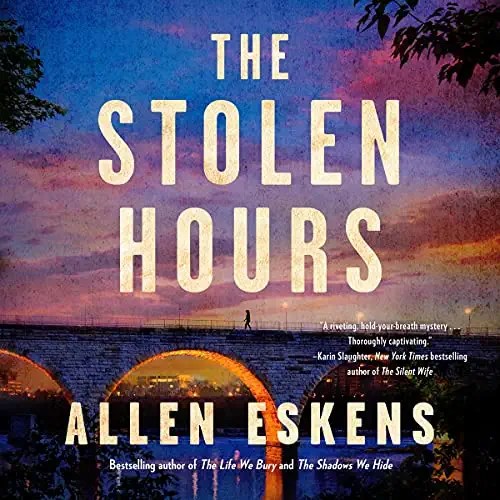
Eskens has written 6 novels and I’ve read 5 now. I’ve been deliberately skipping the one about ex-military people. I’ve enjoyed all of them although a couple weren’t quite up to the level of the first two. They’re mostly pretty different from each other.
The Stolen Hours By Allen Eskens 2021 Read by McLeod Andrews, Christine Lakin, Tina Huang 10h 1m Rating: A / crime
Five years ago Lisa S was raped and essentially left for dead. She managed to get on with life, married and became a prosecuting attorney in Minneapolis. In her year as a clerk in that difficult office she got involved in a case of serial rape and murder of young women. The man who is doing it is rich and angry. He was involved in Lisa’s rape, too.
It’s a good yarn – Eskens always provides that. His characters are somewhat stereotyped a bit, but they’re believable. The twists are occasionally predictable but sometimes not – like the ending of this book is quite a surprise. And the tension is very skillfully built.
The 3 narrators add to the whole and I don’t often enjoy multi-narrator or cast-type productions but this isn’t a cast-type production.
I’ll likely read his next books but I won’t stand in line waiting.
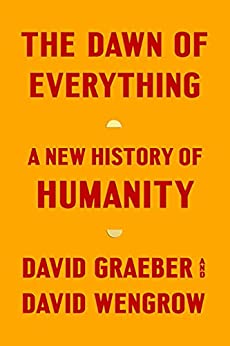
This book is said to be ground-breaking work on the level of Pinker or someone (not quite up to Rousseau or Hobbes). Yes – maybe but … with a lot of buts, actually. I’m not an expert on current thinking in these fields so I don’t know if it’s the publishing company which is pushing the idea of “ground breaking” or it really is. I suspect it contains some really new ideas, however it needs a good editor.
The Dawn of Everything: A New History of Humanity By David Graeber and David Wengrow 2022 / 702 pages Read by Mark Williams 24h 2m Rating: 8 (average of 10 and 6) / pre-history (Both read and listened)
Graeber and Wengrow are supposed to have developed some kind of new paradigm for thinking about mankind’s origins and the development into communities. I suppose maybe it is that, I was certainly not taught what is here. But I do think this is really valuable and a step or two in the right direction.
In the olden days of college (late 1960s early ’70s) I was taught about the extraordinary leap that agriculture made possible for the story of humankind. We suddenly went from nomadic hunters and foragers to agrarian husbandry so we were able to add priests and politics and arts in the cities where we now lived. Improvements in the quality of life were made or available for everyone. That was thought to be a huge leap for mankind and maybe it was the basis of all our progress or the root of all our problems. That’s what I learned from William H. McNeill’s World History text but it’s not how Graeber and Wengrow see it.
What I got out of this brilliant but horribly muddled study is that the way it’s been taught might not have been the way it really was. Also, is certainly not the way it had to be. There were a LOT of options all along the way and many times these options were taken by the people who lived in those times. I was taught that the Agricultural Revolution (capitals) was pretty much an all or nothing advance in “progress.” The authors of The Dawn of Everything have communities sometimes going back and forth accepting agriculture or not and in all sorts of partial ways.
It seems that starting with Rousseau, European thinkers saw the ideas of certain men as being the only “right” way and those explained the way of all progress. Thus began the Enlightenment which has largely led us to today, in the West anyway, and we haven’t changed much. (The past tends to look inevitable when observed from the vantage point of the present.)
Nevertheless, the authors of The Dawn of Everything looked for other ways the world and its people could have “evolved.” And in looking over the history including that of Africa, Asia, and the Americas Graeber and Wrengrew found many alternatives not discussed by anthropologists, archeologists and historians – or not much anyway. The major point here is, as the final line of the books says, “We know, now, that we are in the presence of myths.”
I guess what the authors are saying is that they might not know the answers exactly, but the old ideas built around a great Agricultural Revolution changing everything are not correct. The ideas skip too much and treat the past as though it were obvious and the only way it could have happened. That in itself, they view as a myth – and I agree.
But that doesn’t mean I agree with whatever else it is they’re trying to say. And the way I was taught still makes the most sense to me if we’re looking for generalizations.
This is an old one (1993) but it was on sale at Audible and it looked pretty good. I’m a fan of good True Crime and Jack Olsen used to be among the best of crime reporters. By the time the book wound up I understood why he got called the Dean of True Crime Authors.
The Misbegotten Son: A Serial Killer and His Victims: The True Story of Arthur J. Shawcross By Jack Olsen 1993 (493 pages) Read by Kevin Pierce 18h 11m Rating – 8 / true crime
I used to pass on serial killers so I simply would not have read this. Now? I just finished Maxine Paetro’s 21st Birthday (with James Patterson) which was terrific for a novel so I can do this. Years ago, shortly after my divorce, a friend recommended Silence of the Lambs. I got to Chapter 2, closed the book and took it outside to the trash. I just couldn’t stand the horror. And the next time I picked books I checked out the True Crime genre because, “Who cares what a person can make up?” I was disgusted with fiction. That was in about 1994 and I didn’t read mysteries for quite a long time, maybe 15 years, but more recently I’ve seen a few come out I just couldn’t resist.
The subtitle,”A Serial Killer and His Victims,” pretty much says what it is more directly and the final line, “The True Story of Arthur J. Shawcross” let’s you know the specifics.
A lot of this book is very interesting but there’s more graphic violence against women than I’ve read before. This is pretty sick stuff. But it’s not in any way titillating so that keeps it in the crime genre for me. .
Per Amazon, this is “an account of the crimes of Arthur Shawcross and describes how the paroled child killer shot, stabbed, suffocated, and strangled sixteen Rochester, New York, prostitutes and examines how the legal system failed his victims.”
The narrative consists almost entirely of dozens and dozens of interviews the author had with as many of the people involved as he could get. The parts told by Shawcross are from interviews as well as written reports, but there are the tales of his girlfriends, the police, the street prostitutes (his usual victims), doctors and others. They organized pretty much along chronological lines with an occasional well done foreshadowing. The psychologist’s perspective is presented in the last chapters of the book and to me proved to be particularly interesting. It was definitely different from what I’ve read in either True Crime or mystery novels. There’s a feeling of “real” to it.
Because “real” covers a lot of territory. Shawcress doesn’t fit the mold of serial killers before or after his deeds and arrest. He’s anti-social for sure, but is he legally insane? “He’s legally odd,” says the psychologist.
There are places where it’s repetitive, but sometimes details or contradictions are added onto the repetition. It seems that most of Arthur’s troubles stem from his mother and his military service in Vietnam.
The guy was such a sad case. He wasn’t like the serial killer in 21st Birthday. The stories are not totally dissimilar. Patterson’s guy wasn’t really believable but who knows? Arthur Shawcross, as presented by Olsen, was totally believable but then it’s True Crime and it felt like it.
Jack Olsen has written a lot of books, some True Crime, some nature books, some military action. Many have been huge sellers. I’d just never heard of him before. I’ve got another one my wish list now. Being older doesn’t seem to affect the quality.
I don’t know about James Patterson, but I do enjoy the collaboration between him and Maxine Paetro for The Women’s Murder Club mysteries – I’ve previously read two books by Patterson alone and they seem rather dry and extra violent to me. Paetro doesn’t really spare the violence, but there isn’t anything “dry” about her writing.
21st Birthday By James Patterson/Maxine Paetro Read by January LaVoy 8h 50m 2021 – (417 pages) Rating A / crime procedural (#21 in The Women’s Murder Club Series)
Tara Burke’s mother is really screaming this time – Lucas, Tara’s school teacher husband, has murdered Tara and taken the baby! She knows it. She gets ahold of Lindsay Boxer at the police department. Finally Lindsay, the main star of the Women’s Murder Club mysteries, listens to her and does some checking. Both Tara and her baby have been missing for days and we find out that Lucas had a serious teenage girlfriend. Then the baby’s body washes up and the body of his girlfriend is found.
But Burke has alibis and he has other suspects in mind. He says he was with his ex-wife at the beach and then, later, that his father is a serial killer who probably killed them all.
So that’s a twist on the usual procedural and as usual it turns into a legal thriller with an assistant district attorney, a news reporter and a medical examiner as added attractions. These are the regular characters of the Women’s Murder Club series. Claire, the medical examiner and Cindy, the reporter, have smaller roles in this book but that’s kind of usual I think.
I’ll be looking for more of these books or reading some of the earlier ones, but I can’t do them too close together because they usually involve fem-jeop – females in jeopardy.
Confession time – one of the reasons I read/listen to books so much is that I have tinnitus (ringing in ears) and I often can’t do silence. I can fall asleep (usually) but just sitting around in an empty house can make me nuts. I used to keep the TV on but that gets really old.
A Good Provider Is One Who Leaves By Jason DeParle 2019 / (400 pages) Read by Fred Sanders 11h 44m Rating: 8 / nonfiction
So I listen to books and I get them as needed from Audible or the library and on sale or not – wherever. I don’t usually buy or borrow more than one at a time and read as I go. With a good sale I might buy three or four. I don’t like listening to two really good books back-to-back so sometimes I spread them out with memoirs or crime novels in between.
This is a sale book I got about a week ago which looked interesting and had excellent reviews although for awhile I didn’t think it was going to pan out so well. I’m delighted to report that it turned out to be excellent. When it started looking like a winner, I checked the Kindle version and it seems kind of pricey and it has no graphics (that I saw). But it does have a fine looking chart of family members as well as a Note on Sources and Methods, a formal section on Notes, and an Index. It was a toss-up and I passed.
It was published in 2019 which means it was probably written in 2018 and that leaves Donald Trump as the guy in White House, building his wall etc. This shows in the book. Fears of deportation abounded. Covid-19 had not yet hit and so unemployment of unskilled US citizens was a huge concern to his supporters. It’s the upper classes who benefit the most from the immigrants, legal or not, due to the lower labor costs they bring.
The narrative is divided into two parts – Part 1 really focuses on the story of one Filipino family doing its level best to get migrant status jobs in foreign countries (any foreign country with wages) to make money to send home where it’s desperately needed. Getting a Visa alone is a multi-part task including education, English proficiency, testing, and paperwork. By the end of that I was kind of tired of hearing about the troubles of this one three-generation family. In Part 2 my interest perked up as DeParle’s focus turned to the history of migrant workers in the US and the situation now.
The US is home to about 10 million migrant workers in any given year, but beyond that the numbers are difficult to come by because different agencies take care of different categories and definitions. These aren’t “illegal” or “undocumented” immigrants. These are skilled citizens of other countries who carry valid Visas permitting them to be employed by companies in the US. They usually have jobs before they get here. The biggest reason for the US using migrant workers is that we don’t have enough trained people to do certain jobs. These migrant programs started here back in 1848 (yes, following the Mexican War), but boomed in the 1960s when Reagan and his successful, although somewhat abused, Bracero program for farm workers initiated while he was governor of California.
DeParle deals with one family from the Philippines for a period of about 30 years but he also includes some fascinating US material on the use of eugenics, backlash, fear of Bolshevism, desire for cheap labor on the part of business and “racism” and xenophobia on the part of the Anglo-Americans. Then to balance all that came the quotas.
When I got back to the family (Rosita) in the US it was a pleasure. But then in chapter 13 the focus was back on the larger picture, American society and immigrant problems. There are both benefits and drawbacks and some of it depends on who, what and how you count.
Let me start off by saying that I’m becoming a huge fan of Olga Tokarczuk. This book, having taken six or seven years to write, was first published in Poland in 2014, but it wasn’t translated into English until after she’d won the Nobel Prize in 2019. It was finally offered to the English-reading public in 2022 and on the basis of her prior books, Flights andDrive Your Plow Over the Bones of the Dead – I promptly bought it. It took me all of 5 days to read (a rather long time for me) and I should probably do that again but that would be quite a project. It’s a huge book in many ways.
The Books of Jacob by Olga Tokarczuk Translator: Jennifer Croft 2014/ 912 pages read by Allen Lewis Rickman, Gilli Messer Rating; 9.75 (both read and listened)
It’s a long, lush epic of carefully researched historical fiction. But rather than being a family saga or a biographic novel, it’s more of a “sect” or “cult” novel. It’s based very closely on the life of a real life “prophet,” but it’s still fiction. It’s also a beautifully written, nicely translated, wonderfully narrated and marvelously complex tale of a charismatic leader with hundreds of followers focused on some inner circle leaders and their families. It’s a wonderfully mesmerizing book, but I think it might not be for everyone.
The story is divided into seven basic parts, “The Book of Fog,” “The Book of Sand,” “The Book of The Road,” “The Book of The Comet,” “The Book of The Distant Country,” and “The Book of Names.” This gives the work its title.
Essentially taking place near the Dniester River in central Poland between the 1750s and the 1790s the story extends to the mid-20th century including references to the French Revolution and that aftermath all the way to the end of World War II. Most of the book concerns the period following the echoes of the Counter-Reformation in which the Catholics are still superstitiously focused on maintaining their power by force.
There are dozens of characters living under sometimes tortuous circumstances all bound up with some of the finer points of 18th century Central European Catholicism and Judaism. Because what’s happening is that a group of Jews, dissatisfied with their lot and intrigued by Christianity, has found a leader. He’s one of their own, a traveling prophet from a town not too distant who gathers a number of these people and convinces them to join with him in claiming that he, Jacob Frank, is the new Messiah by way of reincarnation. This makes him the third Messiah starting with Jesus.
This group which had been followers of Tzvi decides to actually join the Christians, at least in appearance, although it’s certainly Frank’s idea. That doesn’t sit very well with most of the non-Frankish Jews so this new group is persecuted from two directions. They go to the Catholics, but there’s not a whole lot of immediate welcoming and Frank, a charismatic and possibly psychopathic personality, spends many years in jail while his followers remain dedicated. And when he gets out he is still most definitely “the Lord.” So, as the author says, “Frank and his followers carried out a multilateral, multifaceted rebellion and fell afoul of everyone.”*
I Googled what I could, names and events, ideas, and only a very few seemed really fictional. Tokarczuk’s book is not as “accurate” as Hillary Mantel’s “Wolf Hall,” but that’s the general idea. And I don’t think the eponymous Jacob Frank is ever as intimately portrayed as Mantel managed with Thomas Cromwell.
I have to mention the focus which Tokarczuk puts on the women. The book is certainly not about the women but their perspective is vital to the whole story. This is pre-Victorian era so there are really no “strong” women characters are we read about in the 21st century, these women have their place in society and there is really no choice about that. But they certainly are a force of their own with their own ideas and doings. I am really impressed by the way this was done.
As I said, I know I “should” read this again. I got the basics and that’s it. Dwight Garner of the New York Times book reviewer, called it “overwhelming,” and yes, it is rather. It’s also rather “Chaucerian,” as Garner says, continuing his excellent although certainly not glowing review, in that it tells the stories of so many characters.
There are a formidable number of characters, but after awhile, 25%?, the reader knows the main ones. At times there is an omniscient narrator, but at other times various 1st person narrators give their perspectives and an originally living woman named Yenta becomes what Tokarczuk, in an interview, calls a “4th person narrator” – a ghost. There is also a wonderful sly and satirical sense of humor mixed with the darkness of some of it.
In terms of ideas I suppose that this covers it: towards the end, one of the main characters says, “I know there is one God but there a great many ways of believing in him.” But it’s not a philosophical book, most of the action is quite active – this is not The Magic Mountain (Mann).
I reread this for a discussion group and as usual, I got a whole lot more out of it the second time. A WHOLE LOT MORE!!!! (1st review is here) Now I’m might have to have to read The Sixth Extinction for which this same author won a Pulitzer. (Or I might just subscribe to the New Yorker to keep up.
Under a White Sky: The Nature of the Future by Elizabeth Kolbert 2021 / 258 pages Read by Barbara Lowman 6h 21m Rating: 8.5 science/environment (Both read and listened)
This is a terrific book and it’s comparatively short, but it’s not an easy book. The style seems like it should be as easy to digest as it is easy read but the essays are filled with details which all build to a specific theme – IT is a collection of essays at least some of which were previously published by The New Yorker.
The Part 1 of Under a White Sky just starts right out in Chapter 1 without any kind of Introduction or Prologue so with my first reading I felt rather dumped into a book about something about which I really knew very little and I had no idea where it was going except I did suspect it was about the environment because that’s what the blurbs said. And the subtitle, “The Nature of the Future,” is cute but not very specific – heh.
With my second reading I was promptly involved, hooked actually, from the start and the book is SOOOO good – in so many ways. (I think I just appreciate formal Introductions.)
The whole did come together for me about midway through Part 2, “Up in the Air.” I’d glimpsed a main theme in Chapter 1 where Kolbert actually says some things about fixing the mess(es) which have been created in trying to fix the problems with dumping sewage into the river. – And that, in a tiny nutshell, is the theme of the whole book.
The rest of the book deals with specific problems along those lines with the final chapter being more of a summing up and projection than there is anywhere else; it’s a good summary or conclusion perhaps, but don’t start there!
Part 1 – Down the River The problems of the Mississippi River from Chicago sewage to the Mississippi Delta
Chapter 1 – it’s all connected and fixing one aspect often creates problems elsewhere (major theme of the whole book). The course of the river was changed and eventually dramatically affected 2/3rds of the US land mass It also gave us the problem of the non-native Asian Carp and relocating Bayou residents.
Chapter 2 In New Orleans the levees which were built to prevent flooding also prevented sediment from getting through to maintaining the entire environment of southeasternmost Louisiana. Now it’s getting so there’s precious land left, it hasn’t been rebuilt after hurricanes etc. It’s one of the fastest disappearing places on earth so residents have to be relocated. Can it be fixed? Will it be fixed?
Part 2 – Into the Wild – Chapter 1: Pupfish of the desert – how have they managed to survive and how can we keep them because they are going extinct due to the stress of the environment and their loss of fins.
Chapter 2 The collapse of the Great Coral Reefs due to warming and stress impacting the reproduction of many species which live in the coral. Darwin was amazed –
Chapter 3 We now have genetic engineering and CRISPR with synthetic gene drives to do the desired rearranging of “nature,” this would include a fix for the Coral Reef problem. Plus we now have home-kids as well as other methods of “unnatural” selection to help alleviate the proliferation of Cane Toads and mice. The problem is not about about going “back” to nature. Nature, as we knew it, is not coming back. It’s about what are we going toward.
“Sometimes doing nothing is better than doing something. Sometimes it is the other way around.” (Paul Kingsnorth). But at this point, what is the alternative?
Part 3 – Up in the Air This is the early Anthropocene hypothesis:
When did people start altering the atmosphere? -Development of wheat and rice and chopping and buying their way through forests so carbon dioxide was released.
The idea of those who subscribe to a ‘late Anthropocene” era is that it started around the time of the detonation of the atomic bomb.
But there was a level 7 volcano in 1815 and it affected the world’s atmosphere dreadfully – it was gray and grim all over. The anthropocene could have started about then.
If, in 10 years, we decide we want the government to do something, it’ll be too late. There are ideas around but they’ve not been tested to well enough. Many have failed like cloud seeding, a bridge across the Bering Straight,
There have been a lot of projects which have worked fine. Yes, there’s the Toad but there’s also agriculture. Bugs were used in Africa. More are being considered. If people think that solutions are on the way will that dampen their enthusiasm for cutting down. Yes, but the opposite may also be true – it may encourage them. There is pressure to have a happy ending.
Geoengineering looks like it might be easy – to deliver aerosols by SAIL (super-planes). Bur it’s not and it’s highly controversial.
Ending – there will likely have to be several strategies involved; deep emission carbon reductions, actual carbon removal, refreeze the poles, sunlight reduction schemes so new ice can be preserved and there are more intense and invasive things.
And then comes the scary stuff.
I keep saying this – go read Appleseed by Matt Bell – (my review) – it’s terrific fiction about this very thing – fixing messes which were made while trying to fix messes or what didn’t suit us.
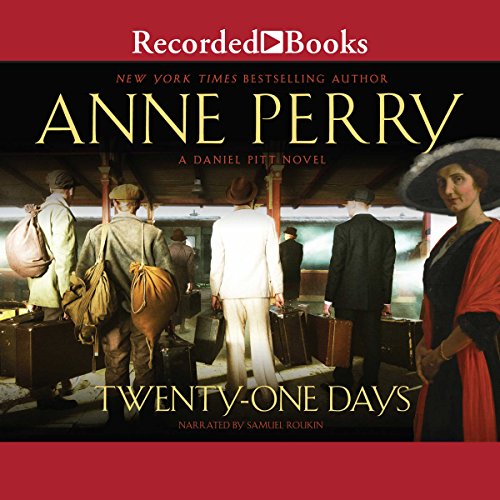
I don’t know why I hadn’t tried any of Anne Perry’s books but for some reason I never had. The English author has been publishing novels since 1979 (43 years?) at the rate of about 2 a year and they are usually available in the US – I see them on the stands and online. Yes, I know something of her background, but that was childhood – tragic and horrific but, at the age of 15, she was still a child. I’m really happy with this first book, the first of the Daniel Pitt series, which was published in 2017.
Twenty-One Days By Anne Perry 2018 / (321 pages) Read by Samuel Roukin 9h 24m Rating: A+ / historical legal mystery (Daniel Pitt series #1)
Russell Graves has been found guilty of murdering his wife Ebony and is set to hang in 21 days (hence the title). His attorney, Daniel Pitt, mostly still believes that Graves didn’t do it. But if not him then who, and can they get this solved before he’s hung in 3 weeks? It looks like Graves has been set up or framed, but why? Because he’s currently writing a book telling tales on lots of people, ugly tales.
Graves is the author of biographies his latest about someone in the spy business. But he himself now has a dead wife. Russell is not a nice man. He’s arrogant and inconsiderate. He has problems with honesty and ethics. He’s a natural suspect, but he’s rich so he might well get away with it. But there are probably many people who wish Graves dead so there are plenty of suspects. It gets twisted.
I’d seen this at Audible for a long time and it was on my Wish List and suddenly one day it was on sale! Oh, oh, oh! And as soon as I finished Blood and Treasure I opened it up. I got the Kindle version too because there are tempting illustrations and notes. Sad to say it didn’t live up to the promise/hype. 😦
The Lost Gutenburg Margaret Leslie Davis 2019 / 294 pages Read by Coleen Marlo 6h 25m Rating: 6.5 / history (Both read and listened)
There are places this book is interesting but there are other places it is totally boring. It details the course of one Gutenberg Bible, originally printed in the 1450s, and one of the remaining 48 (some incomplete) of the original 180 printed on paper. But there is a lot of time and space spent on tangents to make a single book. It might have made a good magazine article.
The structure pretty much goes through the owners of this particular Bible (#45) and their biographies chronologically, but it starts with a chapter for Estelle Doheny who obtained the Gutenberg in 1950. When she died it went to the LA Archdiocese who eventually sold it to Keio University in Japan.
Davis writes well and Coleen Marlo reads it nicely, but I was aggravated by the routine use of the present tense which is done probably because the book is frequently boring. But this is not a present tense book – it’s history. “Dyson follows suit” would be better if it were written as “Dyson followed suit.” (p. 76) It’s okay to do that sometimes, but in this case it’s a bit over-the-top.
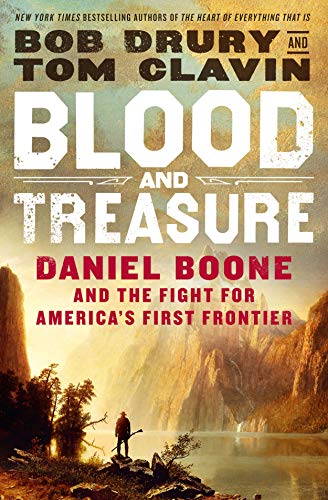
It’s a good thing I’m reading this because I’m one of those folks who would get Daniel Boone and Davy Crocket mixed up from time to time. No more of that! Daniel Boone was a real pre-Revolutionary War pioneer, helping small groups of settlers to get located in what was known as “wilderness.” Meanwhile Davy Crockett was born in 1886, post-Revolution, and was more of a frontiersman, enjoying life in the wilds for its own sake. https://www.brianacrandall.com/blog/danielbooneanddavycrockett
Blood and Treasure by Bob Drury, Tom Clavin 2021 / 384 pages Read by George Newburn, 11h 23m Rating:8.75 / US history-biography (Both read and listened)
That said, it appears everything I learned about Boone or Crockett (the myths, I guess) from school, Disney or parents was skewed. The book Forget the Alamo: by Burrough, Tomlinson, and Stanford improved my knowledge about Crockett (my review on site). So now I could probably stand to read this book again – it’s surprisingly packed with information. It turns out that Daniel Boone was more than his wrongly debunked myth suggested, while Davy Crocked was somewhat less than his myth would have us believe.
Also, I must say that this book is a rather literary rendering of the life of Daniel Boone. Drury and Clavin use a traditional chronological structure, but their vocabulary and syntax are a healthy step above the average history books I’ve read. For instance:
“A frisson of excitement passed through the company when the imposing mountaintop outcropping of sandstone and conglomerate known as the White Rocks hove into view. Wilderness lore held that the pale cliffs, hanging in the sky like phantom drifts of snow, were only a day’s travel from the notch in the mountain.” Page 126
I wanted something to follow up my reading of Fred Anderson’s brilliant “Crucible of War: The Seven Years’ War and the Fate of Empire in British North America, 1754-1766” which was published in 2000, but is really excellent and it’s quoted in Blood and Treasure. That book ends with the colonies being a bit more solid and cohesive in their ideas of unity, but it also shows a less than glorious future for the Crown, even though they and the Colonies were supposedly one. The trouble was that the Brits couldn’t control the peace due to colonists’ determination to settle where they wanted, agreement or no. The colonists felt they’d won, too, so the King couldn’t just bar them from the land the way the Proclamation of 1763 stated.
As the Anderson book ends, peace had been gained and the French had lost their rights to the land to the British who took over. But what about the Natives? On page 354 Drury and Clavin repeat the assertion that “Euro-Americans did wage a protracted war to conquer Indian nations to acquire their lands and its resources.” Protracted in this case means 300 years and I suppose that would be from 1619/20 (with the Puritans coming to Massachusetts and slaves/women/House of Burgesses introduced in Virginia) to 1918 (the last Indian battle) – or thereabouts.
Daniel Boone (1734-1820) lived right at this time. The French and Indian War started in 1754 and although it was mostly fought north of where Boone was, a lot of the issues between the British, French, and Indian interests were the same, to say nothing of those of the Colonists themselves. There were battles all up and down the East Coast west of the Appalachians and the Alleghenies from North Carolina to Canada.
This book is full of detailed personal and historical information and it’s well sourced, too and with additional footnotes. It’s a biography of Daniel Boone but there’s quite a lot about the era which could make a book of its own (and probably has). The Morovian Protestant denomination and the well documented massacre of them; 96 unarmed men, women and children were savagely killed. They were mostly Natives (Delawares) although not entirely, and their religion was somewhat like the Quakers. Now that massacre OF Indians was completely new to me.
Tidbit: And I’ve read that although beer was a staple in the colonies because the water was so bad and the beer so week. Ha! But okay, maybe in town or at home, but there were places (and Boone frequented a few) where the corn liquor was “ferociously potent” and readily available at the “pot and plank alehouses known as ‘ordinaries…’”. P 39 These were apparently willing to serve whomever came in with the cash. Somehow that tidbit just rings true.
“It’s harder than you might think to take people hostage when they’re idiots.”
Anxious People by Frederick Backman – Norway 2020 (349 pages) Read by Marin Ireland Rating 7.5 / general fiction
In a very small city in Sweden, a bank robber is having a terrible day. The bank he has chosen to enter with what he thinks is a toy gun is, to make things worse, cashless; they only transfer payments between accounts. This information unnerves our troubled bank robber, so he runs outside and then into an apartment which is being shown to a group of potential buyers. Someone from the bank calls the police who up almost immediately. They interview a teller at the bank while the group at the apartment just stands around not noticing anything different.
The group viewing the apartment includes 2 couples and a single woman. The first couple is retired and they buy apartments to fix up and flip. The second couple is having their first child but they’re lesbians so that’s an added complication. The single woman is a banker herself, as it turns out; she’s just observing for her own purposes. But that small group of potential buyers grows.
The cops interview everyone involved and it seems each one of them has a serious issue or two – personality problems usually. And the reader gets the background stories of the bank robber and a therapist, too. The story then commences in a complicated and funny, but more or less chronological sort of way. It’s supposed to be heart-warming but I enjoyed Backman’s Bear Town, which I read earlier this month, more. (review on this site)








 Becky's Books -