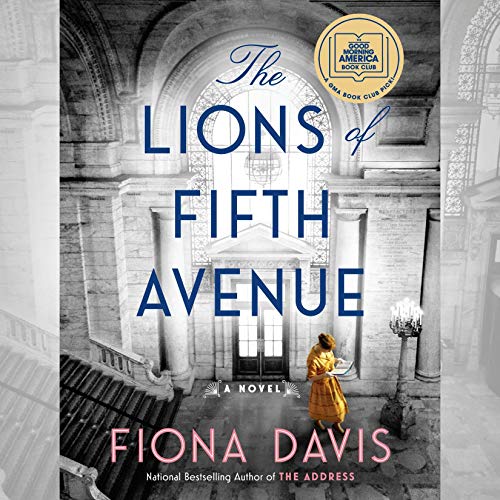
If you like what I like, don’t bother with this one. I’m not sure why I thought it looked good enough to check out. I’m not big on books about libraries because they seem too specifically targeted at one audience – the women who identified with Jo March in Little Women and with Nancy Drew in those books. And when you throw in historical fiction and a bit too much romance, it gets soppy.
The Lions of 5th Avenue by Fiona Davis 2020 / (363 pages) Read by Ellen Bennett, Lisa Flanigan 10h 37m Rating: 7.5 / historical mystery
In 1913 Laura Lions is a married mother of three and wants something more in her life. She and her family live in an apartment inside the New York City Public Library where her husband Jack is employed as Superintendent while writing a novel. They don’t have much money. Books from the library go missing. Laura wants to try a career in journalism and goes back to school at Columbia University. There is a lot of talk about freedom and women’s rights. Laura feels trapped.
In 1993 Sadie, age 23 or so, is the granddaughter of Laura Lions and struggles with having achieved the freedom sought by her mother’s mother, but still wanting to be married with children. Sadie works at the library where there have been a series of thefts of old books, some quite valuable. So Sadie investigates and meets Nick Adriano, from a private security firm.
The chapters alternate between the time frames as the two plot threads catch up with each other and find a satisfactory conclusion. There isn’t much interplay between the stories but they do mirror each other in several ways and that’s quite interesting. A healthy suspension of disbelief was necessary for me, but the story was apparently compelling enough that I managed. And Davis gets an A for tension building, especially in the last 15% (?) which is page-turning.
But the story line is predictable (for me) and holds to today’s standards (not those of 1914) so female readers will be comfortable. There’s even a typhoid vaccine being pushed in the 1914 story.
There are lots of ideas and themes to explore but they boil down to women’s choices and duties – motherhood, responsibility, careers, ambitions and husbands.
If this book had been much longer I wouldn’t have bothered to finish. As it is I was glad it came from the library. The writing is about a 7th grade level (if that) with content at about 11th grade. I suppose it would make a nice young adult book (ages 15-22). If there were a high school women’s studies class someplace …
This is a really good book but it gets complicated even in the structure and organization in part because much of it works together.
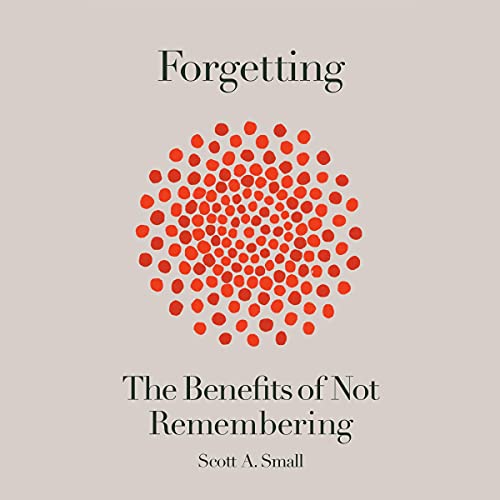
Forgetting: The Benefits of Not Remembering By Scott Small 2021 / 211 pages (print) Read by Timothy Pabon 5h 49m Rating: 9 / nonfiction – psychology
1. To Remember, To Forget: The general benefits of forgetting: “Funes” by Jorge Luis Borges
2. Quiet Minds: Is autism – the need for sameness – parts or pieces more important than the whole (Arcimbaldo paintings) jigsaw puzzles with the box or not? Deficits in pattern – processing social stimuli – same as processing facial features – Autism results in not remembering the pieces to put them together? It’s all new every time? We forget in order to cognitively generalize. (Pg 43)
“Both artificial and natural intelligence depend on forgetting to generalize and reconstruct the whole from the parts in order to categorize and label even when they vary subtly infinite ways.” (Pg 61)
3. Liberated Minds: PTSD – remove power of memory – Israeli conflicts – final category of PTSD is relevant to forgetting and is called “extinction” (ability to forget the trauma). But how to avoid PTSD as the author and buddies did? Also the mechanics and the whole important idea of forgiving.
4. Fearless Minds: Two personalities – cousins. B is bonobo and C is a chimpanzee – together they are Pan genus. But should Homo sapiens be there too? DNA lead to a new taxonomy but the old is not irrelevant. Humans seem to have some of each, B & C. Then there’s fight, flight or fright.
5. Lightening Minds: Dementia and Creativity (de Koonig and Jasper Johns) – when does dementia begin? What is Alzheimer’s and how different? Does this forgetting affect creativity? https://www.moma.org/interactives/exhibitions/1997/dekooning/Johns recommended sleeping and Francis Crick (Nobel DNA) did studies on consciousness and sleep.
“We dream in order to forget.” To clean the spines which collect new memories. No wonder babies sleep so much – there is so much that is new to them.
6. Humble Minds: Personal biases – same ideas as “Noise” by Kahneman Doctor friend feels he has a poorer memory than other doctors. Maybe true – his own dad was like that. But why very high intelligence if poor memory? Less hippocampal functions were higher. Short term memory – pre-frontal cortex is large. Pieces which act collectively. Working memory for manipulation and decisions comes later so children have trouble controlling their impulses.
Metamemory – how well do we assess our own memory. Alzheimer’s patients sometimes know they are losing their memory but some don’t understand they are losing it. Sometimes we are wrong and need to be able to admit it and change our minds – intellectual humility. His Dr X sounds like a generally humble guy. Kahneman and Tversky – Cognitively lazy heuristics humans don’t think through the bat and ball question. Much here is repetitive of Noise and Thinking Fast, Thinking Slow. Memory priming – implicit and explicit memories. Internal indicators in some very mathematical minds – superior pre-frontal cortex will override fast-thinking.
7: Communal Minds: Dementia – Joan and her daughter. forgetting names and how that feels to the person to be named, the loved one. Caring depends on memory. Letting go means forgetting – the brain’s emotional forgetting. Forgiving a nation – Jews. Civil War and canceling and so on. “Returning home” homesickness, extreme nostalgia and a “brain on fire” with too many memories. The doctor Jonathan Hofer understood in 1688. PTSD is toxic emotional memory “hypermnesia” – nationalism. Forgetting – memories overwhelm ethical IQ. In US it’s 9/11.
8. Epilogue: Pathological Forgetting – the cause is defective proteins. It took a long time to acknowledge Alzheimer’s as a disease of dementia/senility and a very wide-spread one. It’s the tail end of the aging process although there is a rare early-onset form. People want to know how to fix it. But then everyone was scared they had it. Small tried to locate earliest stages. Technology had to catch up and show photos of hippocampi. The medical and pharmaceutical industries continue to research protein pathologies.
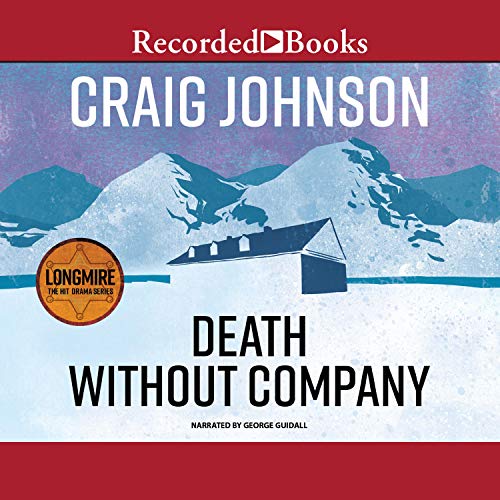
Death Without Company by Craig Johnson 2007 (271 pages) Read by George Guidall 9h 48m Rating: B / western crime (Longmire series #2)
Johnson’s Longmire series and the character are quite popular with some reading group friends so I’ve tried, but I think this is just not my cuppa. It also used to be a very popular TV series but that was cancelled due to demographics (an “old people” show). Out of 17 books I’ve read 3 and just not been able to really get into them. Dry Bones was tolerable, but Cold Dish (#1 in the series) and now Death Without Company (#2) were just flat to me.
Craig Johnson’s books are very similar to those of CJ Box’s Joe Pickett series but for some reason I enjoy the Pickett books a whole lot more.
The series takes place in north central Wyoming where Sheriff Walt Longmire drives his pick-up truck around the fictional Absaroka County to enforce the law. This is located in the very real Absaroka mountains where the local population includes the Absaroka tribe of Native Americans. And Longmire has a whole retinue of friends and assistants including Victoria Moretti, Lucian Connally, and Santiago Saizarbitori helping him out.
In this book he’s not young and has had some experience in the world. His wife is deceased, though, and he still likes women – to look at. It comes to Longmire’s attention that an old woman was murdered at the care home where she lives. She was poisoned. She is a part of the Basque community and then the relationships get more complicated.
Oh what a marvelous book! As I started it I wasn’t sure if I really wanted to get into it or not, but before long I was hooked. Thomas Mann can write the reader into a cozy corner of family and ideas and decadence of the 19th and 20th century Europe. Colm Toibin doesn’t quite get to literary level of Mann, but he definitely knows how it works, like how to do right by ink and paper.
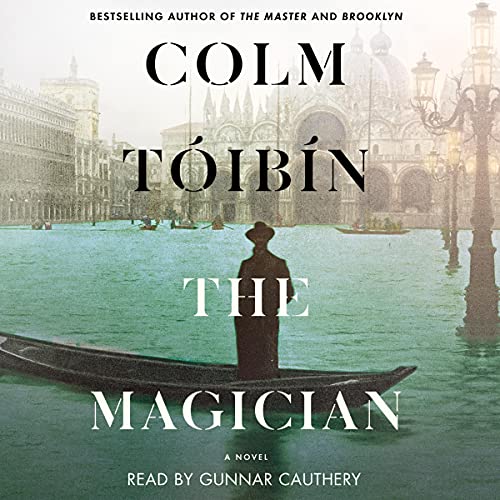
The Magician By Colm Toibin 2021 / Read by Gunnar Cauthery 16h 37m Rating: 9.5 / biographical novel
I think it would be a good idea for readers of The Magician to be familiar with the works of Thomas Mann, Buddenbrooks, Death in Venice, The Magic Mountain, at least before reading the Toibin book. And being more familiar with his biography than I was would be helpful. (I had barely a glossing – if that.) Mann wrote those novels (and much more) in the order above, so quite a lot of his life goes along with the novels chronologically. The book is actually called a “biographical novel” for a reason.
Toibin had an excellent resource in Mann’s diaries which were published a few years ago and there have been proper biographies, too. But Toibin brings his own sensitivities which work to bring a collection of facts to life. (Oh how cliched of me).
The book is written somewhat like Buddenbrooks: The Decline of a Family (1901). It’s a family saga in which grain, banking and the industrial revolution give the family its start. but the children and grandchildren have their own lives to live. This goes further in years than Buddenbrooks because Mann lived through WWII and well into the Cold War.
In The Magician, Mann marries Katia Pringsheim who was from a large and wealthy Jewish family. Thomas and Katia had six children and the family was very close. Mann won the Nobel Prize for literature relatively early in his career. They moved to Davos in Switzerland for medical treatment of TB but didn’t return to Munich because of the Nazi regime. Instead the Manns managed to move to the US. There he was active in opposing the Nazis while each of his children did their own thing in the world.
I suppose, and like Buddenbrooks, the 1st generation of Manns did wonderfully well and the second generation (Thomas and his siblings) did well enough to keep things afloat with Thomas “making” the family name, but the third generation fell apart. That may be the work of a broad brush, so don’t scrutinize too carefully. (However, if Mann did model Buddenbrooks after his own family and the Buddenbrooks Effect in business is developed from that well … I think it’s important to note.) https://www.theguardian.com/lifeandstyle/2011/oct/01/great-dynasties-buddenbrooks-effect-ian-sansom
Toibin is no Thomas Mann, but he’s quite a good novelist for quite a long time and having been awarded numerous prizes. He did the same kind of thing biographical novel with the life of Henry James in The Master (2004).
I shouldn’t have even bothered to put this up here. I don’t usually finish books as stupid as this one and I can’t say as I actually read the whole thing. The reason is that I slept through close to half of it and when I woke up decided to listen to the ending because I was curious. That doesn’t count as really reading a book but I did read the first 3 hours and the last hour or so – that’s about half of it.
The Wives by Tarryn Fisher 2019 / Read by Lauren Fortgang 9h Rating D and might even be DNF – ??
***Massive Spoiler Alert ***
The basics are that the 1st person protagonist has an affair with a married man and gets pregnant. The wife, who is unable to have kids, finds out. The wife leaves him and our protagonist person loses her baby and is then unable to have children. So the man, who has his own set of lies marries someone else but he can’t quite get rid of the mistress. There’s a lot of lying and story-telling – mostly by the protagonist to herself and on top of that she’s paranoid. Finally, at the end, there’s a shooting (no one dies), a trial and a mental hospital.
The narrator is totally unreliable and takes denial to a whole new level. When her troubles mount she creates an alternative reality going so far as creating or destroying physical evidence to prove it. At the end she’s still not well and creates more damage. Okay fine. Don’t bother.
Miles Cookson is an unmarried tech billionaire who, at age 40-something, finds out he has Huntington’s disease, an incurable, genetic abnormality of the brain. He likes to drive fast cars and work.
Find You First By Linwood Barclay 2021 / Read by GeorgeNewburn 11h 8m Rating: B+ / crime
Then, quite suddenly, Miles remembers that he donated sperm to a sperm bank maybe 20 years prior. Those children are grown now and they’re his children. His next project is to find them so he can let them know about the Huntington’s and to probably disperse his wealth. But someone is getting to the kids first – they’re dying before Miles can get to them.
The chapters alternate between various characters including Miles, his brother and sister-in-law, several of Miles’ kids and a few bad guys.
It’s a pretty good novel, complex and twisty but light almost to the point of humorous. The narrator, George Newburn, does a very good job. I think I’m going to have to read more of Barclay’s crime novels.
I’ve followed Richard Powers for decades and my opinion that The Goldbug Variations (1991) is his best stands. Now we have Bewilderment which has made the prize/award lists, but that’s happened before – he’s collected a LOT of awards starting in 1985.
Bewilderment by Richard Powers 2021 / (288 pages) Read by Edoardo Ballerini 7h 51m Rating: 7.5 – B / contemp SF
The story is about Theo Byrne who, after his wife is killed in an auto accident, is left to raise their volatile nine-year-old son Robin. Robin has been diagnosed with Asperger syndrome, obsessive–compulsive disorder, and attention deficit hyperactivity disorder. He’s a brilliant and hyper-sensitive handful.
The story is told in the 1st person of Theo as he tries to help his son grow up. Theo is an astro-biologist who works as part of a group seeking life in the universe. Even after several years, he and Robin still grieve the death of Theo’s wife and Robin’s mom.
The setting is a few years in the future and the end of life on earth is becoming apparent. Theo and Robin are more acutely aware of this than most. His mother had tried to warn people.
The book starts out very nicely but when it got weird I got confused and mentally turned off. Imo, Powers has mixed astronomy with the occult. I’m not big on occult. He tries to make it science but … well, not for me.
Even after being angry at Byrne for putting the child in the public school system I continued to try to like the book, but I couldn’t bring myself to do that. I was lost for most of it – I caught the gist most of the time (I think). I might reread it in January when it comes up for discussion in a reading group.
Powers isn’t noted for the quality of his writing so much as the originality of his thinking. But in this book the foreshadowing is terrific – “That may have been a mistake” leads one forward to the question why. “What’s going to happen because of this?”
And I’m going to have to at least try to reread this book for the poetry of the language. I did catch glimpses of that.
I’ve read a number of books by Erik Larson and mostly quite enjoyed them. However, imo, some are definitely better than others. The ones where there is a murder thrown into what is basically a moderately interesting history are not so good. That said, Larson’s skills are bountiful and he can make you keep reading even if it feels like blather.
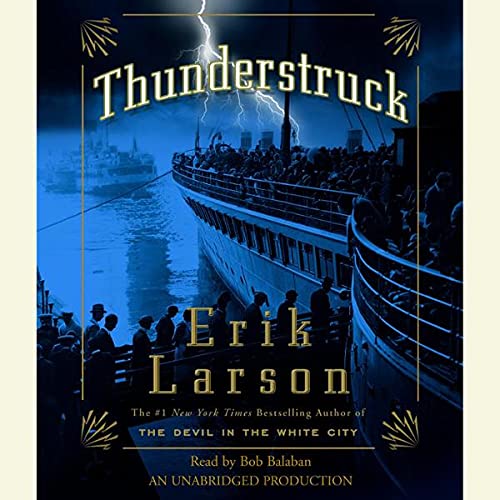
Thunderstruck By Erik Larson 2006 / Read by Bob Balaban 11h 56m Rating: B+/ nonfiction history crime
A bit of a warning – there might be spoilers below because in nonfiction spoilers don’t often count (for me anyway). A reader might very well know how a certain criminal gets caught and convicted well before he reads the true crime novel about it; she might know the points of the Treaty of Versailles before reading Paris, 1919; he might know why Marconi won the Nobel Prize.
On the other hand, there are less notable events in history – the 1893 Chicago Exposition’s serial killer for instance (The Devil in the White City by Larson, 2003) where spoilers might be an issue, depending on how the author structures and writes the book.
I’ve read these books by Larson and given them ratings:
9.5 • Isaac’s Storm: A Man, a Time, and the Deadliest Hurricane in History. 9 • In the Garden of Beasts: Love, Terror, and an American Family in Hitler’s Berlin. 8.5 • The Devil in the White City: Murder, Magic and Madness at the Fair That Changed America. 8 • Dead Wake: The Last Crossing of the Lusitania. 7.5 • Thunderstruck. 7 • The Splendid and the Vile.
Thunderstruck felt slow to me. Most of the book seemed to be about Guglielmo Marconi and the difficulties he had getting his long distance radio really going, while the other part was about Hawley Crippen and how, why he murdered his wife which mostly felt like the boring story of an adulterer/killer.
Most of Marconi’s part in the whole story takes place years earlier when he was doing his inventing which got him rich and famous. His first transatlantic wireless radio message was sent and received in December of 1902. Crippen’s problems started piling up in about 1908 or ’09. That’s the same year Marconi won the Nobel prize which is interesting, I suppose. Their paths never personally crossed but in 1910 their lives kind of touched.
I think I’d probably “categorize” this as being something between History and True Crime the difference being that genre True Crime focuses a bit more on the gory details of the crime itself and its resolution via arrest and trial or death or something. History is more general about the era and biographies of the important people in the story; History is something you study in school. True Crime is a special kind of “history” focusing on an actual crime or crimes and the actions of the people involved.
That said, Larson does True Crime pretty well in Thunderstruck, integrating a sense of Crippen’s times, 1910, into a tightly told tale of murder and investigation. It’s just that most of it is character development of real people. https://en.wikipedia.org/wiki/Hawley_Harvey_Crippen https://www.history.com/this-day-in-history/marconi-sends-first-atlantic-wireless-transmission.
As I said, it’s slow to start. The first 3/4 of the book sets up what we know is going to happen in the last 1/4 and by the time I got to the detectives digging up what might have been the remains of a body I’d already almost put the book down a dozen times. But after that first body gets found then the pages fly by and I was quite satisfied.
This book went on my Wish List at Audible when its upcoming publication was announced. I didn’t pre-order it because I just don’t do pre-orders. Over the last 5 years I’ve read maybe 25 “Trump books” either about him specifically or obviously inspired by him. I haven’t read one in about 3 months though (that was Landslide by Michael Wolff), so I was kinda hankering after something.
Peril by Bob Woodward & Robert Costa 2021 (506 pages) Read by Robert Petkoff 13h 35m Rating: 8 / history, politics
Peril opens with a long Prologue – a tale about General Mark Milley and the days of the Jan 6th insurrection. Miley had China issues and Nancy Pelosi to deal with at the same time Trump was falling apart under the stress of his grievous loss. Now the problem for the administration was how to protect the country from the possibly insane actions and reactions of the commander in chief.
Then the narrative backs up for Chapter 1 on Biden’s life and his campaign. This stuff is pretty well known. And the rest of the book is mostly about that last, crazy Trumpian year – 2020 – the year of so many things, so many crises and during which time our democracy was in a “perilous fight.”
A lot happened between January of 2020 and January 20, 2021 and a few months beyond. This book does a cherry-picked review of issues related to Trump’s incompetence and his determination to maintain his hold on the presidency. As such, it’s pretty fun. But as we lived it – or as the people involved lived it – it was scary.
There are a lot of things happening, many angles, many characters from Kamala Harris to Lindsey Graham but the structure is generally chronological and it’s usually easy enough to follow. ,
Towards the end, the “rogue memo” about Afghanistan made me laugh – how stupid – how 3-Stooges-like – or like a 6th grader. And also toward the end serious people really tried to talk sense into Trump and maybe it worked, all things considered. He did leave pretty much without incident after 1/6. And it looks like life is still going on – maybe into 2024.
Oh my – another fascinating book. (There are just too darn many good books to read and not nearly enough time!)
Forgetting: The Benefits of Not Remembering By Scott Small 2021 / 211 pages (print) Read by Timothy Andres Pabon 5h 49m Rating: 9.5 / nonfiction – psychology
There is a LOT of good information here. And it’s very interesting to me because I’ve had plenty of PTSD and right now my mom has dementia and is in a nursing home. Meanwhile I know I don’t get “enough” sleep. Also, fwiw, I was a kindergarten teacher for most of my adult life and I found it to be a very challenging and creative profession plus there were many autistic children in my classes. All of that and much more is addressed in Scott Small’s new book – !
Forgetting arises when other competing traces interfere with retrieval and inhibitory control mechanisms are engaged to suppress the distraction they cause. … Thus, our findings demonstrate a cortical pattern suppression mechanism through which remembering adaptively shapes which aspects of our past remain accessible.Mar 16, 2015 https://www.ncbi.nlm.nih.gov/pmc/articles/PMC4394359/
The book starts relatively slow and easy. The material was mostly new to me, nicely presented, easy to follow and it made sense. As the narrative went on it presented more complex information, was not quite as easy to follow and even seemed somewhat counter-intuitive at times.
Can you recognize faces? – People with Autism might not because they pay quite a lot more attention to parts. The paintings of Giuseppe Arcimboldo are mentioned: https://en.wikipedia.org/wiki/Giuseppe_Arcimboldo
So this book covers the autism spectrum, PTSD, creativity, Alzheimer’s and more. The artists William De Kooning and Jasper Johns are discussed (and Johns is interviewed). Small covers some of what we can do about and with memory loss – aka forgetting.
And then there’s the relationship between IQ and memory – fascinating stuff. There is a relationship and there is some interaction can be seen when testing is done. But IQ is not a function of memory or vice versa.
Dreaming is very good for creativity and artists and scientists. The body’s need for sleep has remained a mystery. We are forced to sleep more than what it would seem we need, but still, it’s essential. Why? That’s unknown, but as Francis Crick who, with James Watson, identified the double-helix structure of DNA said, “We dream in order to forget.” He called it “smart forgetting.”
Finally, in Chapter 6 we get to Dr Daniel Kahneman, author of Thinking Fast and Thinking Slow, father of the decision-making field, who, with Amos Tsversky, published a revolutionizing paper entitled “Judgment Under Uncertainty.” He won the 2000 Nobel prize in Economics and developed the ideas of “neuro-economics” which examines the insights relating to heuristics and biases. https://www.verywellmind.com/what-is-a-heuristic-2795235
Some ideas I’m taking away: Some of cognitive heuristics are cognitive illusions and humans tend to be cognitively lazy. Some questions are not always purely rational. It was believed that our emotions interfere in the field of decision-making, but that’s not the whole story.
It was also believed that our emotions could buy us some rational thinking if we could approach a problem dispassionately because (ta-da!) the heuristics are built into our cognitive minds! The same way optical illusions are built into their pictures/contexts.
I’m going to make a point of reading this book again and I’ll get the Kindle book to go with it. For Chapter Six in print if nothing else but I’m sure I missed other parts.
In 2012 there was another major breakthrough with the development of functional MRI. Now there was a desire to measure the implicit involvement of the hippocampus in decision making. There is no judgement independent of hippocampal involvement. In fact, the hippocampus drives implicit memory associations. Caring depends on memory and not forgetting can interfere with ethical and moral decision-making.
This last chapter is hard – it deals with forgiveness and amnesty – (amnesia): Think Jews and slaves. The blotting out of a street name (or a statue) does not remove someone or some event from history.
There are ethical consequences to having too much memory. And then there’s pathological forgetting and how to fix that. It might be in anatomical biology- if we can find the source perhaps we can fix damaged proteins.
Oh my – so much info in such a small book.
Author: Scott A. Small M.D. is the Director of the Alzheimer’s Disease Research Center at Columbia University, where he is the Boris and Rose Katz Professor of Neurology. He is appointed in the Departments of Neurology, Radiology, and Psychiatry. https://www.neurology.columbia.edu/profile/scott-small-md
I skimmed a lot of this book because, for one thing, parts of it were almost over-the-top violent. I used to close my eyes in movies when the violence got too much, so I can skim in books. I don’t usually mind the violence if there’s a thematic point although that doesn’t necessarily cover everything – and I can tolerate quite a lot – Cormac McCarthy’s Blood Meridian is horrendously violent but it’s theme needs that.
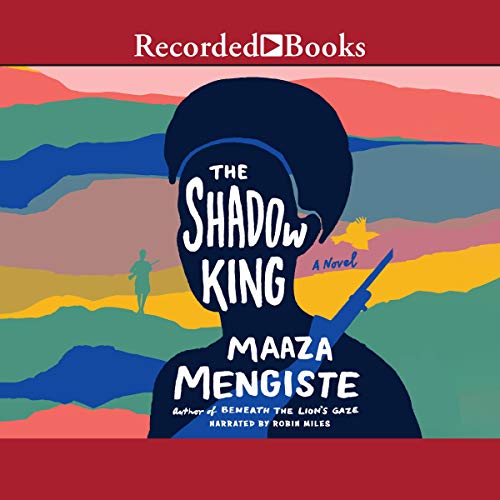
The Shadow King by Maaza Mengiste 2019 / (429 pages) Read by Robin Miles 18h 9m Rating: 9/ historical fiction
The other reason I skimmed some is that the unfamiliar accents on the part of the narrator doing some characters was very strong – difficult to understand.
That said, I think I got the basics and I have very mixed feelings about the book. First it’s brilliant in many ways. It will be studied in college courses for years.
A question I saw in the results of an online search asked: Is The Shadow King by Maaza Mengiste based on a true story?” Well, yes and no. Mengiste did a lot of research to get what she wrote correct. I read somewhere that the book took years of research. At the outset of WWII Italy invaded Ethiopia because the power-hungry Mussolini wanted colonies and women warriors were indeed used by the Ethiopians in their struggle to defend themselves against a powerful and ruthless enemy. Haile Selassie, the new Emperor, went into hiding in England for the duration.
Meanwhile, the main characters were invented as well as the bits about a “shadow king” of Haile Selassie not being in the UK but fighting in Ethiopia, although that may have been what was rumored. The book is a good example of historical fiction. It’s not “nonfiction” in any way and I don’t see it as being “based on a true story.” It’s fiction of an historical variety.
Apparently, the author found photos of some women warriors and that started some research and because Mengiste is a novelist, not a historian, she expanded the story beyond the documentation. She gave some of the women in the photos names and possessions and families. She gave them backstories and problems. She did this with both men and women. The Shadow King took about 10 years to research and write.
It’s beautifully written story in two time frames. It opens in Addis Ababa in 1974 with a woman holding a box at a train station. It then goes back in time to the 1930s when Hirut, a young woman then, is an orphaned girl in the service of relatives who have taken her in. These characters present problems of their own and I have a feeling the social history might very well be accurate – it’s violent, especially against women. But women can be powerful, too. The family is preparing to fight alongside their countrymen as Mussolini’s Fascist Italian forces try to overpower Ethiopia for colonial purposes.
Mengiste is a very creative and talented stylist also -there’s a “chorus” which appears for Selassie occasionally and Aida is summoned to work on him as well. It’s like the Iliad in an Ethiopian rendition of tales of war. “The Shadow King is a work borne of rage, a rage made magnificent for its compassion and the story it tells us—that in war there are no winners. A brilliant novel, lyrically lifting history towards myth.”
So I suppose it is a wee bit less horrendously violent than At Night All Blood Is Black since that gets into war of mythical proportions with some occultist aspects added.
This book could REALLY stand two or more readings but … ***P.S. I’m thinking I want to move away from books of rage with women as much a part of the terror as anyone. I need lighter fare more often as I move through my 8th decade and as this Covid stuff lingers.
There are so many enticing books out this fall – it would seem that our favorite authors have been writing away all during the pandemic with good stories on their minds – less graphic grossness, sex and violence anyway. I’ve got books lined up by release date – Yay! I don’t usually pre-order – why bother when I can get to what I want within a few minutes of when I’m ready to start reading.
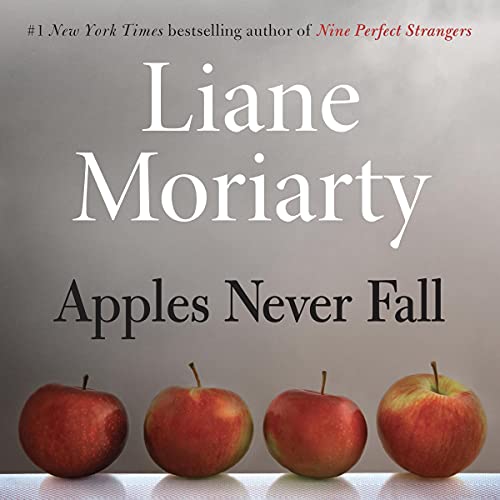
Apples Never Fall By Liane Moriarty Sept 2021 / (516 pgs print) Read by Caroline Lee 18h 3m Rating: 9.5 / Literary – crime
This may be a beautiful love story. I’m not big on genre romance but this isn’t that – not by a long shot. This is dysfunctional people mostly loving each other but sometimes hating each other in family situations. It’s also a crime novel.
And it’s a long book – 472 pages in print – starting slow with Moriarty building and developing several characters and situations in two different time frames, one being “Now” and the other 8 months prior, “Last September.”
In the “Now” sections Mom has disappeared and been missing for 2 weeks. In the “Last September” parts the events preceding Mom’s disappearance are revealed as well as the family dynamics. But the first big twist, for me anyway, was at about 2/3 of the way through.
It’s important though because for those pages the book is actually more a steadily deepening study of this family’s dynamics. At first glance everything looks fine on the outside, but then we get to looking at the insides of the individuals and the tensions people live under. We realize that these people say everything except what’s important. It’s a very passive aggressive environment with very competitive people We get to know all the major characters and the slightly or severely dysfunctional ways in which they operate. Moriarty is a new Anne Tyler or Alice Munro at character development.
The driving mystery of the book is “What happened to Mom, who done it, and why?” And that’s what the tension builds around, starting from a generally placid exterior issue and moving towards disaster on two levels.
Domestic abuse of various sorts and love of all kinds are the major themes. The abuse never gets graphic, but it does result in a couple or more tragedies. And there are myriad connections.
Joy and Stan Delaney are retired tennis instructors who have recently sold their tennis school. Joy is 69, Stan is 70. They live near Sydney, Australia and they have four grown children, Amy, Brooke, and Troy who live nearby andLogan, the most successful, lives further away. They were all very great tennis players in their youth, although not quite the best of the best. That honor went to another, a former student of Stan’s.
This book starts out with this lovely family of six, two parents who are still mostly in love but there are frays, and their four very talented but somewhat screwed up adult children. As the tale unfolds we get a closer and deeper picture of this family which hides all their important difficulties. Dad gets right on the line of abusive.
One evening “Last September” a young woman rings the doorbell at the Delaneys and then pounds on their door until they have to let her in. She has left her boyfriend for abuse and has nowhere to go. Joy and Stan take her in and help her out until Joy disappears – whereabouts unknown.
Stan and Joy are just very competitive people and they train their kids to be champions. The book is more a study of characters and an exploration of family dynamics than it is a mystery. But the mystery is important –
Amy is the eldest in her late 30s, works at whatever jobs she can get, is single and shares a flat with 3 others. She goes to counseling sessions about something. Simon Barrington, an accountant, is her mostly platonic roommate/friend.
Logan teaches business correspondence at a college. He actually went to college, graduated and used it for getting ahead. He has classy tastes. He’s unmarried but in a long-term relationship with a woman who leaves him after 10 years.
Brooke is the youngest daughter, married to Grant and has recently opened a small health and exercise clinic. She overworks at everything. Since she was a child she’s been over-nervous and started getting migraines and dropped out. She couldn’t really enjoy tennis after that. Her father blames Brooke for quitting competitive tennis. She and Grant separate and she’s now losing clients.
Troy, the youngest, is divorced from Claire and works at something, somewhere, making lots of money. He lived in Texas for awhile. He has a very hot temper. Claire is ready to have a baby and wants to use Troy’s saved embryos.
There are no grandchildren although there is desire.
Savannah (Pagonis) is an interloper and not given an intimate treatment until near the end so we never get inside her head which adds suspense. She helps Stan and Joy in many ways. She ingratiates herself quietly and pleasantly but there is always the question of why. Amy does not like Savannah, at all. The others are wary except Mom who wants to be a mom.
The main detectives are Christina and Ethan busily prying into the lives of everyone.
In the backstory we find out that mom and dad have plenty to disagree about concerning their kids and how well they did with tennis. And there’s Harry Hadad who comes into the story because he was the “superstar Grand Slam winner” who got away and became a famous Australian tennis star. Stan never got over the loss of Harry and his children still feel the betrayal.
From the first pages and 2 weeks after Mom’s disappearance the police are involved. This is about 9 months after Savannah appears on the scene and moves in. Information turns up which looks very bad on Stan, but there are lots of leads.
It took me about 6 hours to really get into the book but I was curious from the start. The mystery only comes into play a wee bit at a time. And the voice on the Audio is very interesting –
Moriarity writes nicely with great insight and sly wit and Caroline Lee, the narrator, brings out the best of it. The structure is interesting but not overly complicated. I sometimes got the Delaney children mixed up, but that was minimal. This might go in my top 10 fictions of the year.
This came up on several “best of” lists including former president Obama’s from last year. It was on my Wish List at Audible for months until I just got sick of seeing it there and removed it. Then it was available at the library so I snatched it. Whatever – I’m very glad I read it. It changed my outlook on a few things. The book had some problems though – imo.
The Vanishing Half by Brit Bennett Read by Shayna Small 11h 24m 2020 / (350 pages) Rating: 9 / Contemp. Lit.
The story is about twin Black girls in the late 1960s and on through their lives to the 1990s. While in their teens these girls leave their tiny town of Mallard first for New Orleans and then they take radically different paths in life. The story goes from the very late 1940s when their dad is killed and winds up at the end of the 1990’s.
Mallard is a very tiny Louisiana town where the residents are all a very light Black just as the original developer had been. As teenagers the girls leave Mallard and go to New Orleans where they find work and men. Stella leaves with Mr Sanders, her white boss, for a new life while Desiree follows a very dark man to Washington DC. She finds out that her man is violent and returns to Mallard and her mother. with Jade, her very dark 8-yearn old girl. Meanwhile, Stella marries Blake and has her own child, Kennedy.
Stella starts passing as White during the early years with Blake Sanders. That means she stays away from Mallard and lies to Blake and Kennedy as well as neighbors.
The nonlinear structure makes the novel confusing to follow and I got the multi-generational characters mixed up too. There are 4 main women with each having a separate life which brings up issues of identity and wanting to belong as well as racism, family, mother-daughter relationships, poverty vs wealth.
My problems were that the 60-year time span with a non-linear structure gets complicated and I sometimes lost track. Also, with 4 lead women and their families I got confused about who each one was and when. It did all straighten out though but the ending dragged a bit- like Bennett didn’t quite want to leg go of these people.
Heck of a good book – yes-siree-bob – if you’re interested in international and macro economics in the era of the novel Coronavirus-19. I read Premonition by Michael Lewis which was about the medical aspects and how the US professionals and officials dealt with that. And I read Landslide by Michael Wolff which was about Trump and how he handled it (along with other matters). But this book is about the worldwide economics of it. Fwiw, Tooze is from the UK but the book was written as much of more for Americans as the English.
Shutdown: How Covid Shook the World’s Economy by Adam Tooze 2021 / 354 pages Read by Simon Vance 12h 37m Rating: 9 / current events-economics (Both read and listened)
“This is the real first world war … the other world wars were localized in (some) continents with very little participation from other continents … but this affects everyone. It is not localized. It is not a war from which you can escape.” Lenin Moreno – president of Ecuador. (p. 8)
I read Tooze’s book Crashed back in February of 2019 and enjoyed it so much I wanted to read it a second time but … yeah – time. Here’s my review of it- a 9.75 rating: https://mybecky.blog/2019/02/27/crashed-by-adam-tooze/
In Shutdown I was hooked in with the first few pages. The Introduction is long and fascinating and read by Tooze who is a very good narrator. The book is long and fascinating as it goes over any and almost all aspects of what we (the world) went through as well as some background (2008). And there are the perennial economics issues – big government and big debt vs trying to keep it all to a minimum.
In Chapter 1 Tooze introduces the reader to some of the problems associated with the economics of a pandemic like Covid. What is a life/death worth? How much risk is reasonable? Are we as community minded as the vets of WWI? And now the source and spread of the infectious diseases (like the viruses, HIV-AIDS, SAARS, the Coronavirus-19, Ebola, Swine Flu, H1N1, etc) is global and fast. So we have to be prepared and to fight big because these are costly by nature and they involve “market failure.” By that time the social order and political legitimacy are at stake. This kind of biomedical catastrophe had been seen as a probable future problem for a long time before Covid hit – but still, we weren’t prepared – nobody was. And the US and China were not much better. We were preoccupied with climate.
Of course, I got bored and a bit lost when the narrative turned to junk bonds, derivatives, treasuries and repurchasing, but that’s only a chapter or two. And Tooze covers what Wall Street and the European Union were doing in trying to get their act together. Strong central banks were vital. And what caught my attention were the varied responses of the EU, South American countries, China and the wee bits about Africa – good and bad.
For the first couple of months there was no need for a lot of “lockdowns” and travel bans. People were doing that anyway of their own accord – this is what is meant by “shutdown.” Shutdown is voluntary. The results show that in the economics reports: travel was down something like 90% in places and movies were making no money at all and this was before any mandates or laws about Covid behavior.
Then the governments got involved and everyone did they their own thing with China and South Korea being quickly successful at containing the virus while there was horrendous spread in Bolsonaro’s Brazil.
Trump’s behavior and ideas come into the picture at times and Tooze is no fan but he does give rather grudging credit where it’s due- Trump changed his mind on a few things before the crisis got too much. And Xi Jinping is not exempt from criticism, but I think Tooze supports Xi’s China more than the old -style capitalism of the right wing US which is made up of a strange coalition of Koch money and tattoo parlor/motorcycle repair businesses.
The main thrust of the book is in the economics and how all the countries and agencies worked together (or not) to deal with the crisis.
Overall I enjoyed the book – it’s a good overview of what’s transpired over the last 18 months and how the economy has been affected and how the financial sectors have reacted.
I’ve read several of Indridason’s books and discovered this available at the library. So I got it. Just before I remembered that Matrix by Lauren Groff was released today. Oh dear. So now I’ve got them both. How to read two books at the same time, I don’t know. The Indridason book is a fast paced Nordic thriller and I’m very interested in Matrix.
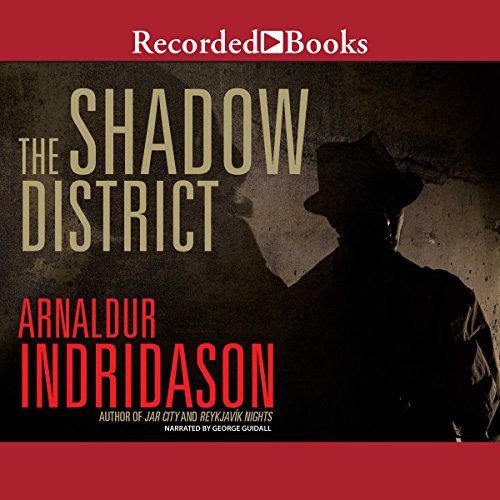
The Shadow District: A Thriller By Arnaldur Indridason, 2017 Read by George Guidall 8h 52m Rating B / Nordic crime (The Flovent and Thorson Thrillers Book 1 of 2)
An old man is found dead in his apartment. His neighbor checks, finds the body and calls the police. It looks like he’s had a heart attack in his sleep, but the coroner said he was smothered with his pillow. This is Reykjavík, Iceland present day. The investigator is Konrad, a retired detective who has been restless and kind of “helps out” with old cases. A woman named Marta who works these cases is Konrad’s old partner. She tells him about this case and it turns out he is very familiar with it, but he keeps mum and starts looking into it.
Time change to WWII era when the body of a young woman is found behind a theater in Reykjavik.. The finders are a US soldier and his date. The soldier makes them hurry away but they were seen by an older woman passing by.
There is a connection in that the old dead man had news clippings of the WWII murder which was 70 years prior. Konrad is intrigued and the reader tries to put the stories together.
The book starts out great but as the threads get tangled so do the time frames with all the different characters. More information is also added and my interest got annoyed. I kept reading and it did clear up but it took awhile. Fwiw, I don’t like what I consider to be a “deus ex machina” in the resolution of the plot.
I used to really enjoy mysteries with art settings and themes and I read quite a number back then, maybe 10 years ago? These days I’ll pick up an art-oriented novel if it catches my eye and has gotten a few good reviews like this one did:
The Last Mona Lisa by Jonathan Santlofer 2021 (404 pages)Read by Edoardo Ballerini 9h 15m Rating: C / crime
It started out as a pretty fun book but as it progressed I realized there were some pet-peeves here. First, novels based on real-life people and events can annoy me by stretching my suspension of disbelief a bit too far. I like historical fiction if the setting and events are emphasized as history – not if the characters named and based on actual historical people.
Still, this book is mostly pretty fun even with the historical incident being the theft of the Mona Lisa from the Louvre in 1911. So far so good. It’s almost everything after that which bothers me. Santlofer invents a lot more than is verifiable about the thief. So the story is simply “based on” this incident with this name doing the deed. It starts with an artist and professor of art history finding out that his grandfather was the Mona Lisa thief and then chasing after evidence of forgery and finding out he’s not alone in that search and that the art world can be a very dangerous place.
I don’t like when local type stories get enlarged to world-wide espionage. (This mostly happens with series where the author has run out of plausible local stories.)
And I don’t like when too many chapters end in cliff-hangers. I don’t like too many coincidences used as plot twists. And then – just to add something over-the-top, the protagonist is an alcoholic in AA.
So the book gets a C and any lower I wouldn’t have even bothered to finish.
This is the first book in a series featuring Lacy Stoltz. The second book is coming out in October so I figured I’d better get going on this one. Grisham has written better but he’s also written worse. I’m satisfied but not pleased. There’s also a short prequel book/short story which should probably be read after The Whistler (?). That’s how they usually are – let you get to know the characters in the story and then tell you how they or the situation got that way.
The Whistler By John Grisham 2016 Read by Cassandra Campbell 13h 10m Rating: B+ / legal thriller (1st in Lucy Stoltz series)
But Grisham is back to his beginnings doing legal thrillers although there’s not as much courtroom drama as there used to be. (For my money Grisham’s best books were first published in the 1990s.)
Lacy Stoltz, who is introduced in this novel, and her law partner, Hugo Hatch, are approached by “someone” who has information that a local judge is very much on the make and that a lot of people are in on it. This is the “whistler” because they’re doing the whistle blowing on more than the judge. It has to do with a reservation casino, a bunch of cousins, an organized crime syndicate. The whole thing also involves an old murder for which the wrong person was convicted and is now sitting in jail. There’s a lot of money involved because casinos are excellent places to launder money as well as skim it.
I enjoyed this book. The plot is twisty and involved with the tension very skillfully developed. Grisham’s style is basically very clear, simple and to the point without getting dumb about it. It works well with his books because it doesn’t interfere with many characters and a complex plot to keep track of. There are three major female characters, Lacy, Johellen and Claudia, and they are drawn more clearly than the men. Here’s a helpful list of the characters: : https://www.bookcompanion.com/the_whistler_character_list2.html








 Becky's Books -