The Underground Railroad by Colson Whitehead

From what I’ve read, Colin Whitehead’s new book The Underground Railroad was popped onto the shelves more than a month earlier than the expected September 13 date.  It was already highly anticipated as a really “hot” book for fall reading,  but when Oprah Winfrey makes a phone call publishers listen,  so Whitehead’s book was miraculously ready for Oprah’s big announcement on Aug 2.  The author himself was overjoyed.

underground.jpeg


*******
The Underground Railroad
by Colson Whitehead
2016 /  308 pages
rating:  9  /  historical fiction (alternative history)
*******

I’m a tad disappointed but there could be a couple reasons for that.  First,  I just finished The Sympathizer by  Viet Thanh Nguyen and that’s enough of a good book to last months.   Whitehead’s book pales when it’s put right up against that of  Nguyen’s multi-award prize winner.  The other reason is the media hype,  I suppose.  I was already going to read it and then came the Oprah announcement –  right – that probably put my expectations over the top.  (And I’m not a huge Oprah fan.)

So what good can I say about it?  Many, many things, it turns out –   The Underground Railroad is brilliantly creative and Whitehead takes his readers on a whirlwind tour mostly of the South as it was for blacks between 1800 and up to today in some ways.   Most of the action takes place in the 1850s,  the time when the Fugitive Slave laws were at their height.    And the use of a physically real “underground railroad”  (and that is an interesting site)  which  becomes a physical means of transportation from one place and time to another is – well – Whitehead did win a McArthur genius award.  The train stations are placed down tunnels under trap-doors in old barns and they even have small seats for when the passengers have to wait.  It’s a fascinating concept, one many of us imagined in childhood history lessons,  and it’s never overdone.  And it’s nothing like magical realism because the fantastical is so limited. It’s also a great metaphor.    The rest of the narrative is quite realistically presented – lots and lots of research went into this book.

But the railroad works as a metaphor for the pathway to freedom – someone must have built it, someone has to travel through its dark chambers,  somewhere there must be places to go up and see the world – but are those places of freedom?  Or are they more places of a destiny less desirable?

This is not the story of one plantation or one family or even one area – it’s not like anything you’ve likely read before.   It’s more of a little travelogue of horrors and at one point it put me in mind of  On Such a Full Sea by Chang-rae Lee  (a really extraordinary travelogue-type book, imo).  Structurally it’s interesting but somewhat difficult what with all the changes in time and place – it’s a rough road.

Cora is an 11-year old slave girl on the Randall plantation in Georgia  when we meet her.  Her mother has made her own bid for freedom leaving Cora to the other women in the Hob,  the cabins for the infirm and breeding women.  Cora gets a few years older, is put to work,  and  finally makes the break herself with the help of a friend named Caesar, a slave of northern origins,  who thinks she can do it.

Along the way Cora meets a variety of strange people,  some loving and helpful,  others as mean as they come.  And there are slave hunters after her,  particularly one named Ridgeway who has made her capture a personal project.   But taking the cake for interesting characters is a little guy named Homer age about 10 or 12 who is the free Black companion of Ridgeway and  I will just let you read about him.

Apparently Whitehead did an enormous amount of research for this and put the pieces of slave diaries together to form a mosaic of black history in American and the quest for freedom expand from then to now and from here to the world.

http://time.com/4447972/colson-whitehead-the-underground-railroad/
Leave a comment

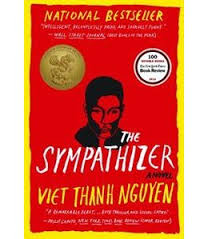
The Sympathizer by Viet Thanh Nguyen

A debut novel winning the Pulitzer which won many other prestigious awards (see * below) just calls my name –  because yes,  it’s true,  I’m a sucker for the reading awards.  Besides,  two (2!) of my reading groups selected it so …   I had to read it.

The end result?   This is probably the most beautifully written book I’ve read in years although it also might be one of the most violent books I’ve read in awhile.  But it’s kind of on the order of Blood Meridian by Cormac McCarthy in that the quality of the writing takes the edge off the horror.    Unlike McCarthy’s novel, though,  Nguyen doesn’t shy away from humor – it too serves to mitigate the ugliness of what’s happening.

sympath.jpeg
*******
The Sympathizer
by Viet Thanh Nguyen
2015 / 348 pages
rating:    9.5 / A –   literary crime 
*******

The story concerns the tragedy of the US war in Vietnam -especially the aftermath.   I avoided that subject for for many years as it was too personally painful.  I finally tried Frances FitzGerald’s prize-winning nonfiction book,  Fire in the Lake (1972) and then went on to The Things They Carried by Tim O’Brien (1990).    But I didn’t get around to those until 2010 or so – 35-40 years after the war.  They’re both excellent books.

Back to The Sympathizer – the bulk of the narrative is structured in the form of a letter to a Commandant written as a confession,  or a pseudo-confession, by a prisoner.  The nameless 1st person protagonist, the writer of the confession who was a spy for the North,  was the head assistant to General in the South Vietnamese Army – but the US is leaving.   He is the “sympathizer” of the title.  His father was a French Catholic priest while his mother was the priest’s maid.   The prisoner/sympathizer had spent a good part of his youth at university in the US but his mother and his best friends were of the North.  This duality is expanded and forms much of the thematic thrust of the book.

As we are transported back through the story we find the prisoner and his General,  along with the General’s  family,  managing to leave Vietnam at the very end of the fall of Saigon. They  came to the US and proceeded to … well … that’s what he tells us.  We also know from  outset that our letter/confession-writer  was/is a  “sympathizer,” –    “a spy, a sleeper, a spook, a man of two faces,” … “a man of two minds” – not wholly convinced of either side.

Nguyen writes beautifully – really, really beautifully!  He’s a stylist of first order with unusual metaphors and just ways of putting things.  His characters are brilliantly constructed and we get to know them in many ways.  The plot is tension filled – the reader  kind of knows what’s going to happen but … how?  why? when? –   (The book also received an Edgar Award for best debut novel –  that’s the crime genre.)

The inspiration came from “Apocalypse Now”  and Nguyen did an enormous amount of research on the making of that movie – (see the Acknowledgements). Also, there is a fictional book which has a huge part in the plot and it’s based on the very real ideas of William Westmoreland as witnessed by his documentary, “Hearts and Minds.”    There is also obviously some good research done on the details of the fall of Saigon which,  for what it’s worth,  I remember watching on the TV news.

Overall this is an incredible book – well deserving of the awards its received.

* The Awards:

Winner of the 2016 Pulitzer Prize for Fiction
Winner of the 2016 Edgar Award for Best First Novel
Winner of the 2016 Andrew Carnegie Medal for Excellence in Fiction
Winner of the 2015 Center for Fiction First Novel Prize
Winner of the 2015-2016 Asian/Pacific American Award for Literature (Adult Fiction)
Winner of the 2016 California Book Award for First Fiction
Finalist for the 2016 PEN/Faulkner Award
Finalist for the 2016 PEN/Robert W. Bingham Prize for Debut Fiction
Finalist for the 2016 Medici Book Club Prize
Finalist for the 2015 Los Angeles Times Book Prize (Mystery/Thriller)
Finalist for the 2016 ABA Indies Choice/E.B. White Read-Aloud Award (Book of the Year, Adult Fiction)
Named a Best Book of the Year on more than twenty lists, including the New York Times Book ReviewWall Street Journal, and Washington Post
** from Amazon

2 Comments

The Gene: An Intimate History by Siddhartha Mukherjee

I’m not a huge science book fan – except sometimes physics or astronomy – but  biology?  Not!   So had the All-nonfiction reading group not selected this title for it’s September discussion I would likely never have even glanced at it.   In fact,  I was really tempted to give it a pass anyway.   Fortunately,  I tried the sample and found myself a bit intrigued.  This is more a history of genetics and the story of how the scientists came to the understandings they have today as well as the ramifications for tomorrow.  So history is a super-favorite genre –  I’m in.

gene.jpeg
*******
The Gene: An Intimate History
by Siddhartha Mukherjee
2016/ 608 pages
rating: 9    /  history/science
*******

The  ideas and the history of the science of genetics are far more fascinating than I had anticipated – from the thoughts of  ancient Pythagoras about male sperm and Aristotle’s ideas of human shape and form , to Darwin and Mendel and Nazism all the way to 2016 and the ideas of recombinant DNA.  The future? –  Well … that seems to be all about how to make choices?

Mukherjee has his own stake in this story and he’s quite frank about it. (Maybe in the way that Atul Gawande did in Being Mortal)   Mukherjee’s  family is afflicted with a form of hereditary schizophrenia and he takes the reader on a bit of a memoir concerning a brother and uncles and even his father.   This is interwoven at appropriate times throughout the book and really humanizes the subject.  It’s a subject which absolutely needs to be humanized – personalized – made real.

Following a very nicely written survey of the history of the sciences of  genetics and evolution which comprises the bulk of the book,  Mukherjee ponders the idea of “disease” and  what is “normal,”  what is “best” as well as what is “race”  and what is “intelligence,”  “creative,”  and other aspects of the human being.    Are genes actual determiners of our destiny?  What about environment?   Free choice?

The photographs are nice but I  kind of wish there had been one clear diagram of what a gene looks like with a bunch of its parts labeled.   Also,  I wasn’t too sure about the technical side – what kind of microscopes were the scientists using at what times?

Leave a comment

The Year of the Runaways by Sunjeev Sahota

I guess I’ve just had my fill of books about India and immigration and so on and this seemed to be a rehash of 3 or 4 different stories.  I know it was short-listed for the Man Booker Award but imo (and I read all the long-listed books in 2015 except one) it’s not up to standard in terms of originality.

runaways.jpeg

*******
The Year of the Runaways
by Sunjeev Sahota
2015 / 485 pages (Kindle) 
rating 7.5 /  contemp India
*******

Three young men from different situations in India feel they need to immigrate to England.  It’s all about the money though.  Randeep comes to help his family after his father has a stroke.  Once there, thanks to loans,  he gets a “visa marriage”  and looks for work.  Avtar sells a kidney to get the money for passage and comes to make more money so he can marry his girlfriend.  He goes to college in order to obtain a temporary visa and he looks for work.    And Tochi, from the caste of “untouchables,”  immigrates because he has nowhere else to go – no family – horrendous background – and he looks for work.

Avtar and Randeep are neighbors from the same neighborhood in India and they end up as roommates in basic, minimum slum-lord type of migrant worker housing in Sheffield,  but there is still food to buy and loans to repay and finally money to send home – maybe. Tochi arrives and there are others in the house so the situation basically turns into a contest of survival of the fittest where suspicion is everywhere and thievery and violence is not out of the question.  Always – where to find work,  where to get money.

Another character is Narindar, a British Sikh woman whose father has recently passed away.  Her brother and mother expect her to marry the young man who was picked out for her.  But she is very devout wants a year to do the kind deed of marrying Randeep for a couple years so he can get his “marriage visa.”   They are hounded by an investigator who suspects something fishy.

Sahota weaves the stories of the characters and settings throughout the book and as they take place over the course of a year plus back-stories.  I was never confused between the times in India or the times in England.  Life was very difficult, almost unsurvivable, in both places although it did seem as though England might have,  possibly,  a glimmer of more hope.

A rather important theme is how the basic cultural traditions, caste, food, religion, and women’s place,  of India follow the immigrants to their new land.  They never really assimilate at all but they really never have the opportunity.   Rather they use what they need to use to survive at the fringes of society.

If I weren’t so tired of books about India I’m sure I would have given this a higher rating – the writing is nice and the structure is interesting.  The character development is well balanced (I did enjoy the book a lot more after Narindar was featured.)

Reviews –
NPR by Nishant Dahiya
The Atlantic by Julie Calagiovanni 

Leave a comment

The Three-Body Problem by Liu Cixin

I very much enjoy translated works from all over the world in part because it feels like I’m getting a bird’s eye view into various aspects of another culture.   Also,  I enjoy a good work of science fiction from time to time.   Well – I struck gold on both counts with The Three-Body Problem by Liu Cixin which won the Hugo Award in 2014,  was nominated for the Nebula in 2015 a-and (ta-da!) also won the Galaxy Award which is the heavy-duty  Chinese science fiction prize a few years ago (when it was first published there).

I usually listen to sci-fi and I’ll bet this would have been a great listen,  but up here in Dakota-land I have precious little listening time.  Furthermore,  it was selected by a group and I can’t just postpone listening until I get home.    I will be listening to the next two books in the series though – you betcha!  (at home)
three-body.jpg

**********
The Three-Body Problem
by Liu Cixin
2008 / 399 pages (Kindle)
rating:  A+   / sci-fi 
translated by Ken Liu
Book 1 of “Remembrance of Earth Past” 
**********

The narrative starts in China during the 1960s when the Cultural Revolution was at its height and academia was in peril.  Ye Wenjei,  the daughter of a family of doomed physicists,  is left at the mercy of the Red Guard and she is sent to a camp in the northern mountains.  There she wonders about a certain “Radar Peak” which she sees often and a friend gives her a copy of the book  Silent Spring (Rachel Carson – 1962).  She is found guilty of even having the book, is arrested and sent to a top-security military base which is focused on contacting extra-terrestrial life.  She becomes involved.

Next thing we know the setting is current era and Wang Miaow,  a nanomaterials researcher, is visited by the police and two scientists.  Other scientists are dying – perhaps committing suicide for some reason.   One suicide note says,  “There is no physics.”   Then Wang starts to see numbers on film negatives,  in front of his eyes, elsewhere.   It’s apparently a countdown with about 50 days to go.    Wang’s own projects have been interfered with and  the security agency  want his help with a spy project.  His own project is put on hold which seems to stop the countdown.   Wang then visits the home of his friend who explains the “three-body problem”  of physics and perhaps related to what’s happening in the world at the moment.

Wang is introduced to a computer game called Three-Body and wearing appropriate head gear and body suit is transported into a full immersion world in ancient China.  Wang plays this game through several chapters and it demonstrates the history of the earth or somewhere as well as a number of science and technology problems.  Very imaginative and with sound research backing it up.

The narrative alternates between the current day with Wang’s “history and science games” plus a couple more deaths and  the 1970s with Ye Wenjei at the military base.  Eventually the plot breaks free and we find that extraterrestrial life has been contacted and there are two factions of humans,  those who want them to come and save the earth and those who are totally opposed to the alien forces coming.  These two factions are essentially at war with each other in their mutual desire to save the earth.

This is great stuff -Liu Cixin has definitely created a believable world including  technology,  physics, quite a lot of history with excellent suspense and a wee bit of  interpersonal relations.  I’m sure folks who are more knowledgeable about the scientific aspects will get more out of it than I did,  but I found myself smiling and really enjoying the science and technology as well as the way it was all woven into a very  imaginative plot.

Review from NPR:
http://www.npr.org/2014/11/13/363123510/three-body-problem-asks-a-classic-sci-fi-question-in-chinese

more info: http://www.zeigua.com/iching/iching_fuxi.htmlhttp://www.zeigua.com/iching/iching_fuxi.html
http://www.zeigua.com/iching/iching_trigrams.html#Top

3 Comments

6 Degrees of Separation – continues

Lisa,  over at ANZ LitLovers LitBlog continued a thread contributing to Six Degrees of Separation as inspired by Jenny (The Secret Son) Ackland and Kate at Books are My Favourite and Best.  That prompted me for some reason to continue –

I’ll start with …

1. Voices from Chernobyl by the 2015 Nobel winner Svetlana Alexievich.  It’s  linked to Secondhand Time  (the last on Lisa’s list) by author and the subject of the last days of the USSR.  Voices from Chernobyl is an expose on the disaster and its effects on the population and entire country. I can easily go from there to Moscow and Amor Towles’ for my next “degree”:

2.  A Gentleman in Moscow –by Amor Towles which is great stuff about a wonderful man under house arrest in a splendid Moscow hotel  for a couple decades while the Revolution undergoes its changes.  Then we go to –

3 I Hotel by Karen Yamashita (one of my best-of-year reads in 2011, prior to Webpage blog) which concerns a variety of characters all of whom live, or lived in, a hotel in San Francisco, a very real historical hotel. The fictional characters tend to be from the lower classes but politically involved in such things as the Black Power movement at UCSF, the Communist revolution (they fly to Moscow for a little bit), the Farm Workers Union, etc.   And this book connects to … ta-da  …

4 The Buddha in the Attic by Julie Otsuka in which immigrant Japanese women arrive in San Francisco in the early 20th century and are married to men already in the US who are waiting for them. These women often work in the fields until they are taken to internment camps of WWII. One interesting thing about this novel is that it is written in second person plural – “we” – from the point of view of the women as a group. And that brings me to

5 Agaat by Marlene van Neikerk which is about a dying woman in apartheid South Africa who owns a farm with many laborers (connection 1) Her maid/nurse has been with her for over 40 years and as Milla dies she remembers her past as well as Agaat’s . This is due in large part due to her old diaries. The point of view is usually or often singular second person – “you.” (connection 2). And the huge connection there is

6 Between the World and Me by Te-Nahisi Coates – non-fiction, a letter to black men (literary device is his son) – about the anger and fear felt by Coates due to US racism which allows “people who think they are white” to violate black bodies with impunity.


2 Comments

Agaat by Marlene van Nierkerk

This book was on my  wish list since its US publication in 2010,  but then I waited until it was available in Kindle format –  very, very much worth the wait,  although it would have been excellent at any time!   There are ways in which it outdid my expectations and Faulkner came to mind more than once.  Van Niekerk is a master of imagery and story-telling and the translator,  Michiel Heyns,  also did an excellent job –  it must have been quite a challenge.

agaat.jpeg
*******
Agaat
by Marlene van Nierkerk 
2010 / 581 pages
rating 9 / contemp fiction – South Africa
(translated from Afrikaners by  Michiel Heyns) 
*******

At the outset of this complex and multilayered novel, Milla de Wet,  the Afrikaner  heir to a largish farming operation in South Africa,  is  totally disabled except for her eyes with A.L.S.  It’s 1996 in South Africa (apartheid ended in 1994).  Her long-term devoted maid-servant, Agaat Lourier, attends to Milla’s every need from room decor and reading to personal hygiene and minor medical issues.  The dark-skinned Agaat has been with Milla since she took her in at age of 6.   When they began Milla was definitely  in charge, teaching Agaat about all sorts of things from embroidery to calf-birthing and from reading to the culinary arts.  But when the frame story takes place at Agaat’s death bed,  all of that has been upended and it’s Agaat who is the force with which to reckon.

The non-linear narrative then goes back to slowly revealing the story of  Milla’s life with Agaat and with her husband Jak (Jakob) as well as with their child Jakkie, and a few other minor characters.

The chapters start out in first person  present tense of Milla’s “voice”  while Agaat tends to her every dying need.   Then the narrative switches to a second person point of view as Agaat reads to her from the old diaries Milla kept all those years although Milla also remembers some things on her own.  The very last bit of each chapter consists of a kind of rambling from Milla’s confused and dying  mind.

Her story?  Milla married Jak de Wet in 1947 only to find out he was an abuser, not much good at anything to do with the farm and hopelessly arrogant.  He is completely  opposed to Milla taking Agaat under her wings and probably with good reason.  Milla’s mother concurs.  And then a few years later Milla gets pregnant and Agaat is needed even more although she has to sort out her own strange relationship with the whole family as well as the other workers on the farm.  We never do get a real glimpse into Agaat’s head  via point of view – only her actions, some incredibly loyal, some apparently rebellious,  some incomprehensible.

Milla and Agaat are both very strong characters and they are not really at peace with each other in all ways.  All through the story from the time they meet until the very end, Milla pushes and Agaat resists then Agaat pushes but Milla resists.  The bottom line is that Agaat has Jakkie as her ultimate weapon – but even he has to grow up.

On one level Agaat can be read as a very good story about a woman and her black maid,  of loyalty, marriage and motherhood with apartheid taking only a very subtle role.  But on another level it can be read as political allegory because come to find out Agaat was born in the year apartheid became law and it ends with  Milla, her farm and the whole country dying – or leaving.

Tremendous book – so glad I finally read it.   Yes,  definitely recommended.


1 Comment

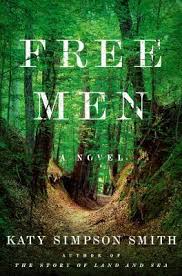
Free Men by Katy Simpson Smith

In 1788, in what is known today as Alabama, a French anthropologist is following a group of three men,  a Creek Native, a fugitive slave and a white man.  The small group or one of them may have killed someone,  many people, or none – that will be revealed.  The Frenchman may kill the three – or not – (but there seems to be that foreshadowing).   But for all that the author seems to have let various literary qualities take over and the the tension fails.

free men

*******
Free Men
by Katy Simpson Smith
2016/ 373 pages
rating : 7  / historical fiction
*******

The narrative unfolds in a structure presenting the overall story in 1788 from one or another character and then an in-depth 1st person tale  as each of the four main characters tells his own background. Then the main story continues with one or the other narrators.  At one point a wife and maybe one other person tell a portion.

There is lots and lots and lots of backstory to wade through.  I’m sure it’s to get to the heart of the theme of all men, no matter the skin tone or heritage,  are quite a lot alike but …

The first character presented in depth is Bob, a runaway-slave with a wife and children back home in Florida who dreams of a piece of land out west.  Out on the trail he first meets Cat, a rather pathetic white man who seems lost in some non-physical ways.  After a few days travel those two come across a Muskogee Native named Istillicha who is on the trail to get his own money returned and create a tribe of his own,  maybe his old one back.  Finally, the background tale of Le Clerc, the tracker- anthropologist and French ex-patriot, is told.

This could have been a powerful book with page-turning tension in a quest theme OR  literary exploration of a fascinating theme-driven work complete with theologically based symbolism without redemption.  Unfortunately  it wasn’t quite able to be both very well and I think that’s what Smith tried for.

Leave a comment

The Jealous Kind by James Lee Burke

It’s summertime in Houston, 1952,  and the 17-year old first-person Aaron Holland Broussard and his best friend Saber Bledsoe doing what kids do in the summer.   Aaron is actually a rather nice young man, smart and generally well- behaved although from a troubled family.  Saber on the other hand has some rough edges and a chip on his shoulder  big enough for him to attract the attention of various elements in the city from the teachers to the police, the local young hoodlums and their big-time daddies.

jealous
*******
The Jealous Kind 
by James Lee Burke
Aug 30,  2016 / 400 pages
Rating:   A++  /  literary crime
***

pro_reader_120
With a huge thank you to Simon and Schuster for allowing me to preview and review this book!)   

*******
One night Aaron is stirred to make some chivalrous moves to protect the beautiful Valerie Epstein from the anger of Grady Harrelson,  her rich, bad-boy boyfriend.  Aaron for some reason unbeknownst even to himself,  sticks up for her – calls Grady out on his behavior.  Grady gets a bit irritated, but Valerie apparently appreciates it a lot.  Grady doesn’t let things like this slide easily and his father is far, far more dangerous.   That’s okay  –  Saber has Aaron’s back.   Yeah? – This one may be beyond Saber’s skills.

Meanwhile a very obnoxious teacher is looking for troubled boys to send to some kind of “camp,”   Grady and his little gang get Aaron and Saber under suspicion for various things including the murder of a young Mexican girl.  Valerie’s father has some issues with Grady’s father but Aaron has his own link to a fringe element of mobsters.   And so it goes.   After Grady’s car is stolen, the big baddies show up and a far more intense type of criminal behavior is involved. Yup –  Aaron has a summer of growing up.

Although the narrative gets seriously gritty and late-night intense, it never turns into a page-turner in the “thriller” sense of the term because Burke’s style is too complex and involved,  too beautifully literary.   But rest assured the tension is all there – Burke is a master story-teller.

The characters are all wonderfully realized evoking a sense of time and place as well as individuals caught in the traps of life,  love, violence, family, etc.   The three women are solidly articulated but possibly more differentiated than the three incredible women in Burke’s prior novel,  House of the Rising Sun (2015), about Hackberry Holland and set in the wild west of the early 20th century.

The Hollands have their own issues. Aaron is the grandson Hackberry Holland who was the cousin of Billy Bob Holland and others in the family who show up in the various novels.   These are all  descendants of the original Son Holland and the series goes back to touch on the aftermath of the Civil War.    Finding the connections is fun,  but … important to note:

** Each novel is perfect as a stand-alone!! **

I’ve read seven of the ten novels which feature members of the extended Holland clan – http://jamesleeburke.com/books/the-holland-family/   – I can’t pick a favorite but the latter books seem better somehow – maybe I just finally made the transition from Robicheaux to Holland? –

In The Jealous Kind Burke perfectly captures the teenage-side in collision with the ugly and treacherous underbelly of Houston circa 1952  – the music,  the cars,  the clothes,  the hair, the drive-ins, the lingo against the backdrop of the Korean War.  But he never overdoes the ambiance or the extraordinary literary passages.  The story itself stays front and center – a good kid’s falling in love while coming of age in a very troubled time and place.

And every once in awhile,  just the right once in awhile,  there’s the flash and thunder of delicious sentences which mark the philosophical and Faulknerian Burke I know and love from the Robicheaux novels.

Leave a comment

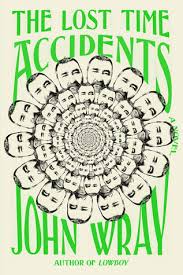
The Lost Time Accidents by John Wray

First off,  although I rather enjoyed it,  I wouldn’t recommend this book to anyone I know (maybe one person if the time an place were right) but … oh well.    The thing is I enjoy time-travel books to see how the authors work with the idea.  I don’t for one real minute believe it’s possible,  but it’s kind of fun to think about on different levels or in different aspects.    This book is actually,  in large part, “about” the time travel itself.

losttime

*******
The Lost Time Accidents
by John Wray 
2016 / 512 pages
rating:  9 – literary sci-fi (time travel) 
*******

Haunted by a failed love affair and the darkest of family secrets, Waldemar ‘Waldy’ Tolliver wakes one morning to discover that he has been exiled from the flow of time. The world continues to turn, and Waldy is desperate to find his way back-a journey that forces him to reckon not only with the betrayal at the heart of his doomed romance but also the legacy of his great-grandfather’s fatal pursuit of the hidden nature of time itself.

Part madcap adventure, part harrowing family drama, part scientific mystery–and never less than wildly entertaining–The Lost Time Accidents is a bold and epic saga set against the greatest upheavals of the twentieth century.

Walter Tompkins is writing to Mrs Havens in contemporary time and in the letter spins off into the tale of his great-grandfather,  then his grandfather and great uncle all of whom were amateur physicist exploring the nature of time, the 4th dimension, and something called the “lost time accidents.”

I actually quite enjoyed quite a number of the characters – not all of them.  Some of them are very cleverly named.  (This book really needs a glossary of names or a little family tree or something-  I hope this is right:

** Ottokar Toula- patriarch:   killed by an “auto-car,”  also Ottokar the flying pest

**Toula –  means “light”   –    Tolliver is Americanization of Toula

**Waldemar (von) Toula  – son of Ottokar, a very bad guy, name like the bad guy in Harry Potter

**Kasper – very good brother of W. – friendly ghost.  Marries Sonja and then Ilsa. father of Enzian, Gentian and Orson.

**Orson Card Tolliver -son of Kaspar and Ilsa (K’s 2nd wife) – father of Walter – author of many books and gathers a cult following and not too far distant from Orson Scott Card.

** Walter Toula –   1st person protagonist:  (Waldemar Gottfreidens Tolliver) son of Orson

**  Ursula Kimmelmann – Israeli boarder next door to Orson, lover, wife, mother of Walter
** Sonja – Kasper’s wife – lovely, dies early / daughter of Silvermann – Jewish?
** Enzian- Kaspar’s daughter – twin- WWII German missile – Orson’s sister – b 1927
** Gentian – Kaspar’s daughter – mother of Walter Tomkins (?)      “
** Nayagünem Menügayan (Julia) –  neighbor/ friend of Mrs Havens – name is backwards/forwards
**Mrs Haven – Walter’s paramour – wife of cult “minister,” Richard Haven.  She is a haven for Walter?
** Mr Haven – rich powerful – started a church but is not religious – Richie Havens? –  ?
** Ilsa Veronica Card – Orson’s  mother – 2nd wife of Kaspar  – sometimes called “the Kraut.”
**  Wilhelm Card – Sonja’s brother, lives in Buffalo NY – Buffalo Bill, Willy
**  Norm – Orson’s beatnik friend
**  Ewa Ruszczyk – Orson’s girlfriend
*****

There are only a few time-travel books which do a very good job with the subject.  Stephen King’s contribution, 11/22/1963 was interesting and all of Connie Willis’ are good. Most of the others simply skim over the time travel itself and tell their story from there.

In TLTA the Möbius strip approach to time was new to me and curious. Also new to me was the idea of confusing someone with a backwards/forwards motion (a car orbiting a second car with both cars in motion – what does this feel like to the passenger of the second car? – Ottarkar again? )

Another thing: – I loved the satire on new-age pseudo-science cults/beliefs. Too funny. And the author did have some fair humor in his style –

The “Lost Time Accidents” at the industrial plant. – lol!

another example:

quote-1 Enzian was smiling her private smile now, the one she used only with her father and Genny. ‘Where do all those theories go, that Occam shaves away? How many tasty tidbits are we missing?’”

Finally, the ending was so satisfying – I didn’t really expect it, couldn’t figure out how in the world Wray was going to wind this up. But he did it, I should have seen it, perhaps from the beginning. lol

Anyway – not one of my best-of-year books but entertaining and it might stay with me for awhile.

4 Comments

A History of the World in 10 1/2 Chapters by Julian Barnes

I really enjoyed the works of Julian Barnes until A Sense of an Ending  when  I wondered if the man had anything else to say.  It seemed I’d read this theme before only with a different plot.   With that in mind- A History of the World in 10 1/2 Chapters was chosen by a group including some dear friends,  so I read it.

historyofworld

*******
A History of the World in 10 1/2 Chapters
by Julian Barnes
1989 / 308 pages
rating 8 / late 20th century lit
*******

Barnes is writer with great imagination and a nice clear voice – too bad he only invents new plots to prove his one theme.   That theme being you can’t trust anything or anyone – not history,  not science,  nothing.  There is no truth because it’s all subjective, invented, falsified, etc.

In Arthur and George the theme of “Truth”  was wound into a plot about heritage and “real” Englishman.  In Flaubert’s Parrot it was in trying to figure out which stuffed parrot “really” belonged to Flaubert.  In The Sense of an Ending the reader and protagonist were concerned with  a letter from a past lover really meant,  what did their love back then mean?   That’s when I got fed up with Barnes and his one-tune show.

A History of theWorld in 10 1/2 Chapters is more complex – more fun.  it’s

This time, in  A History of the World in 10 1/2 Chapters,  we have ten very  loosely connected stories and a parenthesis which are not in any kind of order that I could detect except that the first one starts with Noah’s Arc and the last is a sort of satire on heaven.

The Noah story has to do with a variation of the Noah’s Arc narrative and the following story is close to current day with a cruise ship which has been hijacked by terrorists.  Next story goes back to the Protestant Reformation,  then comes one from some future time – possibly.   Etc.  I think most are based on historical events but some from very subjective personal (to the characters) points of view,  while others are presented as alternative history.

Through all this runs a motif of rain, oceans, unreliable vessels,  narrators and artists, writers, etc – not to forget the wormwood (termites).   To Barnes “all is fiction” I guess.  But is that statement also fiction?   Is he, the presumed character/narrator of the parenthetical half-chapter (between Chapters 8 and 9)  unreliable?  – Imo,  a resounding yes!    It feels like he’s thinks he’s the divine messenger bringing this idea into our lives in new and impressive ways so we’re to think “My,  isn’t he profound?”  (lol –  Not any more.)

Anyway,  what is the definition of fiction –  is it the opposite of truth? – What if there is no truth? – oh dear – then even fiction is a fictional idea.  Maybe “subjective”  equals “fiction.”   But how can you have something like “fiction” without “nonfiction” – or “subjective” without “objective.” Anyway, believing nothing is true is such a dead-end thought – it just cycles around itself –  I don’t go there.

And as Barnes said somewhere – living in a real world necessitates our believing that some things are real and true – the sun did rise this morning – bad-smelling meat can make you sick,  time and history are linear or

But Barnes is fairly clever – the stories are various ways in which no one knows the truth.

** My problem and an aside:    If nothing is reliably and /or objectively true, especially when language and time are involved,  it  really makes me question how the recipe for blueberry muffins I got from someone who got it from someone else, possibly a grandmother,  turned out so good several times and I’ve even proudly used it for company.    Oh well – it’s all subjective, right?  Merely an accident or coincidence.   Whatever –  they are great muffins and I get huge compliments on them.

Chapter summaries From Wikipedia: https://en.wikipedia.org/wiki/A_History_of_the_World_in_10%C2%BD_Chapters#Plot

Chapter 1, “The Stowaway” is an alternative account of the story of Noah’s Ark from the point of view of the woodworms, who were not allowed onboard and were stowaways during the journey.
* Silly –

Chapter 2, “The Visitors” describes the hijacking of a cruise liner, similar to the 1985 incident of the Achille Lauro.
*- rather enjoyed this one –

Chapter 3, “The Wars of Religion” reports a trial against the woodworms in a church, as they have caused the building to become unstable.  Woodworms are obviously from the devil and they are threatening the theological/power foundation
* more difficult than most of the stories

Chapter 4, “The Survivor” is set in a world in which the Chernobyl disaster was “the first big accident”. Journalists report that the world is on the brink of nuclear war. The protagonist escapes by boat to avoid the assumed inevitability of a nuclear holocaust. Whether this actually occurred or is merely a result of the protagonist’s paranoia is left ambiguous.
* Too bizarre –

Chapter 5, “Shipwreck” is an analysis of Géricault‘s painting, The Raft of the Medusa. The first half narrates the historical events of the shipwreck and the survival of the crew members. The second half of the chapter analyses the painting itself. It describes Géricault’s “softening” the impact of reality in order to preserve the aestheticism of the work, or to make the story of what happened more palatable
*Rather horrible –

Chapter 6, “The Mountain” describes the journey of a religious woman to a monastery where she wants to intercede for her dead father. The Raft of the Medusa plays a role in this story as well.
*Strange –

Chapter 7, “Three Simple Stories” portrays a survivor from the RMS Titanic, the Biblical story of Jonah and the whale, and the Jewish refugees on board the MS St. Louis in 1939, who were prevented from landing in the United States and other countries.
* The St. Louis story is best – I guess some semblance of truth is possible.

Chapter 8, “Upstream!” consists of letters from an actor who travels to a remote jungle for a film project, described as similar to The Mission (1986). His letters grow more philosophical and complicated as he deals with the living situations, the personalities of his costars and the director, and the peculiarities of the indigenous population, coming to a climax when his colleague is drowned in an accident with a raft.
*Cute –

The unnumbered half-chapter, “Parenthesis” is inserted between chapters 8 and 9. It is different in style to the other chapters, which are short stories; here a narrator offers a philosophical discussion on love. The narrator is called “Julian Barnes”, but, as he states, the reader cannot be sure that the narrator’s opinions are those of the author. A parallel is drawn with El Greco’s painting Burial of the Count of Orgaz, in which the artist confronts the viewer. The piece includes a discussion of lines from Philip Larkin’s poem An Arundel Tomb (“What will survive of us is love”) and from W. H. Auden’s September 1, 1939 (“We must love one another or die”).
*Boring

Chapter 9, “Project Ararat” tells the story of a fictional astronaut Spike Tiggler, based on the astronaut James Irwin.  Tiggler launches an expedition to recover what remains of Noah’s Ark. There is overlap with chapter 6, “The Mountain.”
* curious

Chapter 10, “The Dream” portrays New Heaven –  funny but not terribly original –
* I think I saw a Twilight Zone along these lines back in the late 1950s.


1 Comment

Shelter by Jung Yun

Kyung Cho,  an immigrant Korean and professor at the local university and his Irish social worker wife Gillian are trying to sell their home because they have become over-extended  by  payments and bills.  This has been their own doing by living beyond their means and trying to keep up with the lifestyle of Kyong’s parents,  Jin and Mae who live in a near mansion only a few miles away.

One day Kyong, Gillian and a real estate agent see Mae running stark naked across the streets to their house.  She’s been beaten and raped.  She tells them something about Kyung’s father but they don’t understand –  they get her to the hospital.

shelter
*******
Shelter
by Jung Yun
2016 / 336 pages 
read by Raymond Lee
rating :  7  –  contemp lit
*******

As the tale unfolds we find several clashes of  culture and of generations between the old Korean ways and the new young American ways,  between Korean and Irish ways,  between the 1960s and the 21st century.   There was physical abuse in Kyung’s childhood and he’s never forgiven either of his parents.

The plot in this one really twists – there were several times I was completely surprised by what happened.

Leave a comment

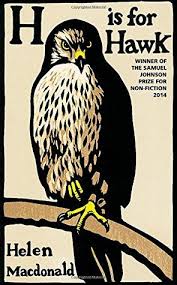
H is for Hawk by Helen Macdonald

Oh I do so love my reading groups! Sometimes they offer convivial chatter, sometimes they give fresh insight into books I read awhile back, but other times they push me into reading something I would never read on my own. Such is the case with H is for Hawk. And wow! What a book!

hisforha
*******
H is for Hawk
by Helen Macdonald
2015/ 288 pages
rating: 8.75 –  literary memoir 
*******

This is a memoir, no problem with that, I enjoy an occasional memoir. But it’s also a book about training a bird, a goshawk, to be specific and I generally have little or no interest in the life sciences.

Macdonald is a journalist by trade but also a naturalist, and a research scholar at the University of Cambridge. As a child she became fascinated with hawks and her photographer father assisted and befriended her. They explored together, each with his own purposes.

So when he died rather suddenly Macdonald  was devastated to the point of near madness, and decided that now was the time to actually put what she had learned in a lifetime of reading and study into actual practice.  She would escape from the pain by training a goshawk. H is for Hawk is the story of that effort – and a hugely compelling and emotional effort it is to read about her journey with the goshawk while in a profoundly vulnerable state due to grieving her father.

Intertwined with the author’s own a experience is the story of the deeply troubled  T. H. White, the author of The Once and Future King (1958).  White also trained a goshawk but for entirely different reasons and with very different methods –  ineffective,  perhaps counterproductive and basically wrong in places.  This story holds its own interest and the transitioning  from White’s story to Macdonald’s is usually smooth and reasonable – only a couple times really intrusive.

Macdonald compares her training processes and experience to that of the lonely, frightened White. White is an interesting man and Mcdonald identified with him in some ways, I think, but she’s clear he was not in any way a father-figure – she had an excellent father whom she is grieving.

Also, of course there’s a bit about goshawks in general, their history in England, their habitat. That’s all pretty compelling stuff in itself (at least in Macdonald’s hands)  so yes, I googled and googled to see photos of it all,  places in England, what goshawks look like and how they fly, etc.

The best part, the part which is beyond interesting and into the realm of completely riveting, is when Macdonald is actually training, “manning” if you will, her bird.  I try to imagine her patience and am lost.  I almost physically ached for her. And the parts where she described running across fields to find dead pheasants or rabbits is page-turning.  The book definitely reads like a novel – lots of literary devices and touches and references.

http://helenmacdonaldpictures.blogspot.com

http://fretmarks.blogspot.co.uk

T.H. White – The Goshawk
http://www.thetimes.co.uk/tto/arts/books/non-fiction/article4561047.ece

3 Comments

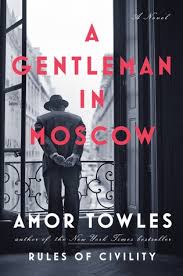
A Gentleman in Moscow by Amor Towles

It glows – it radiates and shimmers and shines.  Amor Towles’ new historical novel,  A Gentleman in Moscow,  is so many things but basically a hotel-window view of Russia  from the time of their civil war following the Bolshevik Revolution,  through unification under the USSR,  through the long harsh era of Stalin,  and on into the middle of the Cold War.
gentleman

*******
A Gentleman in Moscow
by Amor Towles
coming September 2016 / 446 pages
rating: 9.5/historical fiction (Russia)
*
Published by Viking   (and a huge thanks to them and to Netgalley for the advance copy of this book. 

pro_reader_120
******* 

On the “what’s it about”  level,  the life of an aristocrat,  a “Former Person,”   in Moscow has to be lived within confines of the world famous Hotel Metropol where his good fortune is to have been confined indefinitely under “house arrest” rather than executed or sent to the icy north.  Over the course of several decades the history of Russia and the internal dynamics of a great international hotel are interwoven with his personal life – the life of an honorable, intelligent,  loving and gracious gentleman.

As the book opens,  it’s 1922 and his “Excellency,” the twenty-something Count Alexander Ilyich Rostov, has returned to Moscow following a self-imposed exile in Paris. He has come back to reclaim some family heirlooms,  but finds himself confined,  by merciful court order,  to the upper floors of the Metropol Hotel.  His court sentencing also states that if he leaves the premises,  he dies.  Times have changed since the Count was last in Moscow four years prior, during the Revolution,  and the times will continue to change over the next several decades.  And therein lies a theme and a wonderfully well-told tale.

The Count has managed to secrete a fair sized stash of gold coins so he’s not really hurting for money.  He graciously arranges his now smaller and far less accommodating rooms on the 5th floor of the hotel and then meets a precocious young girl named Nina, the daughter of a fellow guest,  who shows him the ins and outs of the hotel – and there are many and it’s great fun.    Then the Count is employed as a waiter at the hotel’s main restaurant, the Boyarski.   His expertise is invaluable as guidance on a good many things from international menus and wines to seating arrangements. He understands princesses and knows what “class” really is.    And the book abounds with amazing descriptions of food.

As the story progresses Russia goes through some changes,  and life inside the hotel and restaurant has to go with the flow of the Stalin and the Communist state,  but the change is probably less evident.

Nina grows up,  Stalin comes and goes,  America becomes important,  but the restaurant “Triumvirate,”  Emile the chef,  Andrey the maitre d’, and the Count as waiter work together and remain fast friends through a series of troubles.   I won’t give away more,  but I became completely involved,  transfixed may be a better word,  in the story of  The Gentleman from Moscow.

Towles tells his story with sustained and perfect pitch matching the character of the Count –  a dignified intelligence,  a splash of humor,  a garnish of elegance, a hint of suspense, a dollop of history,  and a full measure of sparkling love.

I was fascinated by the novel’s footnotes which at times work to nourish the reader’s desire for a bit more information,  or at other times may create an added splash of intimacy,  with a delightful but unnamed narrator “intruding”  once in awhile with his own sardonic little line or bit of information with which to enlighten the reader.

This is the kind of book which is a joy to cozy in with somewhere and have a nice long read,  truly savoring the setting,  delighting in the characters, re-reading chunks of smart and lovely prose.  Get it now and stash it for your next rainy weekend with some blini or dumplings and tea from an old samovar (or vodka after supper), or black bread and borscht might be good or a good bottle of wine. (Did I mention the food descriptions are great?)

“So while dueling may have begun as a response to high crimes—to treachery, treason, and adultery—by 1900 it had tiptoed down the stairs of reason, until they were being fought over the tilt of a hat, the duration of a glance, or the placement of a comma.” –  Book One  – 1922 / An Appointment

And the point of all this is that although everything seems to change,  some people are able to evolve with the times meet the challenges and circumstances and survive- this is the story of one man who did – while keeping the best of the old,  the friendships, the love,  the elegance.
*******

http://metropol-moscow.ru/en/halls/294

2 Comments

Bad Country by CB McKenzie

Rodeo Grace Garnett is an ex-rodeo star turned private eye living in an abandoned housing development  just outside of Tucson,  on the Sonora Desert,  in southern Arizona.  One day he comes home from vacation to find a dead man at his gate.  He calls the police and his lawyer.  The sheriff and others show up and it turns out this man is only the latest in a number of murders where the bodies have been just laid out alongside the highway – findable.

badcount
*******
Bad Country 
by CB McKenzie
2015 / 294 pages
read by Mark Bramhall  10h 37m
rating –  B+
(read and listened) 
*******

One other murder is central to the plot,  though – the murder of Samuel Rocha,  grandmother of Kathryn Rocha, an old Indian  woman.  She is very poor but will pay Rodeo what she can to find his killer.

The story is definitely set in the southwest and it shows in the descriptions of everything from the heat and the landscape to the bulding interiors and from the ethnic mix to the language.   Even the structure seems like an interesting play on the setting –  McKenzie uses no chapters,  no quotations and no unnecessary commas.  This would be in keeping with the striking plainness of the desert.

There are a few too many characters but that might have been necessary for the development of the plot.  Actually,  I really only got interested at about the half-way point when a new person is found dead and some technology is introduced – at that point the crime turned into a puzzler and a who-done-it,  motives and all.

Leave a comment

The Real North Korea: by Andrei Lankov

I’m fascinated by North Korea and have no idea why.   I’ve read 3 books about it now and this is probably the one most fact-based.  The others were  “The Orphan Master’s Son” by Adam Johnson,  and “Nothing to Envy: Ordinary Lives in North Korea”  by Barbara Demick about the lives of six defectors from North Korea.   At this point I feel like I have a fair background in the subject but I’m always watching the news and the new books.

northk
********
The Real North Korea:  Life and Politics in the Failed Stalinist Utopia
by Andrei Lankov
2013  / 303 pages
read by Steven Roy Grimsley 10h 59m
rating:  8+  / nonfiction 
(very little listening) 
********

Andrei Lankov is a Russian scholar of Asia and a world renowned specialist in Korean studies.  He has personal background from his days as a young exchange student from St Petersburg and many subsequent visits.  He currently lives in South Korea from where he writes columns for the English-language daily The Korea Times[6] and for Al Jazeera English.[7]

On Lankov:
Aljazeera
Wikipedia
NK News:

Lankov presents a fascinating look into the history of North Korea which is really only about 70 years old – since the end of WWII and the partition of Korea.  The Kim family dynasty/monarchy/dictatorship is central starting from the staunchly Stalinist Kim Il Song.  who was appointed by the Stalin at a time when there were very few Communists in North Korea.    His son  Kim Jong Il carried the mantle from Song’s death in 1994 until 2012 when he died leaving the young (age 32)  Kim Jung Un in power.

The section dealing with the differences between the war-end collapses in North Korea and Vietnam  is very interesting as is the family soap opera section.

The individual names of the leaders have changed,  but only some of the over-riding policy has.  Interaction with the world has happened in spite of the efforts to control it.   North Korea is one of the most backward nations on earth and yet it manages to manipulate world attention and concessions.  The people are starving (or were for many years) but the saber-rattling and research-oriented military gets most of the spending because big weapons can scare world neighbors into giving aid,  preferably without effective controls. But if controls are set these can be avoided – and any promises North Korea makes tend to be broken when they become inconvenient.    Basically,  the Kim family is protecting itself.

After four interesting chapters of history of all kinds,  personal and family as well as socio-political and economic,  Lankov moves to the future – what will happen next?   –  What are the priorities of the countries who continue to give North Korea aid- of China and Russia and others,  the US? –  Why does the carrot and the stick not work?  What are North Korea’s priorities?  Why is collapse of some kind inevitable?  And what kind of a collapse will that be,  in what way will reunification be a part of it, or will it?   How will different scenarios work out in terms of nuclear weapons,  immigration,  the Kim family,  etc.

The book is structured with the turn to the future at about 2/3 through and then comes an “Intermission” to preview or prologue the switch.  It works well –  like “Considering what we’ve learned,  what are the various scenarios which could likely transpire in the future?”

Also about the structure there are various magazine style inserts which depict less important aspects of the situation.   “The Sorry Fate of Katya Sintsova”  and “A Flower of Unification”  are two of the titles.

Lankov’s narrative is very well organized and he writes almost like a native,  there are places where a word seems to be missing or a correct verb tense is lost in a complex sentence structure.  Not enough to be really annoying.  It is a bit dryly academic compared to other nonfiction accounts which tend to try to “read like a novel.”   I think this is a matter of taste.   It took quite a while

If you’re interested in North Korea but don’t have a lot of background this is an excellent book to get up to speed.  A few things have happened since 2012, it’s really more of the same,  but there will come a time when it will all change.

Washington Post: 


2 Comments

Satin Island by Tom McCarthy

Second reading – the 1st review is here and … well … this time round I think McCarthy’s book may be theme driven without pretense,  although there is a plot of sorts – and the theme may be there is no theme.   It’s hard to explain.

I often loathe theme-driven novels where the plot is constructed to emphasize the themes. (Graham Greene, Julian Barnes), but other times I love them (Pynchon, some of Richard Powers). This one is interesting in large part because it’s not only theme driven, that’s almost all there is to it.

satin
*******
Satin Island
by Tom McCarthy
2015 / 208 pages
rating 8.5 / contemp fiction
*******
The plot:   A guy named “U” is doing a big project for a corporation – it’s an anthropological project focusing on the
“Present-Tense Anthropology”-  or how does Starbucks figure in the scheme of things and other matters like oil spills and whatnot.  We follow “U” as he ponders a wide variety of things and tries to find patterns or underlying statements about our culture.  That’s the thing – to find the artifact which signifies deeply,  which resonates,  which defines western (Euro-American) civilization – possibly more.   This is a major quest of the Christ and Holy Grail magnitude – to the company anyway.

And the theme?   That’s what “U” is apparently looking for.   What’s going on beneath the surface?  Beneath the surface of everything from the Shroud of Turin which supposedly covered Jesus who left his mark, to the pavements of Paris which is so good for skate-boarding, to unfortunate parachutist deaths, to the Great Report our protagonist, “U,” is supposedly writing.  Is there a pattern in the universe of things, of life? What is the defining thing, artifact, myth, rite, of our times? What if it’s all wrong – there isn’t anything – no patterns,  no signifying artifacts,  no connecting threads,   no matter how deep you go.

It’s a fun book if you don’t work at it too hard – stick with the plot and the theme will appear.
Leave a comment