This is a legal thriller read for the 4-Mystery Addicts reading group – I may have nominated it there because I love legal thrillers and courtroom dramas. Dugoni is no Grisham or Turow but he’s not bad – the emphasis is definitely on the thriller part though.
******* The 7th Canon by Robert Dugoni 2016 /334 pages read by James Patrick Cronin – 10h 33m rating: B / legal thriller *******
It started slow but picked up by 1/3 and once I got the characters really squared away mentally, it was fine to good.
In a shelter for homeless boys, often involved in crime, a boy is murdered. As it turns out the priest who runs the shelter is arrested for the murder and Peter Donley is selected to defend him, Donley has his own demons as does the private eye he hires because the DA is proving ruthless in convicting Father Tom.
As a long-time and avid fan of James Lee Burke, I had to get this and read it as soon as it was available. But my reading is still a wee tad slow due to various causes, so although it is certainly is a page turner, I took plenty breaks. I’m not going to worry about getting my speed and stamina back. I’ll read at whatever pace gives me most enjoyment.
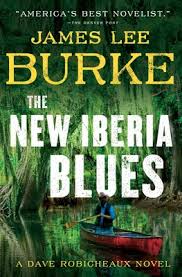
******* New Iberia Blues by James Lee Burke 2019 / 465 pages read by Will Patton -15h 3m rating – A+++ *******
So this is book #22 in the Dave Robicheaux series. Robicheaux is a homicide detective with the New Iberia force in Louisiana. These aree dark and gritty tales, but sublimely well written and the effect is like thick cream flowing slowly over coarse sharp gravel. The setting and internal dialogue of Robi-cheaux is where the creamy smooth wondrous literary narrative lies, while the plot, action and dialogue are the sharp-edged gravel, In some ways they’re similar to the crime novels of the old Elmore Leonard or more recently, Stieg Larsson, but Burke probably gets the prize for grit.
So here we have Dave finding the dead body of a young black woman which washed up on shore from the bayou. She appears to have been crucified and is wearing only a small ankle bracelet. Clete Purcell, Robicheaux’s best old drunk buddy and informal partner in crime detection, Alafair, his grown adopted daughter, and Helen Soileau, his boss, are all on hand to help. There are a few other characters from recent novels also included.
It seems that Desmond Cormier, local poor boy who has done quite well in Hollywood. has now come home bringing with him a strange friend named Antoine Butterworth. Added to that there is a death row escapee on the loose as well as a known trigger-happy nut-case out for some kind of vengeance. Dave, as usual, is haunted by his own demons which include three dead wives, his old battle scars and booze. The East Coast Mafia is involved somehow and maybe even Russia are endangered. Prostitutes and other women are definitely endangered.
If these books were less beautifully written I’d throw them across the room in a heartbeat. But with an underlying theme of good vs evil and some allusions to classic literature – I have to keep going.
I read this a long time ago and thought I remembered it. Well, I did remember the setting and the heroine’s general predicament as well as how it ended, but my memory of the themes and specifics was almost nil so I read it again. This time my comprehension was way, way off and I misread this book completely. I can only put that down to general exhaustion and worry.
******* The Bookshop by Penelope Fitzgerald 1978 / 192 pages read by Doranda Peters – 3h 30m rating – 8.75 (both read and listened *******
But during the discussion at The Booker Prize GroupI got interested in one question: Why did Florence wear a red dress? So I explored that in my Kindle version and found myself intrigued by what all was involved.
Oops! I started reading again starting with the Introduction which brought up all sorts of interesting facets And I continued. It is a very short book and events take place one right after the other with very little said about the individual characters and yet that’s what it’s mostly about. I suppose it’s minimalist in its own way and I usually really enjoy minimalist works but this is cutting some real corners when it rushes from one character smack into another.
Oh well, it’s a wonderful novel, quite realistic in a very late modernist kind of way, but without all the detail which often accompanies that form. There is also some focus on nature and the peculiarities of small towns and their “characters.” An over-riding theme is that of predator and prey I suppose and that’s not unlike Fitzgerald’s other novels.
Basically Florence Green, a widow who has lived in the town of Hard-borough for eight years. decides to open a bookshop in a large but broken down old building. That’s fine with everyone who doesn’t read much because they like her. That said, she has one formidable enemy, a wanna-be socialite who has her own high connections and her own ideas about what should happen with that Old House place.
As described in the first chapter, it’s a fight between a predatory heron and an lowly eel who is simply struggling to survive – it’s an “exterminator” and an “exterminatee” if you will. This is the image Fitzgerald paints for us a couple times to underscore that thee. . Although there are nicely humorous parts, a comedy of manners perhaps, a lot of the book, including the ending, are darkly disturbing.
Brilliant book – Quammen tells us the story of what has been happening to the idea of the “Tree of Life” idea in the field of biology. Charles Darwin came up with that idea and a little graphic back in the early to mid-19th century and it stuck until now. (The idea wasn’t brand new to Darwin, though.).
******* The Tangled Tree: A Radical New History of Life by David Quammen 2018 / 480 pages read by Jacques Roy 13h 48m rating – 10 *******
But where Darwin’s tree had two basic branches (plants and animals) that idea was challenged in 1977 when, thanks to all the new techno-logy available, a 3rd form of life, a new kingdom, was discovered by Carl Woese. It was called archaeans, and following that, cells of this new form were found in other plants and animals. What did that do to the idea of separate plant and animal kingdoms?
And with Darwin’s specialty being evolution. -what did it do to that idea? How did other scientists react? How did non-evolutionists react? What doors did it open?
That all transpired back in 1977 and. a LOT has happened since then. Quammen covers it well. We don’t even have a tree anymore, not really. If one were to diagram what has been being found, it could look more like the “Tangled Tree” of the book’s title, but it really seems more like a web or a road map with intersections and all.
Qammen writes very nicely and the book is wonderfully well organized. There are sections of biography on the important names, especially Woese, who, as a very old man, went out fighting for his own vision.
Wow. I mean “Wow!” Milkman is considered “experimental” and I think it is really what with the lack of character and setting names plus stream of consciousness approach. But it worked for me and apparently the Man Booker judges as well because it won the biggie! And it totally deserved it.
I was a bit hesitant to buy into the hype (and it got lots of glorious reviews) because that sometimes leads me to expect too much from a novel and then I’m disappointed. But I hadn’t completely bought into the hype on this so I ended up being wonderfully well surprised by the enjoyment and quality Banks provided. – That’s just how I am, better off if I don’t expect a whole lot.
******* Milkman by Anna Burns 2017 / 360 pages (paperback) read by Brid Brennan – 14h 11m rating: 9.6 *******
Although the unnamed first-person narrator lives an unnamed city in an unnamed country it’s obviously Northern Ireland but Burns has said she wanted it to be someone allegorical rather than history -specific. The time is one of high tensions and a disgust for the land “across the sea” so that’s likely going to set off Belfast in the reader’s mind. Ireland had serious troubles in the 1970s.
The characters are referred to by the relationship to the narrator or the others in the story. There’s “third sister,” and “brother-in-law,” and “almost-boyfriend” plus Ma and of course Milkman and many others. Sometimes little groups have names, “wee sisters.”
This is not really a historical novel as such because the dates and places are never specifically stated. Burns has said she was thinking more of an allegory when she wrote it. And she said that the novel’s characters just didn’t need names.
The themes are more important and they deal with what happens to relationships in those kinds of times which are full of fear and suspicion and tear neighborhoods apart. There are women’s issues and LGBT issues and political issues and general gossip issues – this poor narrator is witness to lots of issues and she’s trying to stay low and out of it.
I both read and listened and if you happen to listen, the reader, Brid Brennan. is absolutely fabulous. I’d still say you need the book though because it’s very complex and subtle and sometimes the words get confused, like “wee sisters” sounds like “we sisters.”
Has it really been three weeks since I’ve written a book review? There was one non-review blog entry on January 3, but prior to that it was 12/28 and today is 1/17!
I really didn’t want to stop blogging – I was moving my mom into a lovely senior home and getting her settled plus having her birthday party. That took both time and energy as she’s 95 years old now! It will still take a bunch more time and energy to empty her old house and get it sold. But not today. I need at least a couple days free a week. Today I finished another book. (YAY) and that’s four for January so far.
I do have to admit that I wasn’t focused on two of the books I read this month at all. Both To the Lighthouse by Virginia Woolf and The Bookstore by Penelope Fitzgerald seemed too slow for me or something. I’ve read them before and I know there is meat in those books – delicious meat. At least they were short. And I didn’t bother with reviews.
Also today I started cleaning out my folders of really old posts with double and triple copies which were messing up my filing system. And I started listening to James Lee Burke’s new Dave Robicheaux novel, New Iberia Blues (number 22 in the series) and writing a couple reviews.
I might slow down a tad, but I’m not leaving. :-).
My site is currently under fairly heavy reconstruction – remodeling you might say. It’s NOT cosmetic. I upgraded and then the filing system changed and it’s really too cumbersome anyway,. A lot of the old posts/reviews are going to be disappeared and many have gone already. This may take days or months – I have no idea because I’m also in the middle of some personal changes. (I’m hoping for a couple weeks, but …). ‘
I hope to be posting my reviews as usual but may not be reading as much,. Thank you.
This book is so dense and so good I had to read it twice. Yes! This time it gets a 10, but it takes work. The author is a legal scholar at Vanderbilt University so, as one might expect, the book is very well thought out, researched, organized and written basically explains why the Constitution is a “middle class” constitution (rather than a class-warfare constitution”. and how the it changed over the centuries to where it now seems to protect the elites.
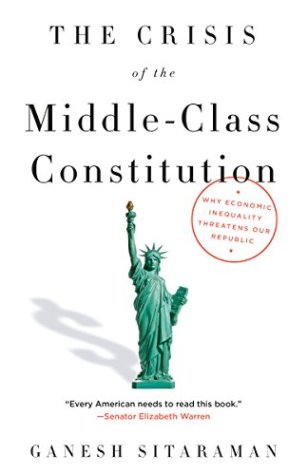
******* The Crisis of the Middle-Class Constitution: Why Economic Inequality Threatens Our Republic by Ganesh Sitaraman 2017 / 433 pages read by MacLeod Andrews – 12h 24m Rating: 9 / history-economics (both read and listened) *******
The Introduction is difficult but interesting and the next two chapters remain challenging. The narrative let up for me in Chapter 3 where I had more background and it continued in a relatively more accessible way.
The material is organized into three Parts each divided into a few chapters. This follows a fairly thorough Introduction. Part 1, “The Radicalism of The American Constitution,” goes back to the Greeks/Romans and what a Middle-Class Constitution might be as well as how others since, like Machi-avelli, have viewed overall governmental structures, and how all of this applies to the Western world, specifically the United States, today.
Part II, “A Brief History of the Middle-Class Constitution,” deals with the Western world prior to the ratification of the US constitution. This means mostly the founding fathers and their era showing that what happened in America really was a Revolution and not just a War of Independence.
And then Part III, “The Crisis of the Middle-Class Constitution,” gets involved with more recent US history and how the struggle between the elites and the middle/lower classes. This includes the fight over slavery, and the feudalism of the south, but not much say about women. Sitaraman also covers the Progressive Era, the WWII boom, the Civil Rights era, the flattening of the middle class since 1970 and what’s been going on since, like the Citizen’s United court case The final chapter deals with suggestions for reviving a Middle-Class and a Constitution which supports stability.
Overall, it’s a fascinating account of what started out to be a brave new way of governance has turned into another form of government by elites., How and why did that happen and can we somehow alter the course of our Republic?
Great novel, inventive, ambitious, fun. It’s a bit wordy and convoluted, but still, one of the best I’ve read this year.
First, the subtitle is definitely meaningful – pay attention. There is a Prologue, but the story really kicks off with Chapter 88. Odd, yes, but with a point – it’s like a countdown and increases tension in itself but there’s more. And we have the best opening lines since “A screaming comes across the sky,” (Pynchon Gravity’s Rainbow) or “Now single up all lines” (Pynchon again from Against the Day):
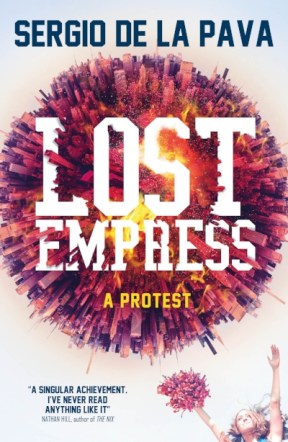
******* Lost Empress (a protest) by Sergio de la Pava 2018 / 624 pages (Kindle) read by full cast 19h 3m rating 9.5 / contemp fiction (both read and listened) *******
From Lost Empress;
“Let us then have, in these pages, an entertainment.”
And indeed the book is, truly, an entertainment in the very best sense of the term. And de la Pava goes on with the paragraph:
Not strictly one, but principally so. Let wit and peals of laughter distract to the point of defiance and leave for elsewhere the desultory analysis of decay and devolution.” –
What a super way to open. It lends the old meaning to the term “novel.” Okay, so it is rather far-fetched
I read de la Pava’s first book, A Naked Singularity (link to my review on this site) and was totally enamored, finding it to be one of the best books I read all last year (2017). But in some ways, Last Empress surpasses that. So what am I to say now?
Okay – so it doesn’t quite start out quite that hot. It took me awhile to get into it because there are so many characters each apparently leading their own weird and separate lives but eventually each a part of a plot thread.
Changes in plot thread usually alternate with the chapters, but occasionally appear rather abruptly. And then there’s the third person narrator interjecting bits and pages( of meditative wisdom or hilarity as needed, sometimes at length. This narrator also addresses the reader directly from time to time.
Meanwhile, some of the dialogue is written like a play script breaking up the narrative nicely and drawing more focus to the characters. There are also 911 (emergency) transcripts (including nonsense code which is not reproduced in the audio version), some excerpts from the Riker’s Island Inmate Rule Book, journal entries, and so on.
The main characters: The following list gives you a kind of sense of the general plot – an NFL strike precipitates the formation of a stronger IFL which is owned by one Nina Gill whose brother owns the Texas Cowboys. Her sidekick, Dia Nouveau is involved in everything. Meanwhile, Nuno DeAngeles, a brilliant but very unfortunate thug, is charged with getting Nina a copy of an old Salvador Dali print hidden on Riker’s Island. There are several more secondary threads including a professor of theoretical physics and various EMT units.
Nina Gill is perhaps the star protagonist because of her “tall, thick, impossibly magnetic” self which de la Pava presents in all its smart-mouthed glory. She is already wealthy, but has been unfairly deprived of her father’s legacy football team (the Cowboys) in his will. Nina knows football and men and many other things but instead of inheriting the Cowboys, she becomes the owner of the Pork, the Indoor Football League (IFL) team of Paterson New Jersey. She spends much of her time in the book collecting a team. Nina is also a collector of the works of Salvador Dali which is important.
Daniel Gill, Nina’s accountant-minded brother who unfortunately did get the Cowboys in their father’s will. There will be a strike. N
Nuno DeAngeles, a very intelligent and sneaky 18-year old inmate at Riker’s Island. Behind his facade of toughness, he’s really very human and literate. He’s in prison for his thievery and he’s angry and really only wants to leave.
Major Harris: An ex-NFL player, friend and supporter of Nina’s –
Sharon Seaborg – a 911 operator, married to an EMT, Huge Seaborg. Lives next to Feliz Heredia
Dia Nouveau – a young woman Nina grabs to act as her attorney, but is actually her “sidekick.” She’s bright and funny and occasionally stands up to Nina.
Travis Mena, MD is a very “unimpressive” young doctor with an elite background who is doing his residency at Bellevue.
Hugh Seaborg – a corrections officer at Riker’s Island, married to the 911 operator, Sharon Seaborg.
Jorge de Cervantes – parking garage supervisor – brilliant and rich now, with a wife and family (Nelson and Gisella), but questioning the meaning of his existence. He immigrated for success and he got it, but …
Nelson de Cervantes – 13-year old son of the deceased Jorge de Cervantes –
Coach Elkins – Ex Cowboys coach Nina gets for the Pork.
Larry Brown – Emergency Medical Tech and friend of Hugh.
Solomon Hanes – a Riker’s island inmate hooks up with Nuno.
Elsie Heredia – a very poor widow with an amputated leg who lives with her son, Feniz who came to the US first. They were originally from Puerto Rico but have now lived in Paterson for over 35 years. She is now in decline and hasn’t left the house for a decade.
Feniz Heredia – Elsie’s son and care-giver came to New York but landed in a mental hospital so now lives with Elsie. They tend to be pessimistic and live next to Sharon Seaborg.
Dylan Reeves – a cornerback who is in Attica prison for drug possession until paroled into Nina’s care and football team.
Sylvester Scarpetti – fatintern at the Manhattan District Attorney’s office who transcribes material perfectly and immediately and with sensitivity and “undeniable reality.”
Manu Mutola – an NFL star from years prior who is recruited by Nina.
Father Simon Ventimiglia – highly educated chaplain assigned to Paterson and Riker’s Island.
Elvis Herrera – another inmate at Rikers, not a friendly one.
Celia de Cervantes – wife of Jorge and mother of Nelson de Cervantes. s
The Theorist – in Bellevue –
The narrative goes from thoughtful to exciting to incredibly sad to silly to a bit of foreshadowing to philosophizing and so on – even theoretical physics and space-time considerations in an encyclopedic sort of way.
I started reading Jonathan Letham back in the 1990s when he came out with Motherless Brooklyn and The Fortress of Solitude, both of which I greatly enjoyed. Then something turned me off, I have no idea what, and he dropped off my radar.
But here he is back with a novel reminding me of a cross between himself, Jonathan Franzen and Michael Chabon, maybe even a bit of Thomas Pynchon as shown in Vineland or Inherent Vice. I don’t know but he’s definitely drawn me back into his circle.
******* The Feral Detective by Jonathan Lethem 2018 / 287 pages read by Zoisa Manmet 8h 23m rating: 7.75 / contemp/fiction – crime novel? *******
Phoebe Siegler, our 1st person narrator, is 30-something, single, well educated and well to do, but she feels completely lost after Trump’s election. So she quits her job at the New York Times and travels to Los Angeles. Her mission is to find her friend’s daughter, Arabella, who seems to have disappeared into the California desert.
Hiring a strange older guy named Charles Heist who technically knows the desert well and the people who populate it but doesn’t quite share how well or the two of them are kind of lost together although he knows the area well and even grew up there – he’s the feral one for fairly good reason.
After a trip to a mountain Zen retreat where they come across a murder, they travel to the desert where they encounter the two feuding tribes, the Bears who are rather Hell’s Angels types, and the Rabbits who are basically arch-feminist.
I suppose it’s a literary thriller of sorts – the thing which really ruined it for me was the narrator’s gravelly voice. And I kept comparing it to Michael Chabon’s The Yiddish Policeman’s Union (which I love). .
Yes! It’s every bit as good as the hype and reviews say it is and it’s on several “Best of 2018” lists. I’ve been meaning to read it since it came out because the techie/true crime nature of it really appealed to me. But the medical part didn’t at all.
This is the story of how the miracle medical breakthrough by a Silicon Valley startup health company named Theranos run by Elizabeth Holmes.
******* Bad Blood: Secrets and Lies in a Silicon Valley Startup by John Carreyrou 2018 / 320 pages read by Will Damron – 11h 37m rating: 9.5 – business-economics-true crime *******
What happened? There’s still plenty of room for speculation as to specifics, but the upshot is that most of the company’s results were fraudulent in some way. Carreyrou uses interviews with many of the top players as well as court transcripts and other written evidence (emails, reports and memos etc) to outline the inside operations of Theranos as Elizabeth pushed her way toward selling her product anyway. Back in 2004 Elizabeth Holmes, the brilliant 20-year old daughter of a prominent business executive and his wife, left Stanford University to form a startup she had conceived. She wanted to develop a method and device for doing blood tests at home instead of in medical labs.
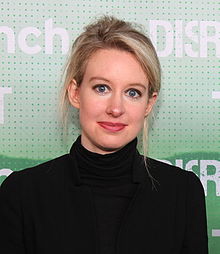
Elizabeth Holmes
The idea was apparently a hot one because she was successful in getting funded through family friends and a few venture capitalists. Then she managed to get the backing of famous people and hire some excellent engineers and other employees. There’s also a developing paranoia on the part of Elizabeth and Sonny Balwani, her co-administrator/significant other. And they used a lot of techniques to intimidate people and skirt the law. There’s a fair amount of material about legal shenanigans involved, but I love that.
There are many interrelated threads as the narrative follows the stories of numerous employees of various sorts, legal people, some friends, board members, doctors, reporters including John Carreyrou and others,
Carreyrou is an excellent writer at the Wall Street Journal and skillfully builds the tension to near thriller level. There is an Epilogue but it would have been written around January of 2018 and more has happened – Google Elizabeth Holmes, there’s lots out there.
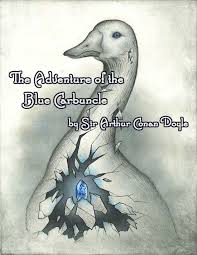
This is the first of my Christmas readings this year. It’s only a short story, (so it won’t count on my tally), but it’s supposedly one of Doyle’s better Holmes tales, so I wanted to read it anyway, and with the holidays here plus its being on sale…well…
I’ve read his novels but not so many of the short stories. I’d like to remedy that. I think I have a volume of them around here.
******* The Adventures of the Blue Carbuncle by Arthur Conan Doyle 1892 / 20(?) pages read by Matt Montanez – 47m rating: 8/B+ /but it’s Christmasy crime by a master *******
Just around Christmas time there is a headline making robbery in London in which the thief got away with a precious gemstone, a blue carbuncle. A man who had been working at the mansion is quickly arrested but proclaims his innocence. There is a hat left behind in a scuffle which provides Holmes with a great number of clues – naturally.
And the stone turns up in the police chief’s Christmas dinner goose. How in the world did it get there and why? It’s a goodie, a nice puzzler but a bit lighter than some for the season.
It’s time for dumb. I’ve followed this series since book #1 which, being a mystery series, caught my attention and then it tickled my silly-bone. But be warned, it’s a stupid kind of humor and while the first one is bad, the following books are worse – lol. This is number 6 in the – ta-da – Paul Jacobson Geezer-Lit series. I’m not sure what this says about me, but I do NOT recommend the series unless you enjoy rather ridiculous situations and silly old-man puns. They’re definitely in the “cozy” mystery genre.
But actually, in some ways I find cozy mysteries kind of refreshing after reading gritty suspense thrillers or challenging nonfiction.
******* Nursing Homes Are Murder by Mike Befeler 2014 – 261 pages read by Jerry Sciarrio – 6h 56m rating: 7 – / cozy crime 6th in the Paul Jacobson Geezer-Lit series (the final one) *******
Paul Jacobson, a lively 80-something “geezer,” suffers from extreme short-term memory loss, has been asked by his friends in the Honolulu police force to go undercover in a nursing home due to suspicious reports about abuse there. This home accepts folks with dementia so there are plenty of high-jinks. But on Paul’s first night there the woman who has been complaining about sexual abuse is murdered. The next night someone tries to smother Paul with a pillow.
His roommate is nearly blind but is able to help with sounds as Paul makes his rounds doing very informal inquiries about and with possible suspects. There is also a cop assigned to the hospital (in custodial work) to assist him if he runs into trouble.
It’s a fun book and it’s the last of the series. Befeler has written several other books though including a couple of series. We’ll see.
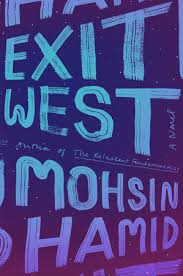
A second read for me because the Booker Group chose it for our December discussion and I read it in March of 2017, which is probably 250 books ago. So although I do remember it, much was fuzzy and because that’s the nature of the book anyway, it was really fuzzy.
This is dystopian fiction taking place in a time in the not too distant future when global warming has resulted in refugees from all over the world slipping into and out of one country or another. These migrants are being fought and attacked by police, soldiers, nativists and even each other as they huddle in groups in camps or abandoned mansions before they are either killed or escape by mysterious means. The world is a very dangerous place.
******* Exit West by Mohsin Hamid 2016 / 340 pages read by Mohsin Hamid 4h 42m rating 9 / contemp lit *******
Saeed, apparently Arab of some sort, and Nadia, probably from some Slavic country, meet and fall in love in Tokyo, but the situation becomes dangerous and Saeed’s mother dies. Although they are not really to that point in their relationship, the pair flee the country, with Saeed’s father’s blessing, and thanks to the mysterious doors which are a signature of the tale, find themselves on the Greek island of Mykonos. then in London where they stay for some time. There are quite a few Nigerians there as well as many other nationalities and they keep coming. The couple moves from place to place in the London camps. This apparently works out for many months, a year, although the circumstances are always very tiring and difficult. Their relationship has not really survived the strains in a romantic way. They’re getting older.
There are other tiny stories told about other people in other parts of the world, Tijuana and Amsterdam, for instance. It’s a world-wide problem including in the United States.
Michiko Kakutani, writing in the NY Times, says Hashim mixes global trouble with a bit of magic in some ways akin to C.S. Lewis’s The Lion, the Witch and the Wardrobe and yes, absolutely, I see it.
Warning: This is about 25% mystery and 75% romance of different sorts. I didn’t get it for either reason, but rather because of the hype. And it was about 35% pretty good and 65% poor. There’s a death (murder?) and legal crime story as a frame for a romance which includes a wild girl known as “Marsh Girl” who has been abandoned by almost everyone and grows up in the salt marshes of eastern North Carolina. A couple local young men get involved with her – that’s the love story part. The crime part includes the procedural aspects and the court case after one of the men is found dead.
For the first 150 pages or so I was impressed, this is the story of Kya as a young girl in a seriously bad situation and there are lovely descriptions of the setting. Then Kya gets involved with Tate on a level deeper than learning to read and then along comes Chase. Shoot, just as I feared, it’s basically a Young Adult romance novel. But because it’s kinda-sorta nicely written and has a mystery/crime tale as a frame story there was a hook for me and I hung in there.
******* Where the Crawdads Sing by Delia Owens 2018 / 379 pages read by Cassandra Campbell – 12h 12m rating: 5 (very mixed) / contemp fiction (read and listened) *******
I’m not going to judge the book or folks who love it because I personally really enjoy crime novels which are some-times as clichéd and with possibly less literary significance than this book. This just isn’t my genre. (And my rating is based on what I like in books, not any kind of ultimate value.)
I was quite pleased for about 1/3 of the book and then it turned into the YA thing. But it did get excellent reviews as general fiction and I enjoyed most of the procedural crime and courtroom drama parts, but the sheriff was really stupid. The last few chapters were rather original again and I enjoyed them.
A big disappointment for me, but not a total waste. As I said in my rating – the review is mostly negative but the rating is mixed.
Bottom line – it’s a very good book if you can stand a bit of perversity. Except for the yukkie parts, which were not as indelicate as in Moshfegh’s other novels, I really rather enjoyed the book .
Our unnamed 1st person narrator is depressed. She is very seriously depressed, rejecting the world and all it entails in order to sleep. Yes, she wants to sleep 16 hours or more a day. A smart, pretty, well educated, and financially independent young woman, she had found herself orphaned while still in college or just afterwards. She had a boyfriend for awhile but he was far more abusive and distant than available and loving, but she still can’t actually let go of him. She found herself a rather odd therapist who prescribes relaxants and sleeping aids (per her complaints and requests) and started to really enjoy sleeping. She gets fired from a good job (for sleeping) and lives on her inheritance and sleeping aids and bits of food. By the time she is 24 she is sleeping an abnormal amount and always tries for more.
******* My Year of Rest and Relaxation by Ottessa Moshfech 2018/ 301 pages Read by Julia Whelan – 7h 14m Rating: 8.5 – general fiction *******
Many readers will object to the workings of this young woman’s mind. She’s really pretty screwed up and it can get less than attractive. . But at the same time there is something peculiarly likable and sympathetic about her. I was curious how this would all turn out and much of the book is how she got this way.
The bulk of the book consists of her version of her life to this point although what’s going to happen to her next is more interesting and contains the tension of the book.
Well, too much sleep can have side effects and her mental state is not improving anyway. When she starts doing things while sleeping it gets quite worrisome if you’re connecting with her and the tension builds nicely.
Enjoy, if you like Moshgegh or are curious about her work, but have heard unpleasant things. She did make the Booker List in 2017 for Eileen.(My review on this site.)
Yes, it’s as good as its hype – a fine, fine book. If I’d known it was this good I wouldn’t have waited. Seriously. And I darn near cried – not quite.
I’d been looking at this widely acclaimed book since it came out as the whole idea behind homeschooling and living off the grid intrigues me. Then it was on sale at Amazon and I knew I could get the Audible version at a reasonable price. Voila – from Wish List to iTunes. Happy days.
That said, it was much better than I expected although quite different.
******* Educated: A Memoir by Tara Westover 2018/ 335 pages read by Julia Whealan – 12h 10m rating: 9 – nonfiction/memoir (both read and listened) *******
Tara Westover was raised by parents who didn’t send her to school or train her to be a part of the world as we know it. Her father was a rather paranoid man of fundamentalist Mormon views who also decided to live off the grid and was making a fair job of giving it a try. The family had a piece of land and Dad was in the junk business as well as construction.
Her mother got into midwifery, healing herb and home remedies while her older siblings, several brothers and a sister or two, either left home or were stuck.
Their home included father’s junk dealing business with his grandparents living nearby for most of the year. In the house were her mother’s plants for healing and the house smelled like that, and it was very dirty.
“The most powerful determinant of who you are is inside you,” he said. “Professor Steinberg says this is Pygmalion. Think of the story, Tara.” He paused, his eyes fierce, his voice piercing. “She was just a cockney in a nice dress. Until she believed in herself. Then it didn’t matter what dress she wore.” (p. 243)
While writing this Westover doesn’t trust her own memory and consults with her siblings and tries to re-imagine. Their memories don’t always agree and Westover is upfront about that.









 Becky's Books -