***** The Searcher by Tana French 2020 / Audible read by Roger Clark rating – B+ / crime *******
Cal Hooper has moved to a piece of land he bought near a small Irish town to find peace and quiet after years in law enforcement in Chicago. He gets acquainted with the locals and a young boy starts watching him work around his place. They become friendly and Tray comes out with his reason for hanging around – his brother is missing and he knows something of Cal’s background. Cal is talked into giving it an investigation.
The story starts slow, but it picks up around 10% and I became engaged at some point there or a bit later. I can’t say as this is a page-turner but I’ve been distracted by news. (I try not to be but the unfolding, real life story of some fool group deciding it’s their patriotic duty to kidnap a governor and start a civil war kinda beats the story of a divorced and retired detective hunting down a missing boy – and then I’ve been sick with some kind of cold – going through a box of tissues a day.)
The story starts slow, but it picks up around 10% and I became engaged at some point there or a bit later. I can’t say as this is a page-turner but I’ve been distracted by news. (I try not to be but the unfolding, real life story of some fool group deciding it’s their patriotic duty to kidnap a governor and start a civil war kinda beats the story of a divorced and retired detective hunting down a missing boy – and then I’ve been sick with some kind of cold – going through a box of tissues a day.)
There’s Cal and his friendly neighbor named Mark who spies on him for gossip. There’s Lena, a very competent and animal loving neighbor, for a bit of possible romance if you’re looking for it. And of course there’s Trey, age 13? whose brother is missing. And for the most part the story follows genre form with a few very nice original twists.
Cal is burdened with his own backstory of difficulties with his own angry wife and daughter back in the States. Trey has a serious living condition at home.
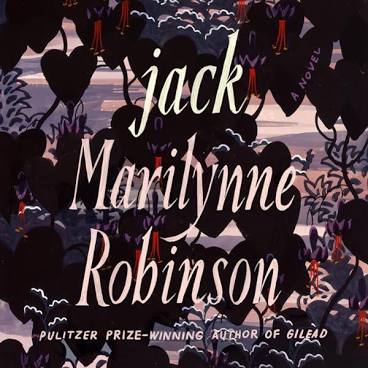
This is the 4th in the series of books following Robinson’s award-winning novel Gilead. These books are definitely connected but it’s not necessarily to read them in order. I did read them in order of publication and I recommend that but … . They deal with the lives of an older widowed minister in Iowa, his first two children, his 2nd wife and his son from the first marriage. The first book, Gilead is basically a journal and a long letter to the son by his 2nd wife, Lila.
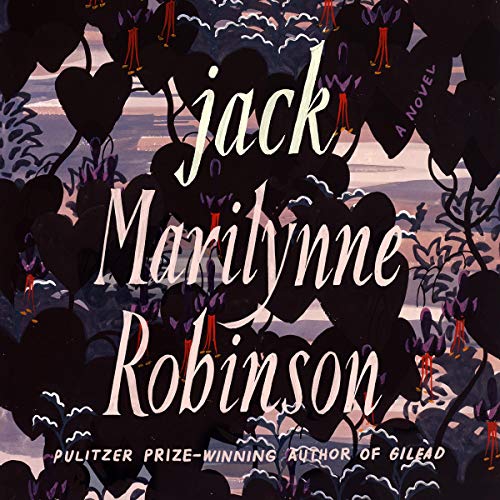
Jack ~ by Marilynne Robinson 09 2020 / Read by Adam Vernor 10h 28m Rating: 9.25 / historical fiction – literary (Book 4 of Gilead series)
They are mostly set in rural Iowa but St Louis and other rural areas figure into it. They take place between WWI and the 1960s with a long flash back to the Civil War in Gilead.
In this book Jack, the minister’s son by his first wife, is found to be living like a semi-bum in St. Louis. He drinks a lot and although he’s a kind of charmer, tries to stay away from people because of his difficulties with God and his father – he’s such a disappointment, so troubled. He feels he brings trouble. As with the other books, there are a lot of Biblical references and philosophy. This is Jack’s story almost entirely from Jack’s point of view but told in 3rd person.
He meets a young woman named Della and they enjoy talking to each other very much. Over time they become involved on a very discreet level. She’s a black woman and the year is 1946 (post WWII). So this is not the safest of relationships for either of them. Jack was 4D for military purposes. He spent 2 years in prison for something minor. He’s very bright and funny but filled with self-loathing. How can he ever be connected to Della who is also the child of a minister and from a very good, protective family. But they do connect – they become so in spite of him.
It’s a good, good book, maybe not as good as the first three in the series, but very compelling, literary, intricate.
I’ve certainly tried to enjoy Louise Penny but after 6 books (!) spread apart by years, I now officially give up, convinced that this author is just not for me. So many of my friend adore what are known as the Three Pines series and these books have had so many raving reviews on the various boards (Amazon, Audible, GoodReads) that I kept trying over the years. If these others liked the books so much what could be wrong? I told myself that I must have gotten the wrong books. – nope – I don’t think that’s the problem.
All the Devils are Here By Louise Penny – 2020 Read by Robert Bathurst – 13h 59m Rating – 3 (because I finished) / crime series
This latest one seemed different and many said it was her best yet. Also, I thought it might be a nice escape from 2020 and all that entails.
******* From the publisher: On their first night in Paris, the Gamaches gather as a family for a bistro dinner with Armand’s godfather, the billionaire Stephen Horowitz. Walking home together after the meal, they watch in horror as Stephen is knocked down and critically injured in what Gamache knows is no accident, but a deliberate attempt on the elderly man’s life.
When a strange key is found in Stephen’s possession it sends Armand, his wife Reine-Marie, and his former second-in-command at the Sûreté, Jean-Guy Beauvoir, from the top of the Tour d’Eiffel, to the bowels of the Paris Archives, from luxury hotels to odd, coded works of art. *******
Yeah – it’s “Three Pines Goes to Paris” where they find a complex international corporate crime to get into trouble with. Taking your characters abroad is a common ploy used by the authors of series whose lead “detectives” have already solved too many murders in their small hometowns but the series is still strong
Gamache continues to be morally and intellectually superior even on the international scene. He is also always loving and sensitive, even in the face of the current case when his beloved son exhibits intense rage, maybe hatred.
The claustrophobic atmosphere of Three Pines and it’s artsy-quirky characters is gone, but the other characters here are flat. The superior Armand Gamache has brought the whole family and Armand is just as superior as he was in the tiny Three Pines. Reine Marie is okay but the rest of Armand’s doting entourage have not improved – but they’ve not got worse (I wasn’t really familiar with his sons.)
Like most novels about Paris which are written for Americans/Canadians there are too many Parisian street names, food names, building names. Whatever will give a French atmosphere and it feels fake and very touristy. I love Patrick Modiano, Marion Barbery, and Michel Houellebecq and others who don’t need to do that because there’s a great story underneath the language. The story here is so-so but it has a good ending.
I loved Wilkerson’s first book, The Warmth of Other Sons but by the time I got around to reading this book, her second, I was kind of tired of all the depressing news for the last 9 months or so. It took me awhile to get into it.
Caste: The Origins of our Discontents By Isabel Wilkerson 2020 / 477 pages Read by Robin Miles – 14h 26m Rating: 8 / social science – politics
After I did though, at about Chapter 4, about page 40 when Wilkerson delves into more specific history, it was great and I went along enjoying the book tremendously – until Part 7 and the Epilogue, from page 357 to the end, where it gets more polemic than anything. So my rating is somewhere between a 9 (the meaty middle section) and a 3 (the draggy beginning and ending). But there is more meat than mush so I gave it an 8. I still had some issues.
The history was interesting as far as it went, but mixing the chronology up as much as Wilkerson did eliminated any thought of progress between the earliest days of slavery and mass lynchings to contemporary times when good low caste people are ignored by waiters, almost deliberately (I think) obfuscates that – there’s been no progress in 500 years?
And Germany’s turn around ignores the fact that Jews were getting upwardly mobile using a variety of methods until WWI which Germany lost and for which the rising Hitler conveniently blamed the Jews (The Pity of it All by Amos Elon – 2002)
I enjoyed learning about the Indian system but imo, there’s not enough of it in the book to entirely justify the title. The caste system has been in effect there for thousands of years and although making it illegal – it’s still operative. This should have been examined more closely because it does absolutely bear on the “race” problem.
And although race/caste is certainly the basis for a LOT of our difficulties, life would not be utopian had race never have raised its ugly head. We have plenty of troubles with greed and capitalism on their own – using race is just another means to selfish ends.
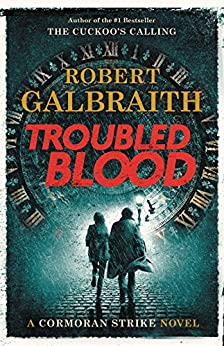
Oh yes! I did jump at the release of another Cormoran Strike crime novel. To get this out of the way right now, I had read rumors of the book (and therefore Galbraith) being anti-trans people, but in this book it would seem that horrifically deviant people come in all varieties and Galbraith is an equal opportunity employer of evil. I do hope that the complainers get further into the book than they apparently have because no category of humanity is exempt in a Cormoran Strike novel.
Troubled Blood By Robert Galbraith 2020 / 944 pages Read by Robert Glenister 31h 51m Rating: A+++ / crime series private detective (Both read and listened)
Also, there’s no serious evidence in the book that this or that particular bad guy (and there are lots of bads) is any kind of real trans. The one character who might be (depending on your definition) sometimes uses dresses as a disguise to lure women to their rape and seriously ugly death, but he is a brilliant schizophrenic with many tricks. There are a couple of seriously bad and/or mad women, too. (I don’t remember any bad gays or lesbians although they are present in the story.) Because of the violence I really don’t think kids under 16 or 18 should be reading it, even if their parents were Harry Potter fans.
The main plot is a who-done-it concerning the disappearance of Margot Banborough, a London-based physician who went missing and whose body was never found even after 40 years. Now, in contemporary London, Anna Phipps, Margot’s daughter, wants to find out what happened to her mother. The timing of Margot’s disappearance was such that Dennis Creed, the crazed man convicted of slaying of several other women, was always suspected but it could never be pinned on him.
So Strike and Robin take the closed case and go about interviewing the people who were involved in the cases at the time. In doing that they go through the notes of the police who were involved, finding that the main detective went a bit mad himself and ended up studying astrology to solve the crimes. That old detective’s notes are a marvel of drawing included in the Kindle version but not the Audible.
There are a lot of characters. There is the ongoing staff at the agency, the families of the multitude of victims, the suspects for each victim whose body has not been found and ascribed to the main suspect who has been in custody for decades, the friends and relations of Robin and Strike, the individuals involved in the agency’s other ongoing cases and some assorted old police friends and detectives who knew of the cases.
The relationship between Strike and Robin continues to progress through its ups and downs which started in Book 1 of the series and that relieves the focus on the horrors which can happen to women. In addition to the developing relationship between Strike and Robin the pair have other detective jobs for their agency to take care of.
I thoroughly enjoyed this novel although it did get a bit long and it is very gritty. Galbraith sets a tone and a mood which the narrator, Robert Glenister just carried out to perfection. I both read and listened to it. If you’re new to the Cormoran Strike series start with #1 – The Cuckoo’s Calling because the story-line of Strike and Robin and their lives is overarching and develops throughout.
HumanKIND: A Hopeful History By Rutger Bregman 2020 – 463 pages Read by Thomas Judd 11h 37m Rating – 8 / behavioral science (read and listened)
I was thinking this would be a good book to stave off depression in this disastrous year of 2020, besides that, it was on my reading group’s schedule. It’s basically about people being basically good rather than evil – basically unselfish rather than acquisitive, basically kind and cooperative rather than competitive and even warlike. Rousseau vs Hobbes.
I must say it started great. But then Bregman and his idea got broader and broader in it’s focus and the author over-generalized using poorly defined words (imo!) So I started mentally arguing with him. But then at the end it ended well, or “to my liking,” I probably should say.
Whatever – voila – Bregman says that people are generally kind and he has the evidence and studies to show it in a bunch of areas including pre-historic man, military life and scientific experiments. He does a lot of experiment debunking because where did we in the 21st century come up with the idea that man is basically selfish and mean?
He talks about power and the up and down sides of empathy and there’s a whole chapter on “What the Enlightenment Got Wrong.” The history is fascinating. I haven’t got much use for social scientists today, and I think that’s probably where my difficulty arose. But the section on prisons was very good. The section on Nelson Mandela and his election sounded like there was some information missing. Kitty Genovese? I guessed Bregman’s response to that and I was right – the scientists/journalist at the time were off. (Journalists can be sooooo off – see The Death of Expertise – lol.)
Then Bregman continues with some sense of balance. When we act as though most everyone is generally good and kind, and when we form our institutions around those kinds of principles, then goodness and kindness result. I think Bregman goes a bit overboard sometimes – he really wants to believe in the goodness of man. So the book started wonderfully well and it ended on a good note. It was the middle which proved problematical. Social science researchers seem to change their minds a lot and every time a new generation of scientists come along the new guys really need to leave their mark – so … we get a new study with new results. And then there are the people who pay absolutely no attention to experts and studies and go for the power – (he’s in office now) –
Bottom line – imo – different people have different ways, different tastes, different motives, different attitudes. They even have these differences at different times! People are not pies. There are evil people in the world as well as saints and it’s probably a bell curve.
I had two children who attended the same open-classroom elementary school. The younger child embraced it and took to his lessons like a champ. The other older child didn’t learn to read until 2nd grade because she was so busy chatting and making sure the other children were doing what they were supposed to. (LOL!). We moved and the kids went to a regular elementary school with more structured classes. The self-motivated child, who walked early and talked late, started being a troublemaker while the slower one, who talked early and walked late, found she was “behind” and buckled down. In non-school activities, the one took to piano lessons and math, the other took to competitive swimming and advanced socializing. Today they’re both gainfully employed in respectable professions. Go figure.
People are not pies – they’re different from each other and even themselves over time, so if the expert opinion is that all people are kind … well – I’m going to have trouble with that – there are too many bad things and people in the world. (No one is 100% good OR bad.)
I probably got off track here … – overall it’s a good book. lol
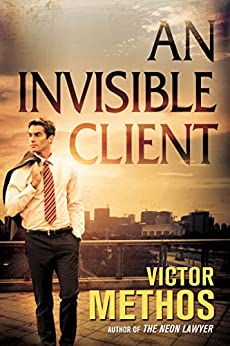
An Invisible Client By Victor Methos 2019 / 256 pages Read by Alexander Cendese 6h 19m Rating A / legal crime
Joel Whiting, the 12-year old only child of the widowed Rebecca Whiting, is very ill from cyanide poisoning the result of over-the-counter cough medicine. There have been other cases and a cursory criminal investigation. Rebecca is convinced the pharmaceutical company is responsible, but they’re pushing the idea of a random killer being the culprit. So she contacts our first person narrator, Noah Byron, a divorced but still young and very ambitious lawyer, one of three partners in a Salt Lake City firm. His first exploratory interview with the Pharma-K company raises his suspicions. He takes Rebecca’s case.
Noah then hires and commandeers the brilliant 3rd-year law student Olivia Sinclair to assist him. It’s when he starts interviewing young Joel, he starts getting emotionally involved with the case. Without a certain medical treatment which is not going to be made available because he is too far gone, Joel will die.
It looks like Noah is in for a very ugly and expensive case. Settlement offers are made but more stuff happens and more evidence is uncovered
The book is politically correct in all the important ways and that’s been a bit of a complaint in some customer-type reviews but doesn’t bother me except when it goes on a bit too long. Methos goes after the big-money pharmaceutical industry business in many ways.
There are surprisingly very touching parts and in a couple places that even gets a wee bit mushy but it all works together nicely. This isn’t really a thriller in the murder and car-chase sense of the genre, but the tension is masterfully built without that. Kudos!
The plot follows several different threads, the investigation and court case, the health of young Joel and a maybe-budding relationship for Noah. And then there’s the tension within the firm due to the expense of litigation. I can’t “love” this book, but it was just exactly what the doctor ordered for someone who right now is basically only able to follow the plot line of the best books while maintaining reasonable expectations of character development and writing style.
Ok, so it’s basically an average legal mystery which includes some nice courtroom drama and well drawn characters. As such, it’s not the best on that shelf, However! It’s just what the doctor ordered for my current condition of not being able to focus well enough for complex reading material. I’ve read three of Methos’ books and they were all “very good” except for Neon Lawyer which was outstanding – I read that one first. I’m going to have to stash a couple of these on my Wish List for the next time I need something to boost my mood from time to time.
Due to all the unfortunate current events and assholes-in-office, I’ve been having a somewhat difficult time keeping my focus when I read almost anything. I’m okay for about a page or two and then my brain wanders. But I keep trying anyway.
******* The Mimosa Tree Mystery by Ovida Yu – 2020 narrated by Crystal Yu – 7h 57m rating – 2 / WWII/ spy/mystery (returned) *******
This was already on my wish list because it looked like a gentle mystery of the historical variety and then a friend recommended it. Okay – I’ll bite.
I don’t know what went wrong. I tried to enjoy it but … the Japanese names were confusing to me (although I’ve read a fair amount of Japanese fiction). The plot was a bit convoluted with relatives and bad guys – and that might be my current mental state. The narrator’s voice got gratingly sweet. I did finish it but that was more out of sheer stubbornness than anything. I write this up to give myself credit I guess.
I have no idea what I’ll read next. There’s an Alexander McCall Smith Ladies’ #1 Detective Agency book coming up this month or next – I sure hope I have the mental energy and focus to read that! LOL!
This was on sale and it just sounded good so it was an impulse buy and an almost immediate read. It did grabbed my attention and I started the ride one evening and finished the next day – a 12-hour listen.
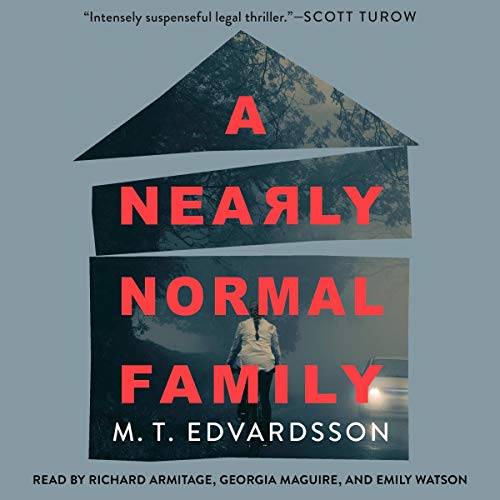
******* A Nearly Normal Family by M.T. Edvardsson Translated by Rachel Wilson-Boyles 2019 – 400 pages read by Georgia McGuire – 12h 31m rating – B / suspense – legal *******
In a city in Sweden Adam, a minister, his wife Ulrika, a defense attorney, and Stella, a 18-year old newly out of school comprise this “nearly normal” family. When Stella is arrested for murder Adam and Ulrika are determined to stand by her no matter what. But as the evidence mounts it looks bad for the good guys.
Stella is incarcerated from early on and that wreaks havoc on everyone including the prison employees because Stella is not a compliant customer. Everyone in the family seems to have problems. And as the story unfolds, the man Stella is supposed to have murdered tops the list of problem-people. To make matters worse he was rich and the adored son of a powerful prosecuting attorney.
Themes of women vs the justice system, rape, loyalty, love and friendship family dynamics/ dysfunction are all explored, but the main thrust is whom do you believe?
There is a lot of backstory so the structure alternates from current time to back story with different 1st person narrators in each of three parts. It works. The tension builds nicely and the characters are all intriguing, if not “likeable.”
It’s a great one-gulp read – one weekend or something.
Oh dear – I just don’t read like I used to – the focus is not there. I get distracted by mail or by the news or by my daily doings or by just thinking. I’m currently reading one mystery while my heart is with the new “exposé” books like Disloyal by Michael Cohen or Compromised by Peter Strzok and Rage by Bob Woodward will be out on Tuesday. But I get 10 pages into something like that and my focus goes. And there are several new fictions on the market I’d love to get to. And this is saying nothing about the older history books lining themselves up on my wish list. Oh bother.
A friend in New Zealand recommended Maurice Gee and as I checked around and although Amazon has quite a number even in Kindle format, Audible had two. So I got this one which, as a mystery, sounded like something I’d appreciate. The book had been made into a movie which I would never have seen so.
******* In My Father’s Den by Maurice Gee (New Zealand) 1972 / read by Humphrey Bower 6h 18m rating B + / mystery *******
Having been first published in New Zealand in 1972 this book is much slower and gentler than our intense, page-turning thrillers. Still, get to the ending and it has tremendous impact. And it’s not a cozy either – there is a bit of graphic violence and discussion of matters not usually found in cozies. .
Paul Prior has returned to his home town outside of Aukland to be a history teacher. He is single and relatively young. There is one young woman who is particularly appealing to him, though, but they remain friends. Then she is found dead. The police first suspect Paul but he is quickly eliminated and the mystery goes on but Paul has a history of his own which has to be resolved.
It’s a good book and I enjoyed the New Zealand atmosphere of the 1970s and 1950’s. The story was well plotted and the main characters were fully realized. I’m interested in the other Maurice Gee now.
I really do enjoy Humphrey Bower’s voice and narration.
Oh my goodness I love this book. Yes, it deals with some very difficult subjects, from the days of Nazi Germany to the current difficult times with Coronavirus. It’s the fourth in Smith’s Seasons Quartet so it’s also a kind of gathering for a few of the characters from the three prior books. The themes are the same, art, politics, time, nature, interconnections and a few more love and grief.
But along with the grief comes laughter and Ali’s lovely word games.
******* Summer by Ali Smith 2020 / 393 pages read by Juliette Burton 9h 27m rating – 10 / literary fiction *******
Where the book Autumn, the first in the series, dealt with Brexit, Summer mentions Trump a few times but sticks pretty much to the English side of the troubles.
The first novel in the series, Autumn, is in large part the story of Daniel, a very old man in a nursing home in Norfolk who has qutie a story to tell in Summer, too. And we have Art and Charlotte who were featured in Winter continuing their story as well. But the main characters here are Robert, a precocious 13-year old, his cheeky 17-year old sister Sasha and their mother, Grace. It all gets tangled up with movies and technology and a memento from the past.
That’s enough – It might be best to start with Autumn and read them in order from there but I don’t think it’s absolutely necessary.
This is a very good book by a well regarded journalist who follows the subject, but there is so much information that even at only 338 pages of narrative, I have to call it a baggy shaggy monster.
******* Veritas: A Harvard Professor, a Con Man and the Gospel of Jesus’s Wife By Ariel Sabar8/11/2020 – 338 pages Read by Robert Petcoff – 15h 32m Rating – 8 – true crime/ history (Read and listened) *******
I down-rated it because parts are too laboriously detailed and it gets to be a kind of “much of a muchness.” Then it all gets old when Sabar gets into the sex stuff in various ways. There’s way too much information on almost everything from the backgrounds lives of the major players, the ink types, and the translation(s) of ancient Coptic writing, to the examination of Egyptian papyrus. All that’s in addition to kinky and illicit sex in Florida and child abuse in Germany with a bit of post-modern literary theory thrown in.
This is the story of a scrap of papyrus with ancient Coptic handwriting conveying the idea that Jesus was married. It turned up in the hands of a Harvard professor in religious studies via an anonymous source. Sabar focuses primarily on the involvement of Dr Karen King who was the contact of an “anonymous” collector. I think I may have read something about this a few years ago when Sabar wrote his articles for the Smithsonian and Atlantic magazines. He continued the search for the truth of the matter until this date.
There are times when Sabar outdoes Dan Brown (and the stories are related) for drama and other times it’s more like reading John Crossan, the renowned New Testament scholar. I prefer Crossan although Brown can cut a good plot line.
To me though, it’s True Crime fiction with a kind of journalist’s procedural sorting out how the expert historians plugged along verifying the scrap of papyrus which came across the path of one of their own, as well as how Sabar went about his investigation with the assistance of some interested media.
There are three different threads Sabat explores. The first is the fragment of papyrus itself and the archeologists who examined it and what it meant to Karen King and the Early Christian history community. The second is the sleazy back story of how that papyrus came to be in the hands of Karen King and Harvard Divinity School. This concerns a lot of material on Walter Fritz. Then there is a large section about Karen King and her development into the scholar she was. This all gets very psychoanalytical.
Then there is the detailed examination of the papyrus to figure out it was a fraud, a forgery at all and then to connect that to Fritz, or not. Who did this laborious footwork and hid it? The first part is pretty straightforward and deeply interesting. The second and third parts intertwine and are either sleaze or investigative work.
When Sabar gets really into the story of Walter Fritz the story gets more compelling, but there’s a lot of pseudo-psychoanalytic stuff there. Much of this seems like padding.
There’s a lot of material such as names, dates, details, events and procedures and Sabat pushes each thread to the saturation point and then switches threads. The threads do connect up within the tale, sometimes.
Overall it was a good read for me what with my interest in True Crime and Christian history but I certainly wouldn’t recommend it to everyone.
Oh wow – there was more in this book than I could really get a grip on in one reading but yes, I did read it all the way through. There was some material and characters from the earlier books in the quartet so it’s a series in more than name.
******* Summer by Ali Smith 2020 / 393 pages read by Juliette Burton 9h 27m rating – 8+ / literary fiction *******
And there were the old themes of time and art and relationships as well as change of course but also interspersed here, again, is politics starting with Brexit and ending with the pandemic of the coronavirus. I wonder how it would have been to read them out of order. I suppose it might be okay. I think the Nazi angle was new.
I’ll be reading this again for sure so I’ll wait with a better review until I’m more connected with more of the connections in the book. I know I enjoyed spending time with these people and their ideas although they weren’t as fully drawn as in some of Smith’s prior works.
I read this twice this month. The first time I was so depressed at reading the middle three chapters but then the end picked up. During the middle I felt like it was all lost and this was the funeral, the wake, the end of expertise as we know it and I could certainly see Nichols’ point. But the last couple chapters were less dirge-like, less angry expert-academic and in some way a different tone.
The Death of Expertise: The Campaign Against Established Knowledge and Why it Matters by Tom Nichols 2017 / 252 pages read by Sean Pratt 8h 40m rating: 8.5 / history and culture
The book is based on an essay he wrote for The Federalist back in 2015. (He’s a Republican turned Democrat for Trump.) The book is almost more important now with a madman in office and another election coming up. There are a lot of voters out there who simply won’t listen to experts in a whole lot of areas and Trump himself seems to be one of them. There is very little really new information in the book since 2015 – a bit from 2016 maybe. It’s very well researched and sourced. Even Michiko Kakutani commented on that in the NY Times.
Nichols starts out with a Preface to the 2017 book and then goes to the Introduction to the 2015 book. He lays out the reasons for writing it and what he’ll cover. There may be some padding to the book as a whole.
Chapters 1 and 2 are a lot of background. Chapters 3, 4 and 5 cover specific areas like in Chapter 3 and how experts are no longer respected in colleges with “entitled” kids (although he never does use that word. – I still have some problems with some of the material in this chapter.
Then there’s Chapter 4 covering the internet and Googling for knowledge. There’s the Dunning-Kruger Effect which describes the confident ignorance folks are proud of they’re quite smart. And Confirmation bias which has the Googler focused on sources which agree with him. Finally of course there are the conspiracy theories out there in the unchecked world with Qanon exploding into elected offices.
And Chapter 5 with the lazy journalists and those who would deceive them. Experts who are not experts. You can’t trust anyone anymore and what is to be done about that? Fox News, talk radio and Facebook. Journalism as entertainment.
Finally in Chapter 6 we get to the problem of when the experts are wrong as they often are – seriously wrong. Wrong about diets, about science, about lots of things – often about small things but sometimes about really important things – like the collapse of the Soviet Union.
I do wonder what his thinking is now with the Coronavirus and all the experts weighing in on that one but the president who knows he knows better, making the decisions which have cost so many lives. And he admits that although science can give us certain answers, it can’t decide things like how and when to open school this is a and question which depend on values for answers. How many lives is the economy worth?
Good book – I’m glad I read it twice because although Nichols did his job well enough, I was so put out by what I thought of as his really negative attitude toward the situation I wasn’t tuned in to what I caught on the second reading.
Brilliant! I didn’t really know all that much about Frederick Douglass before reading this masterful biography. I knew he was an escaped slave who became a speaker and writer of great renown who lived in Boston. He lived to a great old age. I think I knew he married a white woman in his later years.
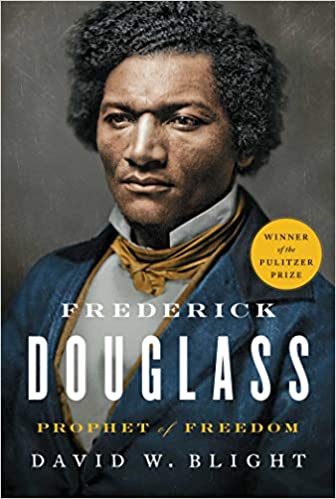
Frederick Douglass: Prophet of Freedom By David W. Blight 2018 / 862 pages Read by Prentice Onayemi – 36h 57m Rating: 9.75 biography Pulitzer winner – 2019
So wow – this book filled in a lot of blanks and added to my knowledge about other people of that era like Lincoln and John Brown. And the political bits, the parts about the divisions within the Republican Party at that time were new to me.
It’s written in traditional biographical style without much beyond a chronological telling needed because the story of Frederick Douglass is riveting in itself. That said, Blight is a master stylist and impeccable researcher.
The biography is detailed, it’s wonderfully well written, it and, as the New York Times said, “(it) treats Douglass as a man. Along with winning the Pulitzer Prize in 2018, it was one of their 10 Best Books of 2018 achieving a massive amount of critical acclaim.
Blight addresses the high points, the well known parts of Douglass’ life like his escape at age 20 from slavery with Anna helping him from that point. Then came his rise to prominence in writing and, a bit later, making his famous speeches. But Blight’s book also goes into his relationship with Lincoln who had the impossible job of maintaining a union of the entire United States, blacks, whites, abolitionists and slave holders. Lincoln was torn with his own ideas. And then there was the fiery abolitionist John Brown. Blight also has much to say about Douglass’ relationships with his wife Anna, a semi-literate black woman who stood by him from the age of and other women like the English Judith Griffiths and German Ottillee Assing. He and Anna had 5 children family difficulties as well as his glorious speechifying and passionate writings on his travels. Blight also covers Douglass’ less than candid autobiographies – three of them!
He lived to see the Civil War, Reconstruction, the Gilded Age and on until 1895 when he died of a heart attack at age 77. There was lots happening during all those years and Douglass was a part of much of it.
Oh my – I did need this book. It’s nothing fancy in any literary way except that the straightforwardness of Tyler is always soothing and comforting and in these difficult difficult times that is such a blessing. Covid is spiking here in North Dakota and California is on fire – (I moved here from California only a couple months ago – I still have friends and family there – some missing.)
The Redhead by the Side of the Road By Anne Tyler 2020 – 192 pages Read by McLeod Andrews / 4h 50m (Long Listed for the Booker Prize) Rating – 9.5 (for many reasons)
Also, it’s no wonder this was chosen for the Booker Long List. Who else can write like Tyler? Omg – she “gets it” about relationships, about family, about lots of things. But she’s not mushy and romantic – she’s real. The last beautifully skillful practitioner of that old fashioned American realism maybe, if realism is in the details.
Micah Mortimer is a single, 44 year-old computer tech with his own business, “Tech Hermit,” which he runs out of his two-bedroom basement apartment in east Baltimore (this is Ann Tyler). He’s somewhat thin with a nondescript appearance and he may be borderline Aspergers – but that’s a “may be borderline.” He does have a girlfriend, Cassia, a middle aged school teacher who’s also never been married. He’s a bit clueless when it comes to interpersonal relationships but he’s happy enough.













 Becky's Books -