
For decades I read real dead tree and ink books and loved them dearly – I’d say I did that for 68 years or so. And I was usually a voracious reader. But some time within the past 20 years or so I became quite nearsighted. and although I used to wear my glasses on top of my head when I read, I started needing them when I read! (Woe!). And I was prescribed bifocals and then trifocals. Now my distance vision is almost good enough to drive without glasses at all – but I can’t read a menu to save my life.
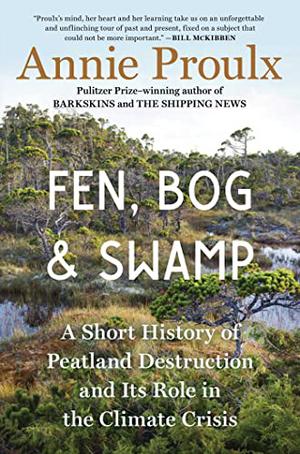
Fen, Bog and Swamp:
A Short History of Peatland Destruction
and its Role in the Climate Crisis
by Annie Proulx 2022
Read by Gabra Jackman 5h 6m
Rating: 9 / non-fiction-science
My solution has been available ver since I discovered that the Kindle books had a magnifier. That worked for awhile but now I can’t even see the largest font without the bifocals – with them I can read all but the smallest size and I’m comfortable at about 1/3 of the largest. (This is all on Mac stuff so my fonts tend to be larger anyway.).
It took me awhile but I got used to the Audio versions of the books and now I’ve been happily listening since 2005 – that’s well over 1000 books from Audible and fewer but growing from the library. I rarely read something in Kindle only and virtually never via ink and paper although I could with my glasses.
The best way for me to read a book which is complex in any way (fiction or non) is to do both – I get so immersed. That’s why these book reviews have “X2 in their titles. It means this is the second reading for me. Sometimes I take notes then because I’m older now and can’t necessarily remember the names of the characters. This is where the Kindle comes in handy because I can do a search and find that guy on the 4th page and not mentioned again until now, by his last name only and no other info, at page 87
So that’s what I did with Fen, Bog and Swamp. I both listened and read it back in August, and then I did that now again in November when it came up in my reading group (All-nonfiction) – I liked it well enough in November, giving it a 9 which is very, very good, but not quite excellent. This second reading put all the bits together and it’s a 9.25. (I can’t quite give it a 10 due to a couple of “flaws.”
Proulx has written quite a lot of non-fiction, but this may be her first full length book – (?) She says she sent it in as an essay and the publishers wanted more. So she wrote another few chapters and they published it as a “slim volume” about “Fens, Bogs and Swamps” in their historic as well as their scientific and aesthetic senses or significance and I don’t know which aspect gets more coverage.
‘m not sure who the book is aimed at – is it for high school students or general public adults with some background in the subject? The footnotes are inadequate if the reader is supposed to be an historical or scientist – they’re fine for a business major. There are no graphics and that would be a huge improvement because this is visual stuff! (So check the internet for some good pictures.)
On the plus side I feel like I learned a lot about the wetlands of the world and how they’re needed for proper balance of nature, homes to so many species, carbon storage for our excess. They are NOT wasteland to be viewed only for their developmental capabilities.
I was somewhat disappointed in my first reading because it really didn’t seem like a very good science or history book. Okay – so it’s not a science or a history book as I had thought. This time I realized it’s not supposed to be that from the outset and tried to appreciate it for what it is.


 Becky's Books -
So you can read with glasses, but you prefer not? I can understand that. I’ve been reading with glasses for over 25 years now, and I don’t like it. I have been arguing for some years now the value of kindle/e-books for failing eyesight and also for their search capacity. I’m gradually increasing my reading of these books, because I am downsizing, so I don’t want to build up my physical collection but I prefer to own my books as I like to make notes in them. I see audiobooks as another form that I will get more into in the future, but I do struggle with enjoying them as much as I do physical reading, partly because it’s hard to make notes when you are listening while doing something else.
So does this book have Proulx’s beautiful prose? I am interested in wetlands.
LikeLike
Oh Sue – your post made me smile. 🙂
When I moved up here to North Dakota I left all my books in the house for the real estate lady to take care of because truthfully, I simply couldn’t – physically. She did a great job of disposing of all my stuff which solved the downsizing. And I bought my mom’s/grandma’s/great-aunt’s old house – fully furnished with antiques of the times (LOL but true).
I have everything on Kindle or Audio now. Even the books are antiques. That’s fine. Like your books, mine were all marked up – I had to buy 2nd and 3rd copies of some – (Nabokov’s Pale Fire, Delillo’s Underworld, etc.)
About Proulx’s new one, Fen; she’s written nonfiction for ages but it’s mostly been for the very small farmer – or large gardener – whichever. This book is not very long – and if you read carefully it’s very very interesting. It covers western wetlands. It’s not too science-y and it’s not too poetic. It’s got a lot of history but it’s not really for historians who want complete footnotes, etc. I really enjoyed it.
LikeLike
I’m glad I made you smile. And I’m glad I’m not the only one who sees that giving up physical books is where I might need to go … resisting it is futile I think if we want to keep reading. This book does sound interesting.
LikeLiked by 1 person