
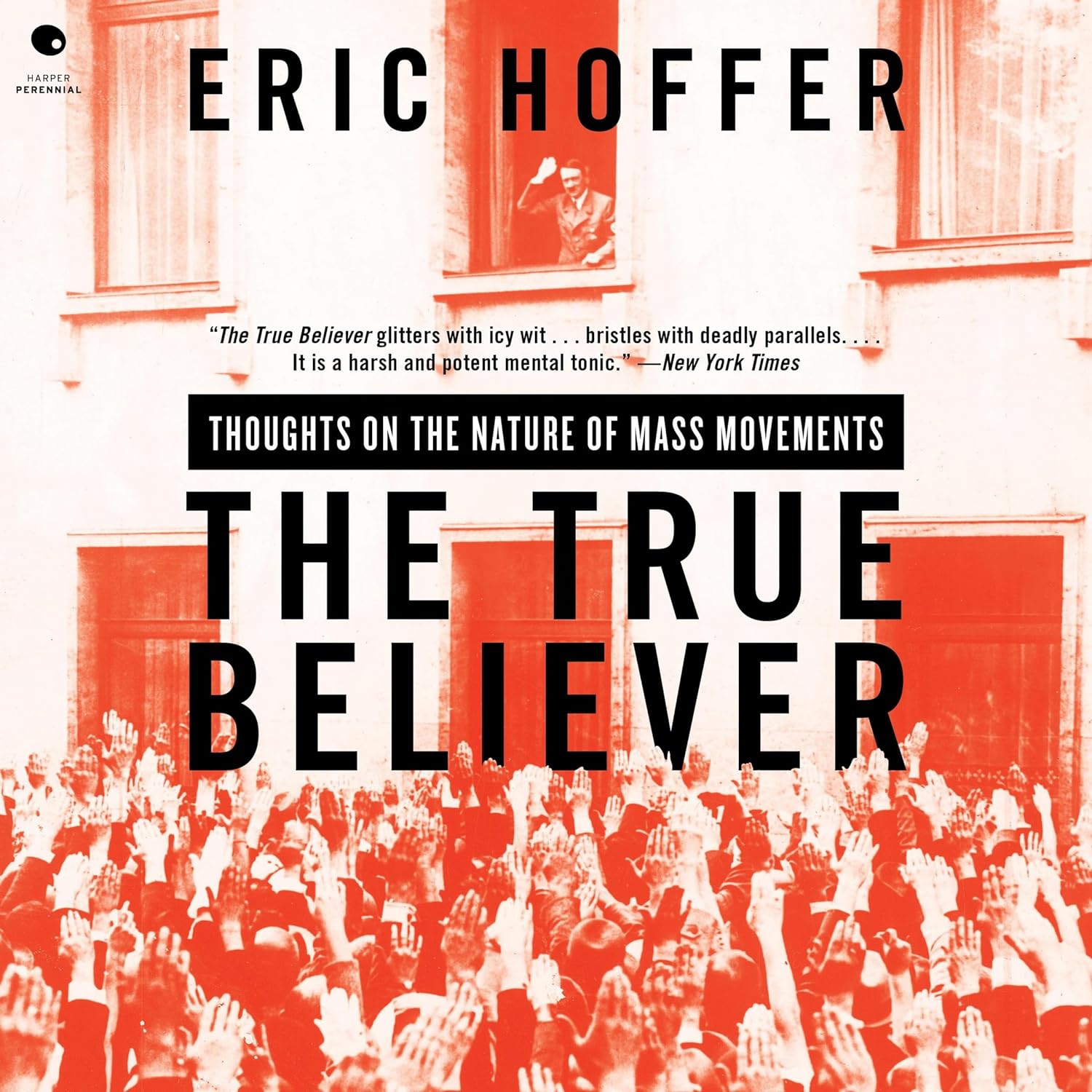
We had to read a section of this back in college days – Poli Sci 101, I believe, 1972. I recognized a passage when I saw/heard it a couple hours ago. And we had the same photo of him in which he always reminded me of Nikita Khrushchev (below under book https://www.supersummary.com/the-true-believer/summary/#
The True Believer
by Eric Hoffer
Read by Fred Sanders 5h 16m
Rating – 7 / (Health and Wellness???)
I wonder if anyone at Audible.com has read this – do they really think it should be categorized as Health and Wellness / Psychology and Mental Health as a second alternative.
Yah? Okay fine, but … (lol) back in the day the New Yorker said, “Its theme is political fanaticism, with which it deals severely and brilliantly.” While the Wall St. Journal mentioned its “concise insight into what drives the mind of the fanatic and the dynamics of a mass movement”

A stevedore on the San Francisco docks in the 1940s, Eric Hoffer wrote philosophical treatises in his spare time while living in the railroad yards. The True Believer—the first and most famous of his books—was made into a bestseller when President Eisenhower cited it during one of the earliest television press conferences.
Called a “brilliant and original inquiry” and “a genuine contribution to our social thought” by Arthur Schlesinger, Jr., this landmark in the field of social psychology is completely relevant and essential for understanding the world today as it delivers a visionary, highly provocative look into the mind of the fanatic and a penetrating study of how an individual becomes one.
I will surely have to read this again – if I feel like it. I’m afraid it’s dated in places and right on target in places Hoffer didn’t intend.
I’m wondering which author his voice sounds like – a philosopher probably. Oh of course – Montaigne! Michael de Montaigne France, It was mentioned by Hoffer himself in the Preface. The style is very structured with short, clipped sentences. But unlike Montaigne’s Essays, the whole book is short (200 pages?) and divided into 4 Parts and then with many 2 or 3-page Sections. Again, not too different from Montaigne, whose work Hoffer very much appreciated. Hoffer makes pronouncements, not suggestions – he shares some examples, but there are very few source notes. He got it published in 1951 when he was
Overview
Another reviews and comments said the book was a philosophical treatise that explores the question of why ordinary people join mass movements and become fanatical devotees of what they perceive as a holy cause. Hoffer argues that prospective fanatics—the soon-to-be true believers—experience personal frustration so intense that their strongest desire is to lose their individuality altogether by surrendering to something greater than themselves. Mass movements exploit this frustration by offering true believers an escape from personal responsibility. Furthermore, the precise nature of the mass movement—its doctrines, objectives, and programs—means little compared to its ability to attract and mold fanatics by offering them refuge from an unwanted self. The True Believer was a critical success upon publication and has remained a famous work on the nature and psychology of mass movements ever since. In 1983, President Ronald Reagan conferred on Hoffer the Presidential Medal of Freedom.


 Becky's Books -