
I’ve been reading this popular mystery series for about 8 years going at the rate of about 1 book per year – lol! This means I’’m working at catch-up but not really. I’ve been reading “the next one” more often lately because my interest has been piqued by the historical material. I was a history major in decades long past and I’e been a history buff ever since. This series takes place in New York City at the height of the so-called “gilded” age where new immigrants, severe poverty, and ethnic gangs way outnumbered the almost obscenely rich.
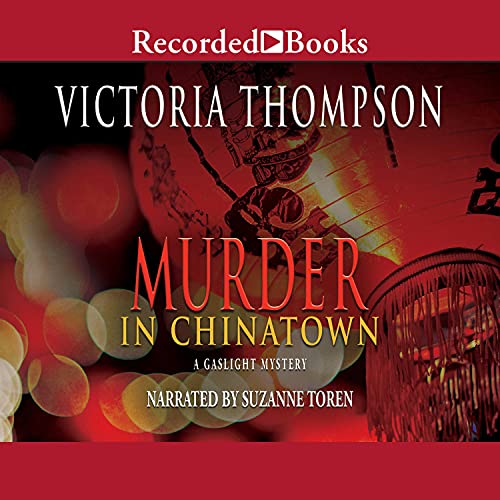
Murder in Chinatown
by Victoria Thompson
2008
Suzanne Toren 9h 10m
Rating A+ / historical who-done-it
(# 9 in the Gaslight Murders series)
I’m really amazed at the research Victoria Thompson puts into the Gaslight Murder books. Murder in Chinatown is only the 8th in the 27-book series and my interest was captured by the “Street Arabs” which Wikipedia gives a brief history of the term as well as a photograph.
In this book, the 15-year old girl, Angel, has been told by her parents that she will marry Charlie Wong, someone she says is “old and ugly and doesn’t speak English!” She really does NOT want to marry Charlie Wong no matter how rich he is. But Father’s word is law, so to Angel this looks like the end of any kind of life she wants. Sohe runs away to her own secret lover and is subsequently murdered. Many young Irish immigrant women married Chinese men when the Exclusion Act was enforced and this novel includes three such couples.
Our series protagonist and midwife by trade, Sarah Brandt, was helping Cora Lee give birth when she found out that Angel was missing. She tells her police detective friend, Frank Malloy, but he thinks nothing of it. Until Angel turns up dead. This is New York and the Chinese and the Irish don’t get along in spite of the occasional intermarriages.

Street Arabs in the Area of Mulberry Street is a black and white photograph taken by Danish American photographer Jacob Riis, probably in 1890. The designation of street arabs was given back then to homeless children. Riis took several pictures of these children, during the journalistic and photographic work that led to the publication of his landmark book How the Other Half Lives (1890), where they were published with the title of Street Arabs in Sleeping Quarters.[1]
Sarah is originally from an upper class family, but when she was young she fell in love with and married a police officer who, only a couple years later, was killed in action. Since then she has lived on her own, doing “freelance” midwifery work throughout New York City. Serving the poor, she often arrives in families who are dealing with crime and/or other troubles and Frank has to help her. A couple times he has had to call on her for assistance.
Unfortunately, in this story Angel is found a day later, dead in an alley. So Sarah Brandt ropes Frank Malloy into helping figure it out. I really enjoyed all parts of this book – the characters are very likable without being smarmy, the plot is twisty with a bit more blood than the usual “cozy mystery,” and the history is very well researched. I love the googling involved. If something turns out to be true I give the author
One really good thing about this series is that it sticks to the history while telling a great mystery story with likable characters developing an overarching plot. All three elements are vital to a successful historical mystery series but are rarely done as well as they are here.
Also, the reader, Suzanne Toren, does and incredible job and lucky for us readers keeps going through book #27 (April 2024).
***********
From Amazon: https://tinyurl.com/5n79kamz
In Chinatown to deliver a baby, Sarah Brandt meets a group of women she might otherwise never have come across: Irish girls who, after alighting on Ellis Island alone, have married Chinese men in the same predicament. But with bigotry in New York from every side, their mixed-race children are often treated badly, by the Irish, the Chinese—even the police.
When the new mother’s half-Chinese, half-Irish, 15-year-old niece goes missing, Sarah knows that alerting the constables would prove futile. So she turns to Detective Sergeant Frank Malloy—and together they begin the search themselves. And after they find her, dead in an alley, Sarah and Malloy have ample suspects—from both sides of Canal Street.


 Becky's Books -