
I’m still pretty certain I read parts of this somewhere else prior to today. Then on the next paragraph or page there are bits I’m sure I’ve never read before at all. ???? (I’m thinking an exerpt somewhere.)
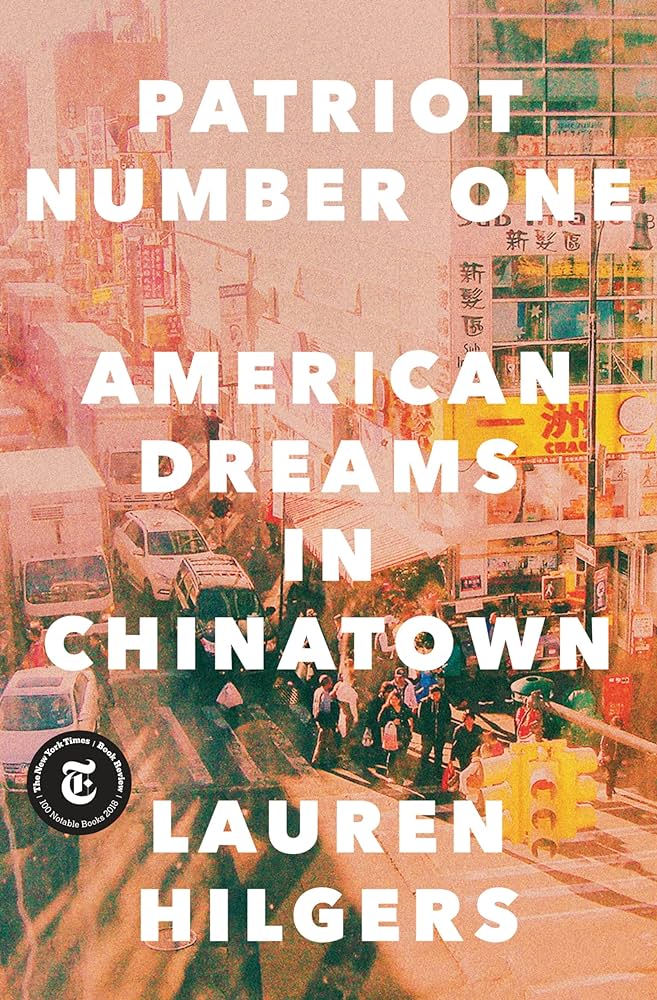
Patriot Number One:
American Dreams in Chinatown
By: Lauren Hilgers
Read by: Angela Lin, 12 hrs and 38 mins
Rating: 9 / biography-memoir sociology
(Both listened and read)
It didn’t quite get the big prizes, but it received a number of accolades from highly regarded places like Wall Street Journal and Christian Science Monitor.and there were many rave reviews and “Best Books of 2018” in noteworthy places.
• New York Times critics
• Wall Street Journal
• Kirkus Reviews
• Christian Science Monitor
• San Francisco Chronicle
• Finalist for the PEN Jacqueline Bograd Weld Biography Award
• Shortlisted for the J. Anthony Lukas Book Prize
• PEN/Jacqueline Bograd Weld Award for Biography
Laura Hilgers, the New York based author, tells us she was working in China on an article for a magazine in the US when her subject decided to move to New York – LOL! . She kept writing and moved home, but there now seemed to be two distinct parts of one story which combined into a broader arc when, a couple years later, her subject, Zhuang, and his wife, Little Yan, were on Hilger’s doorstep in New York!
So this book (NONFICTION!) is written in two, often alternating, parts – one in China where Zhuang gets in trouble for his activism, and one in New York where he and Little Yen try to find and make a home. By this time they have an infant son who was left with Little Yen’s parents until he could be brought over. They found an apartment in Flushing, Queens where there were a lot of Chinese immigrants and Mandarin was widely spoken.
Zhuang was an activist working online in China under the name “Patriot Number One” and he attracted quite a loyal following. The publisher’s summary (quoted below) calls him a revolutionary, but I’d say he was more of an activist organizing protests for his village/town which had lost quite a lot of land due to political maneuverings and outright corruption. Whichever, radical activist or revolutionary, he was nervous about coming to the US and probably with good reason. So he did his research and thought out all aspects.But he was a dreamer as well and he was dreaming of “freedom.”
Hilgers says that both parts of the story had to be told, Zhuang’s difficulties in China and the difficulties of the couple getting to and after arriving in the US. The US problems had to do with paperwork, living quarters, the English language and getting their son with them. They were always working toward the future. But to an extent, Zhuang’s heart was still with the difficulties in China. They made friends and connections and inched forward toward their goals.
Meanwhile there are other “characters” in the story – the people they meet have stories of their own and we follow some of them as they make their ways in a new country with a new language and very different customs.
Penguin Random House says it so well that I (along with many others) have to quote it:
“ The deeply reported story of one indelible family transplanted from rural China to New York City, forging a life between two worlds
In 2014, in a snow-covered house in Flushing, Queens, a village revolutionary from Southern China considered his options. Zhuang Liehong was the son of a fisherman, the former owner of a small tea shop, and the spark that had sent his village into an uproar – pitting residents against a corrupt local government. Under the alias Patriot Number One, he had stoked a series of pro-democracy protests, hoping to change his home for the better. Instead, sensing an impending crackdown, Zhuang and his wife, Little Yan, left their infant son with relatives and traveled to America. With few contacts and only a shaky grasp of English, they had to start from scratch.
“In Patriot Number One, Hilgers follows this dauntless family through a world hidden in plain sight: a byzantine network of employment agencies and language schools, of underground asylum brokers and illegal dormitories that Flushing’s Chinese community relies on for survival. As the irrepressibly opinionated Zhuang and the more pragmatic Little Yan pursue legal status and struggle to reunite with their son, we also meet others piecing together a new life in Flushing. Tang, a democracy activist who was caught up in the Tiananmen Square crackdown in 1989, is still dedicated to his cause after more than a decade in exile. Karen, a college graduate whose mother imagined a bold American life for her, works part-time in a nail salon as she attends vocational school, and refuses to look backward.
With a novelist’s eye for character and detail, Hilgers captures the joys and indignities of building a life in a new country – and the stubborn allure of the American dream.”
Me again: I had to remind myself several times in the opening chapters that Hilgers researched and interviewed to put this together. There is even a section of Notes. It’s a biography as much as anything. But the alternating time frames (noted in chapter headings) and the descriptive detail makes this read more like a novel and giving a certain tension to the story arc
I listened and read – Starting out the narrator’s voice had some of my least favorite attributes – it was too quiet, seeming to whisper lovingly over the words which described a young man planning his escape from China – LOL! I d think I was going to be able to tolerate this, but I kept listening, considering it had received glowing reviews. Okay, fine. Twenty 20 minutes later I was hooked but I still had problems with the names and spellings and I wanted to follow and focus. It was definitely worth it.


 Becky's Books -