
The 20 writings in each edition of The Best American Science and Nature Writing 2023 might not all be cutting edge science reporting, but somehow that’s a part of the appeal. The stories included in this annual anthology were first published in 2023 and selected for their writer’s skill and the science which is explained. There have been 36 editions published by Harper Collins, Good science writing means that the information is true (it’s nonfiction) and it’s very nicely and clearly written stuff. Sometimes one of he authors will get poetic or even comic. ,
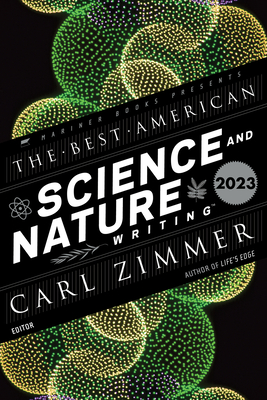
Best Science and Nature Writing 2023
Edited by Carl Zimmer
Narrated by many individuals
Rating: 9.5 / nonfiction anthologya
(both read and listened / 2+x)
The 20 writings in each edition of The Best Science and Nature Writing might not all be cutting edge science reporting, but somehow that’s a part of the appeal. The stories included in this annual anthology were first published in 2023 and selected for their writer’s skill and the science which is explained. There have been 36 editions published by Harper Collins, Good science writing means that the information is true (it’s nonfiction) and is clearly written. Sometimes some of it gets poetic or satirical but those times are not too often.
I read the first of these science anthologies just 2 or 3 years ago and was really rather enchanted. Then last year I read the second and I was disappointed, truly. But I signed up for the 2023 edition way ahead of time. And it’s here. So I read it. This year it’s a mixed bag – most of the articles involved life sciences, but some were more specifically about climate change or medicine in particular and a few are based on physics as we know it – or not. Some of the stories are heart-warming, others are heart-pounding (climate warming), . .Some are very scientific, others are less in-depth science -wise. But they’re all wonderfully well-written and that’s essentially what the collection is about. I really appreciate science and nature writing ssesfor general (non-specialty) readers.
In the Forward Jaime Green writes about being general editor for many years and how she has approached that. Also, she’s written quite a number of books, articles and opinion pieces during that time. Her husband, Josh Green is the governor of Hawai’i as well as being a medical and academic doctor of medicine. Hawai’i had outstanding stats on Covid-19 – fwiw.
Then there’s Carl Zimmer, the actual edition editor of “The Best Science and Nature Writing 2023.” His own writing includes over a dozen books with several award-winners, plus magazine articles, and more prizes. His newest book is She Has Her Mother’s Laugh and that sounds like something I should go read – lol. Zimmer brings current events into the picture without getting political (imo). He’s aware – he has an agenda but he doesn’t push it.
The Editor in 2023 was Carl Zimmer, and he’s so good. https://en.wikipedia.org/wiki/Carl_Zimmer
So what articles made “the best of..?? The articles I had time to reread? In the list below I put a short descriptive sentence, more than just a category as well as an asterisks “rating” the story overall, with *** being highest (and there are several of those).
* An Invisible Epidemic
By Elizabeth Svoboda
The pandemic is over but the healing has to go on.
** The Myopia Generation –
By Sarah Zhang
Myopia is a genetic issue – right? Wrong.
** A Deepening Crisis Forces Physicists to Rethink Structure of Nature’s Laws
By Natalie Wolchover
Physics – why doesn’t it seem to work now? We thought physics was natural! Oops- along came the tiniest of particles –
*The Coming Collapse
By Douglas Fox
The collapse of the western ice shelf in Antarctica/
*My Metamorphosis
By Sabrina Imbler
Transformations of insects to insects and humans to insects (LOL)
*** The Bird and the Flame
By Sarah Gilman
Fires in California Redwoods –
A subject closet to my heart – trees, the forests, especially California forests – and what fire does to the birds – the birds around Redwood Meadow in the Santa Cruz mountains Murrelets, Ravens, Jays,
* Dislodged
by Josh McColough
Mostly about trees living in the same place for ages – or not. The author and his daughter are stranded in the forested mountains driving home, but it’s okay. McColough mentions the Butterfly Hill woman who lived for 738 days in an old-growth tree on the West Coast to protest cutting. Trees communicate with and nourish each other via underground fungi. This is the Jedediah Smith Redwoods in Del Norte County, California (I’ve been there) and the author is taken back to the call of a thrush he remembers. This is rather poetic.
** Bright Flight
By Vanessa Gregory
Congaree National Park, Sourh Carolina. – Raphael Sarfati photographs fireflies and their synchronized flying. Vanessa Gregory writes about it.
Photuris (photos and physics, chemistry and more).
** Brain Wave
By Ferris Jabr
Dennis DeGrey was 53 years old when he slipped on wet pavement and broke his neck, nearly decapitating himself, becoming totally and permanently disabled. This essay is about DeGrey’s struggles to learn to use his brain to actively participate in the world via neural interfacing – thinking to create patterns to mentally produce words. Amazing!
* The Provincetown Breakthrough
By Mary McKenna
How Covid-19 hit the tourist center of Provincetown, Massachusetts but the residents paid attention and they were careful so when Covid returned with the Delta variant the town did what they had to do and didn’t let it leave – they controlled it and kept it under control.
** True Grit
by J.B. MacKinnon
How did the cows do when Hurricane Dorian, 2019, rolled into their part of Texas? Fun story.
** Another Green World
By Jessica Camille Aguirre
Kai Staats and his attempts at building a sealed human habitat like we might need for space travel. It hasn’t worked so far. .
* In El Salvador and Beyond, an Unsolved Kidney Disease Mystery
By Fletcher Reveley
Kidney disease and failure was decimating the field workers of Central El Salvador. Then came parts of Sri Lanka, Egypt and India. And there were links with insecticides but how much? Very complicated and somewhat political.
** The Climate Underground
by Emily Benson
Looking for the ancient, prehistoric climate of earth via stalactites, a good sampling of which are found near Yellowstone. –
* The Butterfly Effect
By Maggie Koerth
The small brown butterflies of the great plains are disappearing.
* The Coming Collapse
By Douglas Fox
Beneath the western shelf of the antarctic
* The Metamorphosis
By Sabrina Imbler
Change – in insects and in humans
***. Shadows, Tokens, Spring
By Ben Mauk
Marmots all across the American plains and the Eurasian Steppes with long histories in both. The Tarbagan is now an endangered type of rodent, but has created havoc by spreading itaaee to humans.
* An Ark for Amphibians
By Isabel Whitocmb
Yellow frogs just looking to survive in special safe places in California – these safe-“houses” are called refugia
* Don’t Look Down
By Lois Parshley
Alaska has a problem. It’s sinking. Apparently “Permafrost” means permanent as long as there’s ice. When it warms there’s melting and, well, melting turns ice into water. Sometimes there’s material other than H2O involved. Sometimes ice is preventing something else from falling or tipping or breaking. There are over 100,000 people living on permafrost. What’s next?
** American Motherhood
By Annie Lowery
When does birth interfere with life?


 Becky's Books -