
The first time through this book was so compelling I just wanted to lose myself in it and skip the jigsaw puzzle or whatever was in front of me to actually “do” with my fingers. This is like crocheting while listening to the radio; it’s not a biggie until the book/radio gets so good I just can’t keep your stitch count and listen at the same time. LOL!
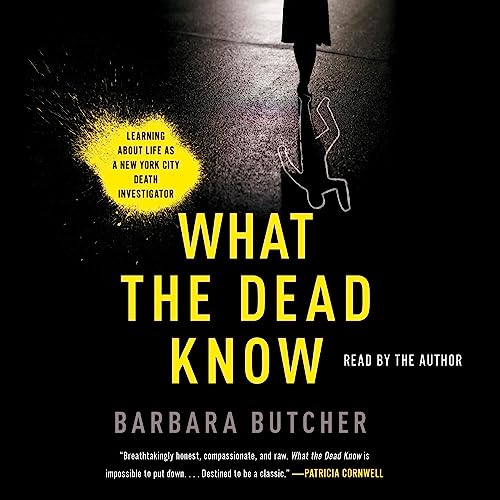
What the Dead Know:
Learning About Life as a New York City
Death Investigator
by Barbara Butcher; 2023 (288 p)
Read by author- 9h 47m =
Rating: 9.5: true crime – memoir
The 9.5 rating I gave it on my first reading meant I thoroughly enjoyed it and it suggested a second reading might be in order and result in a rating of 10. So when I got that second reading finished, a few months later the book still did not quite get a 10 BUT!!! For this go-round I purchased the Kindle version, to go with the audio and it was definitely worth it. (I think the reason for the 10 was that it definitely touched my heart and Butcher was so authentic.
That said, when I first started this re-read I was somewhat taken aback by how much blood and gore and guts and vile acts leading to death there were in the first few chapters. I’m pretty accustomed to graphic violence in some of what I read, but I really do NOT appreciate gratuitous violence – for its own sake or for the bucks.
Barbara Butcher, the author and narrator of What the Dead Know, tells the story of her life from her assignment to the Office of New York Medical Examiner. This is after a stint in rehab for alcohol addiction, some job counselling and a bit of training. She already had a degree to be a physician’s assistant. And her father had been a police officer in New York so the assignment was a natural. When she started work she discovered she was very, very motivated by wanting to solve puzzles and crimes. (Something had to replace the booze.) And so she stayed with AA and stayed with the job for the next couple decades, but had problems with lesbian lovers and became devoted and eventually consumed by a seriously emotionally draining job.
Alcoholics don’t do well with their emotions, but a medical examiner in NYC has to deal with that, it’s what this job is all about. So she stuffed them, sublimated them, and/or denied them. She sometimes acted them out, she prayed, she went to meetings and she didn’t drink.
Then came 9/11 and buddies were killed. Then came a promotion and more stress. It’s an excellent take on an American career – a NYC career really – because even Broadway is involved in the telling.
This book is about way, way more than cops-on-the-beat-in-NYC see when they specialize in the dead. The book is also about how that cop handles the tremendous emotional burden which comes with the job. And when that cop is prone to alcohol abuse you never can tell. It seemed to me that 9/11 was a kind of turning point for Butcher.
Clarity is important in the writing here and authentic laguage is appreciated. New York cops have their own lingo. There’s a change of pace when she goes to her AA functions. And she has a few home-life problems.
This is not “In Cold Blood” by Truman Capote, nor it is “I’ll Be Gone in the Dark by Michelle McNamara – those are really in the Literary True Crime genre and there are others to one degree or another. It’s an old genre going back several hundred years and with a jump-start since the availability of printed material – 1550? – or maybe earlier in China.
There are all sorts of True Crime stories out there from horrors perpetrated by humanity’s insane with their focus on the crimes themselves to crimes of historical importance like Jack the Ripper where detection and forensics plays a huge part. This was the time of Scotland Yard’s detectives using more scientific methods. Eugène-François Vidocq, a criminal turned police informant during the French Revolution probably the father of detection. Wilkie Collins and Sherlock Holmes came right after.
beginnings using detectives like scientists in their own ways. Eugène-François Vidocq,
I had some doubts until in Chapter 3, my enjoyment picked up dramatically due to the humor, a very important part of many crime books, true crime and nonfiction. And the pace and tension stayed right up there. This is NOT a mystery. It’s the story of a woman’s life from being a drunk to AA to finding herself employed in the medical examiner’s office in New York City. Person-ally, I’m usually allergic to detailed descriptions of body parts and this woman was a medical examiner so that usually comes with the job.
I’m not a big fan of authors reading their own books, but with this one, except for the sample, I didn’t even take much note except that she was obviously not a professional reader/actor. Then, at about 20%, I realized she was the perfect narrator for her memoir; her voice made it even more “true” crime. And it’s fascinating, and it feels honest and sincere. Butcher is a good writer but admits to having some help from friends.
Forensics has always interested me because of the tie-in to the whole legal system from cop-shop and 1st responders to death row and examining the trajectory of blood splatters, the DNA of hair samples and the arrangement of body parts. It’s often very much like a puzzle to be solved. And Butcher deals with everything from natural deaths due to old age or heart attacks to a vicious double serial killers and what all they do.


 Becky's Books -