
I don’t know why, but it took me awhile to get into this book. It’s not terribly long, but covers quite a lot of everything with a brilliant intensity. The setting is the coastal area of South Korea basically from the post-Korean War era to contemporary times. That’s about 2 generations of one family, plus an occasional bit of back story. It felt more “foreign” than most of the translated Korean lit I’ve read to date and maybe that’s because of the Gabriel Garcia Marquez touch.
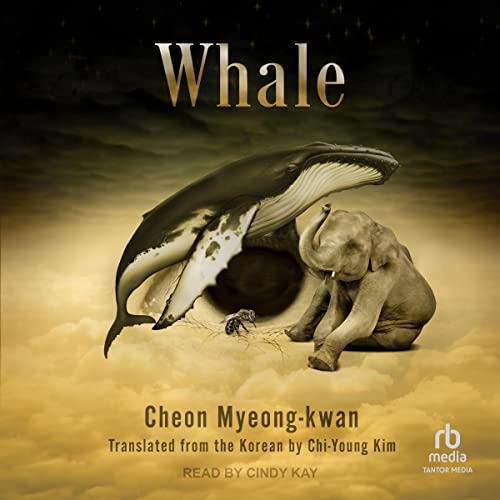
Whale
by Cheon Myeong-kwan
translator Chi-Yong Kim
2023 /
read by Cindy Kay 11h 34m
Rating – 10 / Korean lit fiction
Shortlisted for the International Booker Prize of 2023, Whale by Cheon Myeong-kwan is a very, VERY, compelling novel. It’s reads like a fairy tale with some magical realism opped with an allegory of indeterminate meaning although there are “lessons” or “rules” throughout. They’re all folded or swirled in and out and through each other via the very simple (allegory-style) writing used by Chen Myong-kwan.
https://thebookerprizes.com/the-booker-library/features/reading-guide-whale-by-cheon-myeong-kwan-translated-by-chi-young-kim
Because the author’s background includes a lot of screen-writing the the narrative emphasizes the visual. I would almost always rather read a book than see the movie version of it because my visualization is very good – it always has been. (My dad told me invented stories at night and because there were no pictures, I had to visualize them – this was a couple years before I could read.)
The book is said to have an overtone of “han” which is “rage, resentment, grief, regret and sorrow – a Korean concept that has no direct English translation.” https://www.koreaherald.com/view.php?ud=20230618000165 and yes there is a lot of resentment and rage expressed in graphic violence – and the main characters feel quite a lot of grief, regret and sorrow.
So to me this is a combination of One-Hundred Years of Solitude with Gabriel Garcia Marquez’ magical realism, almost any of John Irving’s later novels (Avenue of Mysteries?) for the scope and zaniness, and the melancholy of Orhan Pamuk’s “Hüzün,” in the melancholy of his nonfiction Istanbul.
It takes place somewhere on the coast of South Korea where fishing is the usual economic activity. The actual tale spans maybe 40-50 years total or 2 generations, those of the mother and her daughter the main characters in the novel. But it goes back to the last emperor of Korea for background. There is some socio-cultural history embedded in the narrative, but it’s not a political-economic history. Rather, it follows social trends from the John Wayne movies shown there and the popularity of the coffee shops in the 1970s and ’80s, to the feminism of the late 1980sand early ’90s, and finally the commercialization of the film industry.
Fwiw, whales are very symbolic and beloved on the Korean peninsula and have been since ancient times when they were revered. They are a very large and beautiful animal and Geumbok, one of the two main characters is large and beautiful as well – so is her daughter and her husband and a couple other characters. In fact, Geumbok is big and brash and lustful and ambitious. She was inspired by seeing the whale and she goes after more and bigger things in her entrepreneurial projects, the restaurant, the brickyard and the movie theater.
Meanwhile, her daughter, Chunhui, is also of enormous size and strength, although she’s mentally very slow, even unable to talk. She is ignored by her mother, but loved by Jumbo, the elephant the family takes in.
I gave this book a 10 although I am generally loathe to do that without having read it twice. I did read that it’s already a classic in South Korea and deservedly so, imo.


 Becky's Books -
Pingback: Becky’s Best Reads of 2023 | Becky's Books –