
I’d had my eye on this ever since it won the Pulitzer Award for History in 2022. I was a history major and I kind of know US history and some European history, but that’s about it. Sad to say, my background in the Americas outside of the United States is quite limited.
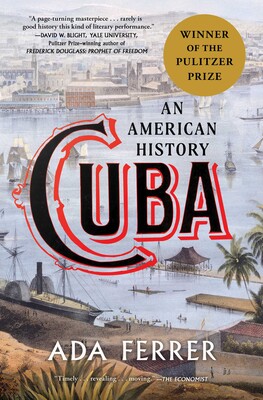
Cuba: An American History
by Ada Ferrer
2022 /566 pages
read by Alma Cuervo 23h 13m
rating 9.5 / history Americas
(read and listened)
Decades ago, the author, Ada Ferrer, immigrated from Cuba as a baby with her mother. Years later she took it on herself to get the education, do the research and write an excellent and well thought out history called “Cuba: An American History” to get the appropriate geographical context. She’s not writing to commend the US as our school books do, but neither is she an American critic. I think she tries to focus on the middle although in some places that gets rather hairy.
The one downside for me: in th Prologue, Ferrer rants on the old idea of how Columbus didn’t “discover” America because the Natives were already here. Okay, got it. I learned that in 6th grade (about the time Ferrar was born) and was told that we remember him because after his explorations no one forgot. I taught that to my Kindergarteners and I retired a long time ago so it shouldn’t be a huge surprise to anyone at this point.
Giving credit to Columbus for the discovery of America places him right smack in the middle of the continents. There isn’t one person discovering North America, another person getting to South America first, and Central America as a separate find (however accidental it was).
And she makes a couple excellent points, one being to show the relationship, however uneven, between the two countries over time. This would include the colonial period, the US War of Independence, the slave trade, the Civil War, Manifest Destiny and the Spanish American War followed by decades of both neighborly and colonial doings right up until Castro took over and all cordial relations were stopped in 1961 and again in 1963 for Cold War struggles.
Then for the next several decades we lived next to each other without so much as a cigar to trade legally and Cuba’s immigrants sometimes had to get from there to Florida in home-made boats.
Then she gets into the formal history of Cuba which gets pretty darned bloody at times as it sat off our southern coast owned and operated by Spain via her slaves and lackeys while being attacked by Britain and the climate.
After that comes the new politics between the not-quite born US, Spain, and France who all wanted Cuba, but how to get it? The ambassadors or kings or whatever didn’t even all speak the same language. But Spain supported the colonies which gave the US access to Havana and the Spanish money – this was a huge benefit – but Spain was a bit worried, what if …
Cuba’s history under Spanish rule from that point was based on sugar, coffee, and slaves but France started freeing her slaves in the New World (Haiti) and the ideas of freedom and independence flourished but Spain was determined and used France’s troubles as their own opportunity. And Cuba imported more slaves from Africa and made more money for the plantation owners – lots of money
As time went on matters got twisty and corrupt and still often bloody with wanna-be national conquests, a US drooling over colonialism for herself, a Constitution, and internal dictators (in violation of their new Constitution) plus labor unrest with some racism included.
They have many heroes and heroes turned villains and new heroes arising, to say nothing of sham elections and student organizations and worker protests. Around that time US gangsters visited and migrated and vacationed en mass, so there’s a chapter on that era. And then comes Castro out of the mountains but much better educated than I’d understood – he was portrayed as a kind of hoodlum turned Communist in US media.
The chapters after Castro makes his appearance are eye-opening and nei t what with the CIA, the Russians, the propaganda, the attempt at a 10-million ton sugar harvest and so on. Raul Castro and
In fact, it’s pretty serious (but fascinating) history in the first half or so with the understanding that although Ferrer does have a bit of a liberal bias, it’s certainly not overwhelming. There are excellent sections strewn throughout this first half. But at chapter 22 it turns to generally excellent – this is when Fidel Castro is introduced and becomes an integral part of Cuba’s history. This is when the story gets riveting – or it did for me.
And we get the height of the Cold War with the Bay of Pigs (never have I read such a detail-oriented and carefully written account) after which came the Cuban Missile Crisis and then the years of waiting for the next shoe to drop. \
Castro really did try to engineer a full revolution with new people to match new conditions with new rules always with the idea that education was the answer. He catapulted Cuba on to the world stage. But still, as soon as they could, many Cubans were opting for Miami, (not Ecuador, and once there turned to extreme anti-Castro sentiments.
Castro really did dominate Cuba for decades and his presence will be there for a long time to come. This is a brilliant book in case you missed it.


 Becky's Books -
Good book – :-).
LikeLike
Pingback: Becky’s Best Reads of 2023 | Becky's Books –